Introduction
Cyberattacks no longer respect boundaries. Adversaries routinely move from a phishing email to a compromised endpoint, then to cloud applications, Active Directory, and finally data exfiltration - crossing multiple layers in minutes. According to Palo Alto Networks' 2026 Unit 42 Global Incident Response Report, 87% of real-world intrusions now span two or more attack surfaces, with 67% crossing three or more domains. This reality makes your choice of detection and response solution more consequential than ever.
Both EDR (Endpoint Detection and Response) and XDR (Extended Detection and Response) are designed to detect and respond to threats, but they operate at fundamentally different scales. EDR provides deep, focused visibility into activity on individual devices. XDR extends that visibility across endpoints, networks, cloud workloads, email, and identity systems, correlating signals to reveal complete attack chains.
The right choice depends on your environment, security maturity, and available resources. This guide breaks down both options so you can match the tool to your actual threat landscape.
Overview
- EDR monitors and responds to threats on individual devices such as laptops, servers, and desktops
- XDR extends that protection across endpoints, networks, cloud workloads, email, and identity systems in a unified platform
- Scope separates them: EDR delivers deep device-level visibility; XDR correlates threats across every layer of your environment
- EDR fits teams focused on endpoint protection; XDR fits environments where attackers move laterally across systems
- Without in-house security staff, a managed EDR or XDR service closes the coverage gap faster than building it internally
EDR vs XDR: Quick Comparison
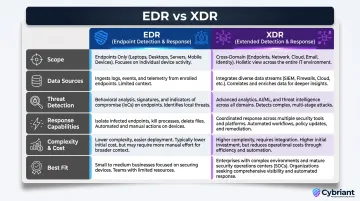
Here's how EDR and XDR stack up across the dimensions that matter most for security decision-making.
| Dimension | EDR | XDR |
|---|---|---|
| Scope | Endpoint devices only | Endpoints, network, cloud, email, and identity layers |
| Data Sources | Device-level telemetry (process activity, file changes, registry events) | Telemetry from multiple security domains simultaneously |
| Threat Detection | Behavioral analysis and machine learning at endpoint level | Cross-domain correlation to surface multi-stage attack chains |
| Response Capabilities | Endpoint-level responses (device isolation, process termination) | Coordinated response across entire security stack |
| Complexity & Cost | Simpler to deploy and manage; lower cost | Requires broader integration and deeper expertise; higher cost |
| Best Fit | Endpoint-centric security needs; leaner teams | Complex multi-domain environments; mature security programs |
What is EDR?
Understanding Endpoint Detection and Response
Endpoint Detection and Response (EDR) is a cybersecurity solution that continuously monitors endpoint devices - laptops, desktops, servers, and mobile devices - by deploying lightweight agents that collect data on process activity, file changes, network connections, and user behavior.
When suspicious activity is detected, EDR can alert security teams or trigger automated responses such as isolating the affected device to prevent spread. This gives security teams a forensic trail to investigate incidents, understand attack techniques, and satisfy compliance audit requirements.
EDR emerged to address the limitations of traditional antivirus software, which relies on signature-based detection and fails against fileless techniques, zero-day exploits, and living-off-the-land attacks.
Core EDR Capabilities
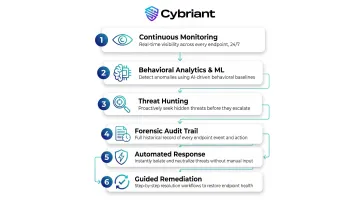
- Continuously tracks process execution, file modifications, registry changes, network connections, and authentication events across every monitored device
- Applies machine learning and behavioral analytics to flag suspicious patterns - unauthorized credential access, unusual lateral movement, abnormal data transfers - rather than relying on known malware signatures
- Provides query interfaces and investigation tools so security teams can proactively hunt for indicators of compromise before dormant threats activate
- Records every endpoint action with timestamps and full context, giving analysts an audit trail to reconstruct attack chains and assess incident scope
- Automatically isolates compromised devices, terminates malicious processes, quarantines suspicious files, and rolls back unauthorized changes to limit dwell time
- Analyzes detected threats and surfaces guided remediation steps, helping teams respond effectively even against novel attack techniques
These capabilities deliver measurable operational impact. For example, a 2026 case study with SentinelOne EDR demonstrated a reduction in Mean Time to Detect from 30-60 minutes to under one minute, with a 98-99% faster Mean Time to Respond, dropping resolution times from days to minutes.
EDR Limitations
While EDR provides critical endpoint visibility, it has inherent constraints:
- Endpoint-only scope: EDR cannot see threats that originate in cloud applications, phishing campaigns delivered through email, or attacks targeting unmanaged devices outside the corporate network
- Limited context: Without visibility into network traffic, cloud activity, or identity systems, EDR can generate alerts that lack the broader context needed to assess true severity
- False positive challenges: Behavioral analysis can flag legitimate administrative activities or unusual but benign user behavior, requiring skilled personnel to distinguish real threats from noise
- Expertise requirements: Effective EDR deployment requires skilled security professionals to configure detection rules, tune behavioral models, investigate alerts, and execute remediation actions
Use Cases of EDR
EDR fits as a foundational layer protecting the endpoint attack surface, which research identifies as a primary entry point for breaches. In Palo Alto Networks' 2026 Unit 42 report, endpoints were involved in 61% of all investigated incidents, making endpoint visibility essential for any security program.
Organizations where EDR is the dominant solution:
- SMBs with no prior detection capability: EDR's focused scope and manageable deployment requirements make it the right starting point for teams building security from scratch
- Primarily on-premises environments: Traditional data center infrastructure with limited cloud adoption gets strong coverage through comprehensive endpoint monitoring alone
- Lean security teams: Groups that need effective protection without the operational overhead of managing multiple integrated security domains
That said, EDR's endpoint-only view creates gaps as environments grow more complex - which is where XDR enters the picture.
What is XDR?
Understanding Extended Detection and Response
Extended Detection and Response (XDR) is a security framework that aggregates and correlates telemetry from multiple security domains - endpoints, networks, cloud workloads, identity systems, and email - into a unified platform. Instead of surfacing isolated alerts from individual tools, XDR connects signals across layers to reveal complete attack chains. For example, XDR can correlate a phishing email that leads to credential theft, then lateral movement across the network, followed by cloud data exfiltration - presenting this as a single unified incident rather than three disconnected alerts.
Modern attackers exploit the gaps between siloed security tools. When EDR, SIEM, NDR (Network Detection and Response), and CASB (Cloud Access Security Broker) each generate separate alerts, no single analyst can effectively correlate them to reconstruct the full attack narrative.
XDR platforms use advanced correlation engines to stitch these signals together automatically, giving security teams incident-level visibility instead of alert-level noise.
Key XDR Capabilities
Cross-domain telemetry ingestion: XDR platforms ingest and normalize security data from endpoints, network traffic, cloud workloads, email gateways, identity systems, and SaaS applications, creating a unified data layer for analysis.
Advanced correlation using machine learning: XDR engines use behavioral analytics and machine learning to identify relationships between seemingly unrelated events - recognizing that a failed login attempt, followed by a successful authentication from an unusual location, followed by lateral movement to a file server, represents a single credential compromise incident.
Unified incident view: Rather than presenting hundreds of individual alerts, XDR groups related signals into consolidated incidents with complete attack timelines, reducing alert fatigue and enabling faster triage decisions.
Coordinated automated response: XDR platforms can orchestrate response actions across the entire security stack - simultaneously isolating a compromised endpoint, blocking a malicious IP at the firewall, revoking compromised credentials in Active Directory, and quarantining suspicious emails - all from a single workflow.
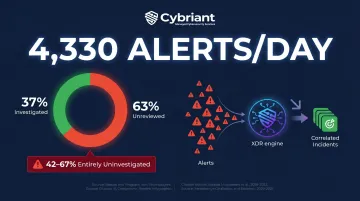
This correlation capability directly addresses the alert fatigue crisis facing security operations centers. Organizations generate an average of 4,330 security alerts daily, yet analysts only have capacity to investigate 37%, with 42% to 67% of alerts going entirely uninvestigated. XDR reduces this overwhelming volume by presenting correlated incidents rather than raw alerts.
Why XDR Emerged
The clearest measure of why this matters: CrowdStrike reports that the average eCrime breakout time dropped to just 29 minutes in 2025 - the window between initial access and lateral movement across the environment. When analysts must manually pivot between EDR, SIEM, NDR, and CASB consoles to piece together what happened, that 29-minute window closes long before containment begins.
XDR was built to close that gap. By consolidating fragmented signals into a single correlated incident view, it gives security teams the speed they need to outpace attackers working within that narrow timeframe.
Use Cases of XDR
Organizations with distributed environments: Companies operating across multi-cloud platforms, supporting remote workforces, relying on SaaS applications, and managing hybrid infrastructure face threats that routinely move laterally across domains. XDR provides the cross-layer visibility needed to track these complex attack paths.
Concrete scenario: A phishing email compromises a user's credentials. The attacker uses those credentials for privilege escalation in Active Directory, gaining domain admin rights. They then move laterally to cloud storage and exfiltrate sensitive data. In an EDR-only environment, this appears as three disconnected alerts across different tools. In XDR, this surfaces as a single correlated attack chain with a complete timeline, enabling rapid containment.
Organizations where XDR is dominant:
- Enterprises with mature security programs: Organizations with established security operations benefit from XDR's ability to reduce tool sprawl and consolidate visibility into a single platform
- Multi-cloud environments: Companies managing workloads across AWS, Azure, and Google Cloud require unified visibility that extends beyond endpoint-only monitoring
- Teams struggling with alert fatigue: Security operations centers overwhelmed by disconnected alerts from multiple point solutions gain immediate operational relief through XDR's correlation capabilities
EDR vs XDR: Which Is Right for Your Organization?
Choose EDR If...
Your security priorities center on endpoint protection: If the majority of your critical assets reside on managed endpoints - corporate laptops, servers, and workstations - and your threat model focuses primarily on malware, ransomware, and endpoint-based attacks, EDR provides the deep device-level visibility you need without unnecessary complexity.
Your environment is not heavily distributed: Organizations with primarily on-premises infrastructure, limited cloud adoption, and centralized data center operations can achieve strong security posture through comprehensive endpoint monitoring without requiring cross-domain correlation.
You have a lean security team: EDR's focused scope makes it easier to deploy, tune, and operate with smaller security teams. The narrower attack surface reduces the expertise requirements compared to managing a full XDR platform.
You are early in building a security program: EDR serves as a strong foundational layer before expanding scope. Organizations just establishing detection and response capabilities benefit from mastering endpoint security before tackling more complex cross-domain visibility.
Choose XDR If...
Your environment spans multiple domains: If your organization operates across cloud platforms, SaaS applications, remote identity systems, and on-premises infrastructure, threats moving laterally across these layers require correlated visibility that EDR alone cannot provide.
Your team faces alert fatigue from disconnected tools: Security operations centers managing separate EDR, SIEM, NDR, and CASB tools benefit immediately from XDR's ability to consolidate alerts into unified incidents, reducing noise and enabling faster triage.
Lateral movement across layers is a real concern: With 82% of detections in 2025 being malware-free attacks using valid credentials, organizations need visibility beyond endpoint malware detection to track credential compromise and lateral movement across identity systems, networks, and cloud workloads.
You need automated response beyond device isolation: XDR enables coordinated response actions across your entire security stack - simultaneously addressing compromised endpoints, blocking network connections, revoking credentials, and quarantining emails - from a single platform.
Key Practical Considerations
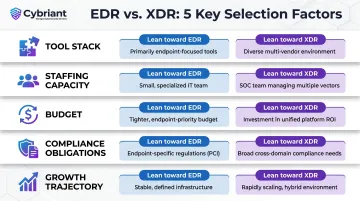
Five factors should shape your decision:
- Existing tool stack: Heavy investment in multiple point solutions (EDR, SIEM, NDR, CASB) makes XDR consolidation attractive. Minimal existing infrastructure favors starting with focused EDR deployment.
- Staffing capacity: Both tools require skilled personnel to configure and act on alerts. 48% of security professionals report feeling overwhelmed by workload, and 33% of organizations lack resources to adequately staff their security teams - a real constraint regardless of which platform you choose.
- Budget: EDR carries lower licensing costs and simpler deployment. XDR requires broader investment in platform licensing, data ingestion, and storage, though consolidating redundant tools often offsets that cost.
- Compliance obligations: NIST CSF 2.0, HIPAA Security Rule, and CMMC 2.0 mandate monitoring and response across all workloads - not just endpoints. Depending on your regulatory obligations, this may require XDR-level coverage.
- Growth trajectory: Organizations planning significant cloud migration or SaaS adoption should factor future complexity into the current decision. Starting with EDR and evolving toward XDR is often more cost-effective than deploying XDR before your environment justifies it.
Addressing the Expertise Gap
Both EDR and XDR require skilled professionals to configure detection rules, tune behavioral analytics, investigate alerts, and execute response actions. For organizations without a dedicated security operations center, that expertise gap is often the biggest barrier to getting value from either solution.
Managed security service providers close that gap by delivering 24/7 monitoring, expert analysis, and incident response without the overhead of building an in-house SOC. At Cybriant, our analysts investigate, validate, and triage alerts so your team focuses only on confirmed threats - while we handle continuous monitoring, threat hunting, and remediation guidance.
Whether you choose EDR or XDR, working with an experienced MSSP ensures you have the expertise to respond effectively when threats emerge. Reach out to our team to discuss which approach fits your environment and how managed services can help you get full value from your security investment.
Conclusion
EDR and XDR are not competing tools - they represent different points on the same security maturity scale. EDR provides deep, focused endpoint protection that serves as the foundation of any detection and response strategy. XDR extends that foundation across the entire attack surface for organizations facing complex, multi-domain threats where adversaries routinely move between endpoints, cloud workloads, identity systems, and networks.
The right choice depends on your environment's complexity, your team's capacity, and your organization's risk profile. For organizations navigating this decision, the most important step is an honest assessment of where threats are most likely to enter your environment and whether your team can realistically monitor and respond across every relevant attack surface.
If that capacity isn't there yet, managed detection and response services - like those offered by Cybriant - can bridge the gap, providing 24/7 coverage across endpoints and beyond without requiring you to build out a full security operations function in-house.
For most mid-market organizations facing multi-domain threats, the practical path is to build on strong EDR as your foundation and adopt XDR - or managed XDR - once threats and team capacity outgrow endpoint-only coverage. Cybriant can help you make that call and operate it for you. Call 844-411-0404 to talk through the right fit for your environment.
Frequently Asked Questions
What is the difference between XDR and EDR?
EDR focuses on monitoring and responding to threats at the endpoint level, tracking activity on individual devices. XDR extends detection and response across multiple security domains including endpoints, network, cloud, email, and identity - correlating signals into unified attack narratives that reveal complete incident timelines.
What is endpoint detection and response (EDR)?
EDR is a cybersecurity solution that deploys agents on endpoint devices to continuously monitor activity and detect threats using behavioral analysis and machine learning. Response actions such as device isolation or process termination allow teams to contain attacks before they spread.
What is XDR (Extended Detection and Response)?
XDR is a security platform that aggregates and correlates telemetry from endpoints, cloud workloads, email, networks, and identity systems to provide a unified view of threats across the entire environment - enabling coordinated response actions beyond what endpoint-only tools can achieve.
Do I need EDR if I have XDR?
Most XDR platforms are built on top of EDR functionality, so EDR capabilities are typically included within XDR solutions. Organizations moving to XDR do not need a separate standalone EDR tool.
How do XDR, EDR, MDR, NDR, and SIEM differ?
EDR covers endpoints; NDR monitors network traffic; SIEM aggregates logs for compliance and detection; XDR unifies all of the above for correlated threat detection across domains. MDR is a managed service model that delivers detection and response capabilities - either EDR or XDR - operated by a third-party security team on behalf of the organization.
How much does EDR cost?
EDR pricing varies significantly by vendor and deployment size, typically ranging from a few dollars to over $50 per endpoint per month. Organizations should also budget for implementation, tuning, data storage, and the personnel needed to handle alerts and respond to incidents.