Introduction
The numbers are stark: vulnerability exploitation has surged 180% year-over-year according to the 2024 Verizon Data Breach Investigations Report, now present in 20% of all breaches analyzed. Meanwhile, CISA's Known Exploited Vulnerabilities catalog has grown to 1,484 entries, yet organizations take an average of 55 days to patch 50% of critical vulnerabilities - leaving attackers a wide-open window.
That gap has consequences. 60% of breach victims were compromised through an unpatched vulnerability - one where a fix already existed but hadn't been applied.
As attack surfaces expand across cloud, endpoints, and hybrid environments, ad hoc scanning can't keep pace. Structured vulnerability management solutions give security teams the continuous visibility to find weaknesses, prioritize what matters, and close gaps before attackers reach them.
Overview
- Vulnerability management solutions continuously identify, prioritize, and remediate security weaknesses before attackers exploit them
- Top solutions differ in deployment model, scope, and automation level - the right choice depends on your environment and team capacity
- Evaluate solutions on coverage breadth, risk-based prioritization, patch management integration, and compliance reporting
- Managed options like Cybriant deliver enterprise-grade protection without building an in-house program
- Solutions were selected for reliability, remediation support, and fit across businesses of varying sizes
What Is a Vulnerability Management Solution and Why Does It Matter?
Vulnerability management is the continuous, risk-based process of discovering, assessing, prioritizing, and remediating security weaknesses across an organization's IT environment. It operates as an ongoing lifecycle - not a periodic audit - integrating people, processes, and tools to address risk continuously.
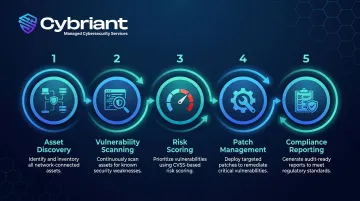
A complete solution integrates five core components into a unified workflow:
- Asset discovery – Identifies all devices, applications, and workloads across your environment
- Vulnerability scanning – Continuously detects known weaknesses in software, configurations, and systems
- Risk scoring – Leverages CVSS, EPSS, and CISA's KEV catalog to prioritize vulnerabilities based on exploitability
- Patch management – Automates testing and deployment of security updates
- Compliance reporting – Demonstrates adherence to regulatory frameworks like PCI DSS, HIPAA, and NIST
Research shows it takes an average of 43 days for organizations to remediate a critical vulnerability after a patch is released - yet attackers weaponize the same flaws within days of disclosure. That gap is where breaches happen, and it's why continuous, automated vulnerability management is no longer optional for organizations of any size.
Top Vulnerability Management Solutions to Reduce Cyber Risk
The options below fall into two categories: enterprise scanning platforms your team buys, configures, and operates in-house, and Cybriant's managed vulnerability service, which delivers continuous scanning, risk-based prioritization, and remediation without requiring you to run the platform yourself. For most organizations without a dedicated security team, the real question isn't which scanner to license, but whether to operate one yourself or have an expert team do it for you.
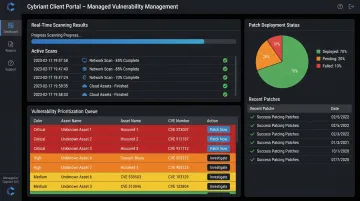
Cybriant – Managed Vulnerability Scanning and Patch Management
Cybriant is a SOC 2 Type 2-certified managed security services provider (MSSP) founded in 2015 and recognized on MSSP Alert's Top 250 MSSPs list for five consecutive years. Their managed vulnerability management service delivers real-time scanning and automated patch management as a fully managed offering, making enterprise-grade protection accessible to businesses without large internal security teams.
Rather than handing clients a tool and a dashboard, Cybriant operates as an extension of your security team. The service includes:
- 24/7 live monitoring where security experts assess alerts in real-time
- Expert-led triage that prioritizes vulnerabilities based on asset criticality and threat context
- Integrated patch management that actively remediates vulnerabilities - not just reports them
This reduces mean time to remediate (MTTR) and closes security gaps faster than self-managed tools.
The service leverages Tenable for vulnerability discovery and Automox for automated patch deployment, combining proven technology with expert human oversight. Coverage spans the full attack surface including servers, network infrastructure, cloud environments, containers, web applications, and IoT devices.
| Attribute | Details |
|---|---|
| Key Features | Real-time vulnerability scanning, automated patch management, 24/7 managed monitoring, compliance-ready reporting |
| Deployment Model | Fully managed service (MSSP); no heavy internal infrastructure or dedicated security staff required |
| Best Suited For | SMBs and mid-market enterprises seeking enterprise-grade vulnerability management without building an in-house program |
Tenable Nessus / Tenable Vulnerability Management
Tenable is one of the most widely deployed vulnerability scanning platforms globally, with Nessus offering deep network and endpoint scanning and Tenable Vulnerability Management (formerly Tenable.io) extending coverage to cloud environments. The platform is trusted across banking, healthcare, and government sectors.
Key differentiators include:
- 328,770 plugins addressing 120,009 CVE IDs, giving security teams broad detection coverage across known vulnerabilities
- PCI DSS Approved Scanning Vendor (ASV) certification, making it a strong fit for compliance-heavy environments
- Asset identification algorithms that flag every device on the network, with detailed remediation reporting to guide technical teams through fixes
Tenable was named a Leader in the 2025 Gartner Magic Quadrant for Exposure Assessment Platforms, recognizing its innovation and market execution. The platform focuses on detection; patch management requires additional integrations.
| Attribute | Details |
|---|---|
| Key Features | Comprehensive plugin library, PCI DSS-certified scanning, cloud and on-prem coverage, detailed remediation reporting |
| Deployment Model | Agent-based and agentless options; available as on-prem (Nessus) or cloud-managed (Tenable Vulnerability Management) |
| Best Suited For | Security teams needing thorough network and endpoint vulnerability detection with strong compliance reporting |
Qualys VMDR
Qualys VMDR (Vulnerability Management, Detection and Response) is a cloud-based platform that consolidates asset discovery, vulnerability scanning, risk quantification, and patch orchestration in a single interface. It's widely used by large enterprises managing complex, distributed environments.
Qualys' proprietary TruRisk™ scoring system (0–1,000 scale) combines threat intelligence with asset criticality to measure actual business risk - not just technical severity. The platform also supports virtual patching to protect systems before patches are available, and offers CIS Benchmark-based evaluation for configuration compliance.
Qualys was recognized as a Strong Performer in The Forrester Wave: Unified Vulnerability Management Solutions, Q3 2025. The cloud-native architecture scales across hybrid and multi-cloud environments, while real-time threat intelligence feeds ensure risk scores reflect current attacker activity.
| Attribute | Details |
|---|---|
| Key Features | TruRisk™ risk quantification, virtual patching, CIS Benchmark alignment, real-time threat intelligence feeds, agentless or agent-based scanning |
| Deployment Model | Cloud-based SaaS; supports agentless and agent-based deployment across hybrid environments |
| Best Suited For | Large enterprises needing centralized risk quantification and patch management across diverse, multi-cloud environments |
Rapid7 InsightVM
Rapid7 InsightVM is a live vulnerability management solution that emphasizes real-time risk visibility through continuous scanning and dynamic dashboards. It integrates well with the broader Rapid7 ecosystem including SIEM and incident response tools.
InsightVM's Adaptive Security feature uses breach data and exploit intelligence to automatically prioritize scan frequency for the highest-risk areas. The Active Risk scoring model (0–1,000 scale) pulls from AttackerKB, Metasploit, and CISA's KEV catalog to reflect how actively a vulnerability is being exploited in the wild - not just its theoretical severity.
Liveboard dashboards give security and IT teams shared, real-time visibility into open vulnerabilities and patch status, bridging the gap between security and operations. The platform integrates with Jira, ServiceNow, Splunk, and Slack to automate remediation workflows.
Rapid7 was recognized as a Leader in the 2025 Gartner Magic Quadrant for Exposure Assessment Platforms for the second consecutive year.
| Attribute | Details |
|---|---|
| Key Features | Adaptive Security prioritization, real-time Liveboard dashboards, SIEM integration, policy compliance review, agent or agentless options |
| Deployment Model | Cloud-managed with agent or agentless scanning; integrates with Slack, JIRA, and ticketing systems |
| Best Suited For | Organizations looking for real-time risk dashboards and tight collaboration between security and IT operations teams |
Microsoft Defender Vulnerability Management
Microsoft Defender Vulnerability Management is deeply integrated into the Microsoft security ecosystem, making it a natural fit for organizations already running Azure, Microsoft 365, or Defender XDR. It provides continuous endpoint vulnerability discovery alongside endpoint detection and response (EDR).
A unified dashboard connects vulnerability findings with EDR telemetry through Defender XDR and SIEM data through Microsoft Sentinel, supporting the full detection-to-response workflow. Lightweight agentless scanning snapshots VM disks for out-of-band analysis - no installed agents required, and no impact on machine performance.
Flexible APIs allow integration with third-party tools alongside Microsoft-native products, ensuring the platform fits into existing workflows. Microsoft was named a Leader in the 2025 Gartner Magic Quadrant for Endpoint Protection Platforms, driven by its continuous investment in cloud-native endpoint security.
| Attribute | Details |
|---|---|
| Key Features | Unified vulnerability and EDR dashboard, Microsoft Sentinel integration, lightweight scanning, flexible integration APIs, continuous endpoint discovery |
| Deployment Model | Cloud-native; integrates natively within Microsoft 365 and Azure environments; supports third-party tool integrations |
| Best Suited For | Microsoft-centric organizations seeking tightly integrated vulnerability management within their existing security stack |
What to Look for in a Vulnerability Management Solution
The criteria that matter most: continuous detection rather than point-in-time scans, risk-based prioritization using real-world threat intelligence (CVSS, EPSS, KEV catalog), and support for remediation, not just reporting. A common buyer mistake is selecting tools based solely on scan speed or feature count rather than asking how findings actually translate into fixed vulnerabilities, and who will do that work.
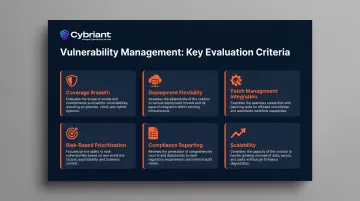
Key Evaluation Criteria
| Criterion | What It Covers | Why It Matters |
|---|---|---|
| Coverage Breadth | Endpoints, cloud workloads, network infrastructure, containers, IoT | Comprehensive visibility closes the blind spots attackers exploit |
| Deployment Flexibility | Managed vs. self-managed; agent-based vs. agentless scanning | Fits your team's capacity and existing infrastructure |
| Patch Management Integration | Automated testing, approval workflows, deployment capabilities | Faster patching means a shorter window for exploits |
| Risk-Based Prioritization | Contextual scoring using threat intelligence and asset criticality | Keeps your team focused on vulnerabilities that actually matter |
| Compliance Reporting | NIST SP 800-40, CIS Controls, PCI DSS, HIPAA, CMMC | Reduces audit risk and demonstrates regulatory adherence |
| Scalability | Adapts to infrastructure growth and organizational changes | Protects long-term investment and avoids costly future migrations |
For organizations without a dedicated security team, a managed service approach like Cybriant's offers a meaningful advantage. Vulnerabilities get triaged and remediated by professionals - not left sitting in a dashboard waiting for someone to act.
Conclusion
The right vulnerability management solution isn't about picking the most feature-rich platform - it's about finding one that fits your environment, your team's capacity, and your risk tolerance. A tool that surfaces thousands of findings without helping you act on them creates noise, not security.
Evaluate solutions on ongoing performance metrics:
- Mean time to detect (MTTD) and mean time to remediate (MTTR)
- Patch coverage rates across your asset inventory
- Number of recurring vulnerabilities
- Compliance posture over time
These metrics reveal how a solution performs over time - not just at deployment. From there, scalability and integration with existing workflows matter as much as the initial feature set. Ask vendors how their solution handles growing asset counts, supports your specific compliance frameworks, and fits into your incident response playbooks.
For businesses that want vulnerability management handled end-to-end - scanning, prioritization, patching, and reporting - Cybriant's managed service covers the full program without the overhead of building it in-house. Visit cybriant.com or call 844-411-0404 to see how Cybriant's vulnerability management fits your environment.
Frequently Asked Questions
What is a vulnerability management solution?
A vulnerability management solution is a platform or managed service that continuously identifies, prioritizes, and helps remediate security weaknesses across an organization's systems, networks, and applications. It runs as an ongoing process - not a one-time audit - integrated directly into security operations.
What are the 5 steps of vulnerability management?
The five core steps are asset discovery, vulnerability scanning and assessment, risk prioritization, remediation or mitigation, and verification/monitoring. Modern solutions automate most of these steps, delivering continuous visibility instead of point-in-time snapshots.
How often should I run a security scan?
CIS Controls v8 recommends quarterly scans at minimum for internal assets and monthly scans for externally-exposed assets. Environments storing sensitive data or subject to compliance requirements should implement continuous scanning rather than relying on scheduled intervals alone.
What are the 4 types of vulnerabilities?
The four commonly referenced types are network vulnerabilities (exposed services, weak protocols), operating system/software vulnerabilities (unpatched flaws in code), configuration vulnerabilities (misconfigurations, default credentials), and human/process vulnerabilities (weak policies, inadequate training). Gaps in any one category can be enough for attackers to gain a foothold.
How do you evaluate the effectiveness of your vulnerability management program?
Track metrics such as mean time to detect (MTTD), mean time to remediate (MTTR), patch coverage rate, recurring vulnerability count, and compliance posture over time. Most VM platforms include dashboards that surface these for both security teams and auditors.