Introduction
Enterprise SIEMs detect only 21% of MITRE ATT&CK techniques on average, and 10-18% of detection rules are broken - they will never fire due to misconfiguration. Most organizations don't know this until after a breach.
The root cause is straightforward: most SIEM platforms run on generic, out-of-the-box rules never designed for a specific environment, infrastructure, or risk profile. Sophisticated threats don't follow predictable patterns, and static default rules can't keep up.
SIEM deployment is widespread, but its protective value only materializes when detection rules are customized and continuously managed. Without that, the platform generates noise instead of insight. What follows covers why generic rules fall short, what managed SIEM with customizable detection actually looks like, and what's at stake for organizations that ignore the distinction.
Overview
- Managed SIEM with customizable detection rules detects threats specific to your environment and risk profile, beyond generic signatures
- Cuts false positives by filtering routine business activity, keeping analyst attention on genuine threats
- Expert-led rule tuning keeps detection logic current with new attack techniques without requiring in-house security staff
- Without customizable rules, organizations face missed threats, reactive postures, and rising costs from irrelevant alerts
- Businesses of all sizes access enterprise-grade detection accuracy through managed SIEM providers like Cybriant
What Is Managed SIEM with Customizable Detection Rules?
A managed SIEM is a security information and event management platform operated by an external provider that handles log collection, correlation, alerting, and monitoring - so internal teams don't manage the platform themselves.
Customizable detection rules are the logic-based conditions within the SIEM that define what counts as suspicious activity. Unlike generic, prebuilt rules, custom rules are tailored to an organization's specific environment, user behaviors, infrastructure, and threat exposure.
Together, these two elements produce faster, more accurate threat detection with fewer false positives - and without requiring more headcount. The key advantages this model delivers:
- Catches real threats faster by filtering noise through environment-specific logic
- Reduces alert fatigue by eliminating rules that don't match your actual infrastructure
- Scales as your environment grows without adding internal security staff
- Keeps detection logic current through continuous refinement based on threat intelligence
Cybriant's 24/7 managed SIEM pairs expert-led monitoring with ongoing rule customization, handling everything from initial configuration to live analysis - so internal teams stay focused on the business, not the platform.
Key Advantages of Managed SIEM with Customizable Detection Rules
These three advantages translate directly into metrics that matter: response time, analyst efficiency, risk exposure, and cost of security operations. Each is measurable, defensible, and grounded in how real environments operate.
Advantage 1: Precision Detection Aligned to Your Actual Environment
Out-of-the-box SIEM rules are written for the broadest possible audience, which means they cannot account for what "normal" looks like in any given organization. Custom rules fill that gap by encoding environment-specific context into detection logic.
How this works in practice: Custom rules incorporate knowledge of an organization's user behavior patterns, approved tools, network architecture, access policies, and critical assets. Alerts are generated when activity deviates from what is genuinely expected, not just from a generic baseline.
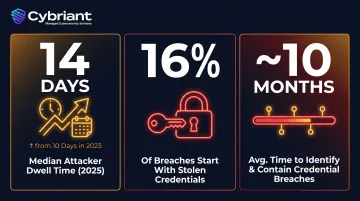
Environment-aligned detection dramatically reduces false negatives (missed threats) because rules are built around how attackers would actually move through that specific environment - rather than searching for generic indicators that sophisticated attackers have learned to evade. Global median dwell time has increased from 10 days in 2023 to 14 days in 2025, indicating that generic detections are failing to catch sophisticated, stealthy behaviors.
When detection rules reflect real-world context, security teams shift from reactive investigation to proactive threat interception - shrinking the window an attacker operates undetected. IBM's 2024 report notes that stolen credentials were the most common initial attack vector (16%), and those breaches took the longest to identify and contain at nearly 10 months. Customizable rules enable behavioral detections that spot credential abuse and lateral movement, rather than relying on static signatures that miss these attacks.
KPIs impacted:
- Mean time to detect (MTTD)
- False negative rate
- Dwell time
- Number of confirmed incidents surfaced vs. missed
When this advantage matters most: Precision detection is critical in environments with complex infrastructure (hybrid cloud, remote access tools, multiple identity systems), regulated industries where specific access patterns must be monitored, and organizations that have experienced prior breaches through detection gaps.
Advantage 2: Significant Reduction in Alert Fatigue and False Positives
Alert fatigue - analysts becoming desensitized due to high volumes of low-quality alerts - is one of the most damaging outcomes of untuned SIEM rules. It slows response, increases the chance of missing critical threats, and burns out security teams.
Customizable rules solve this by tuning thresholds, filtering known-benign behaviors, and incorporating asset and identity context. Managed SIEM providers reduce alert volume to only those signals that represent genuine risk - improving the signal-to-noise ratio in the analyst queue.
Organizations face an average of 4,330 alerts daily, with only 37% investigated. Microsoft/Omdia reports that 46% of alerts are false positives, and 42% go uninvestigated. SANS data shows 73% of security teams name false positives as their top detection challenge.
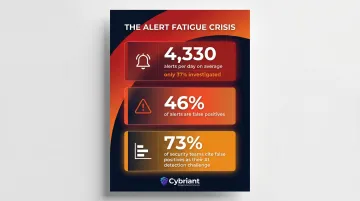
When analysts trust their alerts, response speed and accuracy both improve. Fewer low-fidelity alerts means time goes toward actual investigations rather than noise triage - directly reducing the per-incident cost of response.
The human toll compounds the operational one: 70% of junior analysts with five years or less of experience leave within three years, largely due to alert fatigue. Reducing that burden matters for retention, not just efficiency.
KPIs impacted:
- False positive rate
- Alert-to-investigation conversion rate
- Mean time to respond (MTTR)
- Analyst hours spent per confirmed incident
When this advantage matters most: Alert fatigue reduction matters most for lean security teams (common in SMBs and mid-market organizations) where each analyst handles a disproportionate alert load, and in high-velocity environments like financial services or healthcare where alert volume is structurally high.
Advantage 3: Continuous Expert-Led Rule Management Without Building an In-House Team
Threat actors continuously evolve their tactics - new vulnerabilities, novel attack chains, and emerging attacker behaviors mean that detection rules written six months ago may already have blind spots. Keeping rules current requires dedicated security expertise most organizations cannot staff internally.
Managed SIEM with expert-led rule management addresses this directly: security providers continuously update and refine detection rules based on threat intelligence feeds, post-incident learnings, and environmental changes - keeping detection logic current without requiring organizations to hire and retain specialists to manage it.
Building and retaining an internal team capable of writing, tuning, and maintaining detection rules at this level is prohibitive for most organizations. The 2024 (ISC)² Cybersecurity Workforce Study identified a global workforce gap of 4.8 million professionals, a 19% year-over-year increase.
The cost picture is equally stark. The median annual wage for Information Security Analysts is $120,360 - and with employer benefit costs averaging 29.9% of total compensation, the fully-loaded cost per analyst exceeds $170,000. A 24/7 SOC requires 5–6 analysts just for Tier 1 coverage. For most SMBs and mid-market organizations, outsourcing to a managed SIEM provider is substantially more cost-effective than attempting to staff in-house.
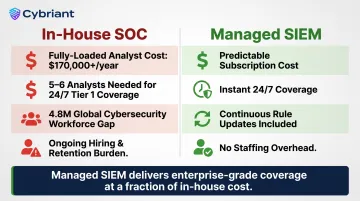
Cost aside, in-house programs face a scaling problem. As organizations add cloud services, remote access tools, or new compliance requirements, managed rule management adapts automatically - whereas internal programs often stall when resources are stretched thin.
KPIs impacted:
- Cost of security operations (per-analyst cost, tooling cost)
- Rule coverage gap percentage
- Time-to-update detection rules after new threat disclosure
- Compliance audit outcomes
When this advantage matters most: Expert-led managed rule management delivers the highest impact for organizations without a dedicated security operations center, those undergoing rapid growth or digital transformation, and businesses with compliance obligations (HIPAA, PCI DSS, CMMC) that require demonstrable, ongoing monitoring controls.
What Happens When Detection Rules Are Generic or Unmanaged
Organizations running SIEM on default or rarely-updated rules face a predictable pattern of failure: more alerts, less signal, and widening blind spots that attackers learn to exploit.
Common operational failures:
- Excessive false positives flood the analyst queue, making it statistically likely that a real threat gets dismissed alongside routine noise - this is how breaches occur even in organizations with SIEM deployed
- Lateral movement, living-off-the-land attacks, and insider threats are rarely caught by out-of-the-box signatures - CISA notes that many organizations lack the baselines needed to detect living-off-the-land activity, making it hard to distinguish legitimate admin behavior from malicious actions
- Security teams shift into a reactive firefighting posture, chasing alerts instead of reducing risk - analyst hours per incident climb while actual outcomes stagnate
- Without continuous rule updates, the detection gap grows: threats documented in incident response reports six months ago may still have no corresponding rule in your environment
How to Get the Most Value from Managed SIEM with Customizable Detection Rules
Managed SIEM with custom rules delivers compounding value - but only when three conditions are consistently met:
- Rules stay current with both the environment and the evolving threat landscape
- Detection performance is reviewed on a regular cadence, not just at deployment
- Insights from near-misses and incidents feed back into rule refinement, not just a post-incident report that sits on a shelf
Organizations get the most out of this approach when they treat managed SIEM as an ongoing security program, not a technology purchase. The relationship with the provider should include regular reporting, detection gap reviews, and collaborative tuning based on the organization's evolving infrastructure.
Practical starting points:
- Ensure the managed SIEM provider has visibility into all relevant data sources (endpoints, identity, cloud, network)
- Define priority use cases and risk scenarios upfront so rules are built around what matters most to the business
- Establish a review process tied to major infrastructure changes or incident learnings
- Set expectations for reporting cadence and detection performance metrics from day one
That last point on cadence is worth emphasizing. CIS Controls v8.1 recommends organizations "tune security event alerting thresholds monthly, or more frequently" to keep pace with threat actors. SANS data reinforces this: monthly reviews are now the most common cadence at 34%, and annual reviews are widely considered far too slow.
Conclusion
The value of managed SIEM with customizable detection rules comes down to three practical outcomes: precise visibility into what's actually being monitored, alerts that analysts can act on rather than sort through, and detection logic that keeps pace as environments and threats shift.
These gains compound over time. Organizations that invest in tuned, expert-managed detection build a progressively stronger security posture, while those relying on static, generic rules grow more exposed as attacker techniques evolve. For businesses of all sizes, managed SIEM providers like Cybriant deliver the detection accuracy of a mature security operations team - without the overhead of building one in-house.
Frequently Asked Questions
What are the SIEM alert rules?
SIEM alert rules are logic-based conditions that analyze collected log and event data to identify suspicious activity - when a rule's conditions are met, it generates an alert for analysts to investigate. They can be signature-based, behavioral, or threshold-based, and accuracy depends on how well they're tuned to your environment.
What are the 4 types of threat detection?
The four primary threat detection approaches are:
- Signature-based: Matches known indicators of compromise
- Behavioral/anomaly-based: Identifies deviations from baseline activity
- Rule-based/correlation: Flags specific sequences of events
- Threat intelligence-driven: Matches activity against known attacker TTPs and IOCs from external feeds
What is the difference between out-of-the-box SIEM rules and custom detection rules?
Out-of-the-box rules apply broadly across many environments - useful as a baseline, but prone to high false positive rates and blind spots unique to your organization. Custom detection rules are tailored to your actual infrastructure, user behaviors, and risk profile, making detections more accurate and operationally relevant.
How often should SIEM detection rules be tuned?
Rule tuning should happen continuously - not just at deployment. Best practice includes reviews after infrastructure changes, new tool integrations, post-incident analysis, and quarterly scheduled reviews. In a managed SIEM model, the provider handles tuning on an ongoing basis so your team doesn't need to manage it internally.
Can a small business benefit from managed SIEM with customizable detection rules?
SMBs often benefit most from managed SIEM because they typically lack the internal team to build and maintain custom detection rules. A managed provider gives them access to enterprise-grade detection expertise and continuous tuning without requiring an in-house security operations team - at a fraction of the cost.
How does managed SIEM reduce alert fatigue?
Managed SIEM reduces alert fatigue by combining expert rule tuning with environmental context - filtering known-benign behaviors, adjusting thresholds, and correlating signals so that only high-confidence, meaningful alerts reach the analyst queue. This improves both response accuracy and analyst efficiency over time.