Introduction
Most growing organizations reach a point where security decisions are too complex to delegate downward and too expensive to hand to a full-time CISO. That gap - between needing executive-level cybersecurity leadership and being able to afford it - is exactly where a virtual CISO program steps in. A vCISO implementation roadmap is a phased plan that guides organizations from initial assessment through ongoing risk management, without the overhead of a full-time hire.
This roadmap is essential for SMBs and mid-market organizations that are scaling rapidly, facing compliance pressure from new enterprise contracts, or responding to a security event. The global cybersecurity workforce gap reached 4.76 million professionals in 2024, while the average US CISO compensation hit $1.447 million in 2025. For most growing businesses, those economics put full-time security leadership out of reach.
So they engage a vCISO - and then stall. The problem isn't commitment; it's that no one defines what "implementing" the program actually looks like operationally. What follows is a milestone-driven roadmap that turns outsourced security leadership into tangible outcomes: reduced risk exposure, audit-ready compliance, and a security program that scales with the business.
Overview
- A vCISO engagement follows four phases - discovery, strategy, execution, and continuous monitoring - requiring ongoing commitment, not a single hire
- Ad hoc security decisions without executive oversight lead to compliance failures, wasted spend, and unmanaged risk for growing organizations
- Success depends on integrating the vCISO with internal stakeholders, not just deploying tools
- The most common pitfall: treating the vCISO as a vendor instead of a strategic partner, then expecting compliance results without sustained engagement
- Revisit the roadmap when business scope, regulatory requirements, or incident history shifts
What Is a vCISO Implementation Roadmap?
A vCISO implementation roadmap is a documented, milestone-driven plan that operationalizes outsourced CISO leadership. Spanning 12 to 24 months, it defines what gets assessed, prioritized, built, and monitored - with clear timelines, assigned owners, and measurable outcomes at every stage.
This differs fundamentally from simply hiring a vCISO consultant. Without a roadmap, the engagement tends to drift into a periodic advisory relationship with no enforcement mechanism, deliverable tracking, or measurable progress.
The roadmap is the execution layer that converts strategic advice into program management. In practice, that means:
- Sequenced security initiatives with defined owners and due dates
- Accountability checkpoints tied to specific deliverables
- Visibility into progress across compliance, risk, and technical controls
- A mechanism to prioritize new threats against existing commitments
Why Growing Organizations Need a vCISO Implementation Roadmap
Growing businesses face specific pressures that make a structured roadmap necessary. Rapid headcount growth expands the attack surface as new employees, devices, and access points multiply faster than security controls can keep pace.
New enterprise customers or regulated contracts add compliance obligations - SOC 2, HIPAA, PCI DSS, or CMMC - that demand formal security programs with documented oversight. Meanwhile, IT teams rarely have the bandwidth to manage security strategy alongside daily operations, so strategic planning gets consistently deprioritized.
Research illustrates why a full-time hire is often not feasible: the global cybersecurity workforce gap grew 19.1% year-over-year to 4.76 million professionals, and 64% of SMBs operate without any CISO. With average US CISO total compensation reaching $1.447 million in 2025, executive security leadership remains economically out of reach for most mid-market organizations.
What Goes Wrong Without a Roadmap
Security efforts become reactive and fragmented without structured implementation. Organizations patch tools onto problems rather than building a coherent program, leading to:
- Audit failures from missing documentation and control gaps
- Insurance underwriting problems when carriers identify unmanaged risks
- Duplicated security spending on overlapping tools that don't integrate
- Ineffective controls that check compliance boxes but don't reduce actual risk
The financial stakes are real: organizations with fewer than 500 employees face average breach costs of $3.31 million. A structured program isn't just best practice - it's cost avoidance.
Regulatory Requirements for Documented Oversight
A vCISO roadmap is both a best-practice choice and a regulatory-driven need. Modern frameworks require documented risk management programs and ongoing executive oversight:
- NIST CSF 2.0 introduced the GOVERN function requiring that cybersecurity risk management strategy, expectations, and policy are established, communicated, and monitored
- SOC 2 Trust Services Criteria mandate ongoing risk assessment and monitoring activities to evaluate control effectiveness
- CMMC Level 2 requires documented practices, operational plans of action, and assigned responsibilities for incident handling
- HIPAA explicitly requires assignment of a "Security Official" responsible for developing and implementing security policies
- PCI DSS v4.0 Requirement 12.1.4 formally assigns responsibility to a CISO or executive management
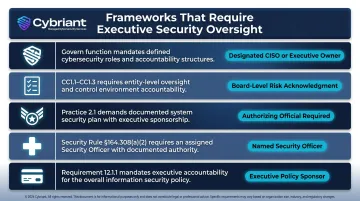
Each of these frameworks expects the same thing: a named accountable leader, documented processes, and evidence of ongoing oversight. That's exactly what a vCISO roadmap delivers - without the full-time executive price tag.
How the vCISO Implementation Roadmap Works: Phase by Phase
The roadmap progresses from understanding the current security state, to defining strategic priorities, to executing targeted initiatives, to establishing continuous monitoring. Each phase builds on the outputs of the last, creating a cumulative security posture improvement that's both measurable and sustainable.
What the Organization Needs to Bring
For the engagement to succeed, the organization must provide:
- Systems and applications inventory (cloud, on-premises, SaaS)
- Any prior audit findings or compliance reports
- List of applicable regulatory frameworks and contractual requirements
- Identified internal stakeholders who will coordinate with the vCISO (typically IT Director, COO, or CTO)
Phase 1: Discovery and Current-State Assessment
The vCISO conducts a structured risk assessment following NIST SP 800-30 guidelines, evaluating existing controls, policies, infrastructure, and compliance gaps against relevant frameworks - NIST CSF, SOC 2, CMMC, HIPAA, or industry-specific standards.
The assessment process typically includes stakeholder interviews, documentation review, configuration analysis, and vulnerability scanning to identify technical and procedural gaps. Research shows that mid-market SMBs typically operate with a 60-90 day remediation backlog, making prioritization critical from day one.
Good output from Phase 1 includes:
- Risk register documenting identified threats, vulnerabilities, likelihood, and business impact
- Compliance gap matrix mapping current controls against required framework controls
- Prioritized critical vulnerabilities ranked by exploitability and business impact
- Baseline security posture score giving leadership a measurable starting point
These outputs drive every decision made in Phase 2 - without them, prioritization is guesswork.
Phase 2: Strategy Development and Roadmap Prioritization
The vCISO translates Phase 1 findings into a prioritized, time-bound roadmap. Initiatives fall into three tiers by urgency and complexity:
- 30–90 days: Critical vulnerabilities, missing MFA, exposed systems, incident response gaps
- 3–6 months: Policy development, security awareness training, vendor risk management, compliance documentation
- 6–24 months: Advanced monitoring capabilities, security automation, zero trust architecture, continuous compliance
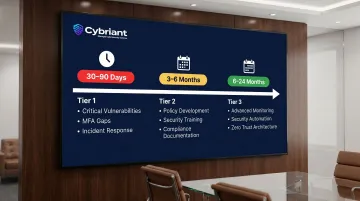
The roadmap must align with business objectives and budget constraints. A manufacturing company preparing for an acquisition will prioritize different initiatives than a healthcare provider pursuing SOC 2 certification.
Executive buy-in determines whether the roadmap succeeds. Leadership must review and approve it with clear accountability for each initiative - otherwise, security priorities get treated as IT tasks and perpetually deprioritized.
Phase 3: Implementation and Execution
Phase 3 is where the roadmap moves from document to action: deploying security controls, rolling out policies, training staff, and standing up incident response. Typical activities include:
- Technical controls - SIEM configuration, vulnerability management deployment, endpoint protection rollout, MFA enforcement
- Policy and documentation - acceptable use policies, incident response procedures, vendor risk management frameworks, security awareness programs
- Training and enablement - staff security awareness, incident response tabletop exercises, secure coding training for developers
Organizations working with managed security providers like Cybriant can activate services such as 24/7 managed SIEM, real-time vulnerability scanning, and managed detection and response during this phase. This accelerates deployment without requiring additional internal headcount or specialized expertise.
The vCISO's role in Phase 3 is coordinative, not just advisory. That means managing vendor relationships, tracking progress against the roadmap, and resolving blockers as they surface. Each deployed control must trace back to a specific risk from Phase 1 - this traceability is what separates real risk reduction from checkbox compliance.

Phase 4: Monitoring, Reporting, and Continuous Improvement
Ongoing monitoring is what sustains the roadmap's value over time. Phase 4 includes:
- KPI reporting to leadership - vulnerability closure rates, incident response times, audit readiness scores
- Quarterly roadmap reviews to adjust priorities as threats evolve, systems change, or business direction shifts
- Incident response tabletop exercises - organizations with mature IR planning saved $1.49 million in breach costs and resolved incidents 54 days faster
- Compliance maintenance as regulatory requirements change or audit cycles approach
At this stage, the vCISO engagement shifts from project-based to program-based. The roadmap is updated quarterly, keeping security investment aligned with actual organizational risk rather than a fixed plan written at kickoff.
Research demonstrates the financial impact of continuous monitoring: organizations utilizing extensive security AI and automation shortened breach lifecycles by 80 to 108 days and lowered average breach costs by $1.76 million to $1.9 million.
Key Factors That Determine vCISO Roadmap Success
Internal Stakeholder Alignment
vCISO programs stall most often not because of technical gaps but because there is no designated internal owner who can act as the vCISO's organizational counterpart. This role - typically an IT Director, COO, or CTO - must have authority to allocate resources, make procurement decisions, and coordinate cross-functional teams. Defining this role before engagement begins is critical to avoiding bottlenecks when the vCISO needs internal coordination to advance roadmap initiatives.
Industry and Framework Specificity
The roadmap must be built against frameworks and regulations actually relevant to the organization. A generic roadmap that doesn't map to specific compliance obligations will fail audits and miss the actual risk surface. Healthcare organizations need HIPAA-aligned controls, defense contractors require CMMC compliance, and e-commerce businesses must address PCI DSS requirements. The vCISO must tailor the roadmap to the organization's regulatory reality, not deliver a one-size-fits-all template.
Scope Definition and Change Control
Growing organizations frequently expand scope mid-engagement - new acquisitions, product lines, or geographies - without adjusting the roadmap. This causes initiative drift and budget overruns. A formal scope definition at the start - paired with a documented change control process - keeps the engagement on track. When business scope expands significantly, the roadmap must be formally revised with updated timelines and resource allocations before new work begins.
Engagement Model and Cadence
Quarterly-only check-ins are rarely sufficient for mid-market organizations with active compliance timelines or evolving threat landscapes. Monthly cadence with defined deliverables produces measurably better outcomes. Regular touchpoints keep the vCISO informed about organizational changes and give technical teams timely guidance. Without that rhythm, roadmap progress stalls.
Measurable Success Criteria
Without pre-agreed metrics, both the organization and the vCISO lack a basis for evaluating whether the roadmap is working. Effective success criteria include:
- Number of critical vulnerabilities closed within SLA
- Mean time to detect and respond to security incidents
- Audit readiness score or control coverage percentage
- Percentage of staff completing security awareness training
- Compliance certification achievement (SOC 2, ISO 27001, etc.)
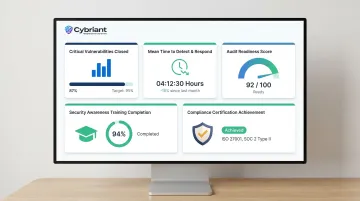
Define these metrics in Phase 2 and track them consistently from Phase 4 onward. When audit time arrives - or when leadership asks for a security posture update - these numbers make the answer concrete.
Common Pitfalls and Misconceptions in vCISO Implementation
Misconception: Compliance Equals Security
Many organizations task their vCISO solely with passing an audit and then disengage. Compliance does not equal security - audits run on annual cycles, but attackers can mass-exploit a critical vulnerability in a median of five days.
Compliance is a byproduct of a strong security posture, not a substitute for it. A roadmap that checks boxes without addressing underlying risks leaves the organization exposed between audit cycles. Continuous monitoring and ongoing risk management fill the gaps that point-in-time assessments never will.
Pitfall: Treating the vCISO as a Vendor, Not a Partner
Organizations that route all vCISO requests through procurement, delay stakeholder access, or fail to include the vCISO in strategic planning meetings undermine the entire engagement model. vCISO value is directly correlated with organizational integration quality.
Symptoms of vendor treatment:
- vCISO excluded from leadership meetings where security-relevant decisions are made
- Requests routed through ticketing systems with multi-day response delays
- No designated internal owner empowered to coordinate with the vCISO
- vCISO only engaged when audit deadlines approach
To succeed, the vCISO must be treated as an extension of the leadership team with appropriate access, authority, and visibility into business strategy.
Misconception: The Roadmap Is Static
Some organizations finalize a 24-month roadmap in Phase 2 and expect to execute it unchanged. That approach fails. Threat landscapes shift, regulations evolve, and business priorities change - often within the same quarter. Review and update the roadmap at least quarterly to keep it aligned with current risk and strategy.
When the Standard Roadmap Model Needs Adjustment
A phased, ongoing roadmap is not always the right fit. The standard model should be adjusted or replaced with a scoped project engagement when:
- The organization only needs a one-time compliance assessment for a specific audit
- The business is pre-revenue with minimal digital infrastructure
- A mature internal security team exists and needs only fractional advisory support
- The organization requires a targeted project like vendor risk assessment or incident response planning without ongoing oversight
In these cases, a defined-scope project engagement is often more practical and cost-effective than a full implementation roadmap.
Frequently Asked Questions
How long does a vCISO implementation roadmap typically take?
Most roadmaps span 12–24 months for full implementation, but organizations begin seeing measurable risk reduction within the first 90 days. This initial period addresses high-priority findings from the discovery phase - critical vulnerabilities, missing access controls, and immediate compliance gaps that pose the greatest business risk.
What is the difference between a vCISO and a fractional CISO?
A fractional CISO typically refers to a single individual engaged part-time, while a vCISO service often provides a team-based model with specialists covering risk assessment, compliance, training, and incident response. This makes vCISO services better suited for organizations with complex or multi-framework compliance needs requiring diverse expertise.
What deliverables should a vCISO roadmap produce?
Core deliverables typically include:
- Risk register documenting threats and vulnerabilities
- Compliance gap analysis mapping current vs. required controls
- Prioritized roadmap with milestones and owners
- Security policies, procedures, and incident response playbooks
- Executive reports tracking progress against defined KPIs
Can a vCISO implementation replace an internal IT security team?
No - a vCISO complements rather than replaces internal IT. The vCISO provides strategic leadership, program oversight, and specialized expertise, while internal teams handle day-to-day operations and tactical response.
How much does a vCISO implementation cost compared to a full-time CISO?
vCISO services typically cost 5% to 15% of a full-time CISO. With full-time CISO compensation averaging $1.447 million in 2025, vCISO retainer models typically range from $3,000 to $20,000 per month, providing predictable costs that scale with organizational needs.
How do I know if my vCISO implementation roadmap is working?
Measurable indicators include reduction in open critical vulnerabilities, successful completion of audit or compliance milestones, improved incident response readiness scores from tabletop exercises, and consistent progress against the roadmap KPIs established during the strategy phase.