Introduction
Data breaches have surged in both frequency and cost, with the global average breach now reaching $4.44 million and U.S. organizations facing $10.22 million per incident. For SMBs specifically, the financial damage averages $3.31 million - often enough to threaten business continuity. What began as a concern for large enterprises has become an operational and reputational risk for businesses of every size.
Most businesses know they need stronger cybersecurity but lack the in-house expertise, time, and resources to keep pace with evolving threats. Internal IT teams are stretched thin, and reactive security postures leave organizations exposed.
The result: ransomware, phishing, and insider threats that go undetected for months - by which point containment costs dwarf prevention costs.
This article breaks down how managed cybersecurity services actively prevent data breaches - covering detection windows, proactive vulnerability closure, and incident response that stops damage before it compounds.
Overview
- Managed cybersecurity services outsource security operations to specialized providers who monitor, detect, and respond to threats around the clock
- Providers like Cybriant reduce breach lifecycles to 251 days versus 310 days without managed services
- Businesses without managed security face longer threat detection windows, unpatched vulnerabilities, and reactive postures
- SMBs gain enterprise-grade protection without building a $1.2+ million in-house SOC
- Consistent application of these services produces cumulative risk reduction - fewer incidents, faster response, and lower breach costs
What Are Managed Cybersecurity Services?
Managed cybersecurity services are an outsourced model where a Managed Security Service Provider (MSSP) handles the monitoring, detection, response, and management of an organization's cybersecurity on an ongoing basis. Rather than relying on internal teams to balance security against competing IT priorities, businesses delegate this critical function to specialists whose sole focus is protecting sensitive data from unauthorized access.
These services cover the full perimeter where breaches typically originate. That includes:
- Network and endpoint protection against intrusions and malware
- Cloud environment monitoring to catch misconfigurations and unauthorized access
- User access controls that flag anomalies in login behavior
- Real-time phishing response and vulnerability scanning for unpatched software
What makes this model effective goes beyond the tools involved. Security becomes a 24/7 operational discipline - not a periodic checklist item - so threats are caught and contained before they escalate into full-scale data breaches.
Key Advantages of Managed Cybersecurity Services for Data Breach Prevention
The three advantages below focus on operational impact - how managed cybersecurity services change security outcomes in measurable ways, including detection speed, vulnerability exposure, and breach response time.
Advantage 1: 24/7 Threat Monitoring That Catches Breaches Before They Happen
Continuous 24/7 monitoring means threats - from phishing-related intrusions to insider anomalies - are identified in real time rather than hours or days after the fact. Managed SIEM tools aggregate security events across all systems, flag unusual behavior, and enable analysts to act before a threat escalates into a data breach.
Cybriant's 24/7 Managed SIEM with live analysis combines advanced SIEM technology with dedicated security professionals who review logs and alerts around the clock. The system captures and correlates activity from firewalls, IDS, anti-virus, operating systems, and other security event sources. AI-powered detection rapidly identifies unusual behavior, while human analysts filter false positives and determine the cause, response, and remediation path for actionable alerts.
Organizations using an MSSP identified and contained breaches in 251 days (188 days to identify, 63 days to contain) compared to 310 days for those without managed services (232 days to identify, 78 days to contain). That 59-day difference translates directly to lower breach costs: breaches detected in under 200 days cost an average of $3.61 million, while those taking over 200 days cost $5.49 million - a $1.88 million difference.
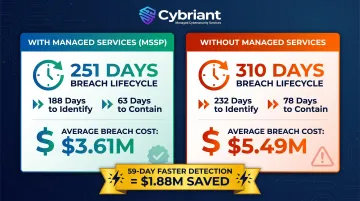
Detection speed drives cost outcomes. When a security team identifies a breach internally, the average cost is $4.55 million. When the attacker discloses the breach, costs jump to $5.53 million.
KPIs impacted:
- Mean time to detect (MTTD)
- Mean time to respond (MTTR)
- Number of undetected threats
- Cost per breach incident
When this advantage matters most:
Organizations operating outside standard business hours, companies with distributed or remote teams, and industries like healthcare or finance where even brief unauthorized access carries heavy regulatory consequences.
Advantage 2: Proactive Vulnerability Management and Patch Management
Vulnerability management involves continuously scanning for weaknesses across networks, endpoints, and software - and ensuring patches are applied before attackers can exploit them. Without this discipline, known vulnerabilities remain open, providing attackers with easy entry points.
Cybriant combines real-time vulnerability scanning with structured patch management cycles. Continuous scanning provides automatic visibility into where each asset is secure or exposed, eliminating the dangerous gaps between periodic scans. Risk-based prioritization focuses remediation on asset criticality, threat context, and vulnerability severity rather than burying teams in long, unsorted vulnerability lists.
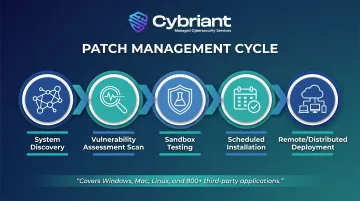
The patch management cycle includes automatic system discovery, vulnerability assessment scans, sandbox testing of patches before network-wide deployment, and scheduled installation to minimize disruption. Cybriant's solution handles Windows, Mac, Linux, and up to 800 third-party applications, with distributed and remote patching capabilities that reach devices behind the firewall, on the road, or at remote sites.
Exploitation of vulnerabilities was present in 20% of all breaches analyzed in the 2025 Verizon DBIR - a 34% increase from the previous year. The median time for a CISA Known Exploited Vulnerability to be mass exploited is just five days, and for certain edge device vulnerabilities, exploitation occurred on or before CVE publication (zero days).
Yet organizations typically take about 55 days to remediate 50% of critical vulnerabilities, leaving a dangerous exploitation window open. Internal IT teams are often too stretched to maintain consistent patching schedules - and with 48,244 CVEs published in 2025 alone, manual patching becomes unsustainable.
KPIs impacted:
- Number of critical unpatched vulnerabilities
- Average time-to-patch
- Percentage of endpoints with current security updates
- Frequency of vulnerability scans completed
When this matters most:
Organizations running legacy systems or diverse technology stacks, businesses that recently scaled or onboarded new software, and any company subject to compliance frameworks that require documented vulnerability management (HIPAA, PCI-DSS, CMMC).
Advantage 3: Structured Incident Response That Limits Breach Damage
Even the best defenses don't guarantee zero incidents. Without a structured response plan, organizations lose critical time deciding what to do - allowing threats to spread and data exposure to grow.
Managed cybersecurity providers bring pre-built incident response playbooks, trained analysts, and 24/7 availability to execute containment the moment a threat is confirmed. Cybriant's approach covers the full response lifecycle:
- Rapid containment to stop threat spread as soon as an incident is confirmed
- Forensic analysis to identify root causes and understand how the breach occurred
- Customized playbooks with clear steps for each threat scenario, tailored to the client's infrastructure
- Immediate client notification with actionable guidance to begin containment
- Stakeholder communication support to protect reputation during and after the incident
Organizations with both an IR team and a tested IR plan identified and contained breaches in 252 days, compared to 306 days for those with neither - a 54-day difference. Structured incident response also directly reduces breach remediation costs and regulatory fine exposure.
For regulated industries, compliance mandates strict timelines:
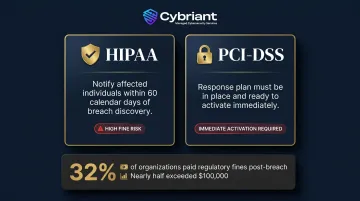
- HIPAA requires notifying affected individuals within 60 calendar days of breach discovery
- PCI-DSS requires organizations to have a response plan in place and be ready to act immediately
Managed providers handle breach notification procedures as part of their standard service. That matters: 32% of organizations paid a regulatory fine following a breach, with nearly half exceeding $100,000.
KPIs impacted:
- Mean time to contain (MTTC)
- Regulatory fine risk
- Data recovery time
- Reputational impact measured through customer retention metrics post-incident
When this matters most:
Regulated industries where breach notification windows are legally mandated, SMBs without a dedicated security team capable of responding after hours, and organizations that have experienced a prior incident and need structured improvement.
What Happens When Managed Cybersecurity Services Are Missing or Ignored
Without managed security, threats go undetected for weeks or months, vulnerabilities remain open due to infrequent patching, and the first sign of a breach is often the breach itself - not a warning. The average breach lifecycle without active monitoring is 310 days, leaving attackers ample time to move laterally, exfiltrate data, and establish persistence.
The compounding costs of a reactive security posture are severe:
- Financial losses from breach remediation: SMBs under 500 employees face average breach costs of $3.31 million
- Regulatory fines for compliance failures: 32% of breached organizations paid fines, with nearly half exceeding $100,000
- Extended downtime: Longer detection windows mean more systems compromised and longer recovery times
- Lasting reputational damage: Customer trust erodes and can outlast the incident itself
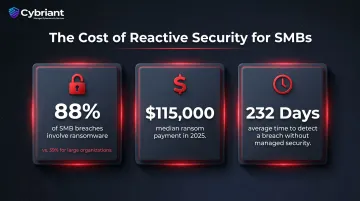
These costs aren't hypothetical - they follow predictable patterns when security gaps go unaddressed. Ransomware was a component of 88% of breaches in SMBs, compared to just 39% in large organizations. Threat actors actively exploit the resource gaps in smaller businesses. The median ransom payment in 2025 was $115,000, not counting recovery costs, downtime, and data loss.
The operational impact compounds at every stage of the breach lifecycle:
- Detection gap: Organizations without continuous monitoring take 232 days on average to identify a breach - nearly eight months of undetected access
- Vulnerability exposure: Critical CVEs remain unpatched for 55+ days on average, while attackers exploit them in as little as five days
- Containment delay: Unstructured incident response stretches containment from 63 days to 78 days, and costs rise by $1.88 million when the lifecycle exceeds 200 days
How to Get the Most Value from Managed Cybersecurity Services
Managed cybersecurity services deliver the greatest prevention impact when applied as a continuous, integrated program - not treated as a one-time setup or an emergency measure after a scare. To maximize the value of the partnership, adopt these three practices:
1. Define clear security baselines and review threat reports on a regular cadence
Findings must be acted upon, not just logged. Cybriant provides executive-level reporting and actionable insights, but value is realized only when clients review findings and implement recommended actions.
Track these metrics to measure progress over time:
- MTTD and MTTR - mean time to detect and respond to threats
- Unpatched vulnerabilities - total count and trending direction
- Endpoint coverage - percentage of devices with current security updates
2. Ensure the managed service covers all attack surfaces
Gaps in coverage are where breaches tend to originate. Managed services should protect:
- Endpoints - via EDR/MDR for detection and response
- Network perimeter - via firewall management and intrusion detection
- Cloud environments - via continuous scanning and configuration monitoring
- User access - via anomaly detection and insider threat monitoring
Cybriant provides visibility across IT, cloud, and IoT/OT environments, so no critical attack surface goes unmonitored.
3. Combine managed services with periodic employee security awareness training
Human error remains one of the leading causes of breach incidents regardless of the technology in place. 68% of breaches involved the human element, and stolen credentials were the primary hacking vector in 33% of SMB breaches. Organizations with high levels of employee training saw average breach costs of $4.15 million, compared to $5.10 million for those with low training levels - a nearly $1 million difference.
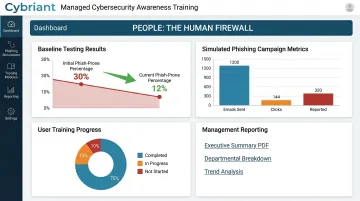
Cybriant offers a Managed Cybersecurity Awareness Training service that includes baseline testing, user training, simulated phishing attacks, and management reporting. By strengthening people-side defenses alongside technical controls, organizations build a more resilient security posture that prevents breaches at every layer.
Conclusion
Managed cybersecurity services prevent data breaches not through a single tool or tactic, but through continuous monitoring, proactive vulnerability closure, and disciplined incident response working together. Every patched vulnerability and contained incident builds a stronger security posture - and the cumulative effect compounds over time.
The numbers back this up. Organizations using managed services consistently outperform those going it alone:
- Identify and contain breaches 59 days faster, saving an average of $1.88 million per incident
- Close critical vulnerabilities before attackers can exploit them, eliminating the 50-day exposure window common with manual patching
- Respond to incidents with pre-built playbooks and trained analysts, cutting containment time by 15 days and avoiding regulatory fines that frequently exceed $100,000
Businesses serious about preventing data breaches should treat managed cybersecurity as an ongoing operational investment, not a one-time purchase. Cybriant has been helping organizations of all sizes do exactly that since 2015 - with 24/7 SOC operations, SOC 2 Type 2 certification, and five consecutive appearances on MSSP Alert's Top 250 MSSPs List. The question isn't whether your organization needs this level of protection. It's whether you have it yet.
Frequently Asked Questions
What are the benefits of managed cybersecurity services?
Managed cybersecurity services provide 24/7 monitoring, access to specialized expertise, proactive threat detection, compliance support, and cost efficiency compared to building an in-house security team. Organizations gain enterprise-grade protection without the $1.2+ million annual payroll required to staff a 24/7 SOC internally.
How can you prevent a data breach in cybersecurity?
The most impactful prevention measures are:
- Continuous monitoring to detect threats in real time
- Vulnerability and patch management to close security gaps before exploitation
- Strong access controls to limit unauthorized entry
- Employee training to reduce human error
- A structured incident response plan to contain threats quickly
What types of threats can managed cybersecurity services detect before a data breach occurs?
Managed monitoring detects a wide range of threats before they escalate, including:
- Phishing attempts, suspicious login behavior, and insider anomalies
- Network intrusion attempts, lateral movement, and ransomware activity
- File-based and file-less malware, weaponized documents, and unpatched software being probed
AI-powered detection and behavioral analytics identify these threats before they become full-scale breaches.
How quickly can a managed security provider respond to a data breach threat?
Response times vary by provider, but top MSSPs offer near-real-time alerting and containment through 24/7 SOC teams. Cybriant's analysts assess alerts in real time and execute containment the moment a threat is confirmed. Without managed monitoring, organizations average 232 days to detect a breach - managed SOC coverage cuts that exposure dramatically.
Is managed cybersecurity affordable for small and medium-sized businesses?
Yes. Managed cybersecurity typically operates on a subscription model, making enterprise-grade security accessible to SMBs without the capital investment of building an in-house team. Average MSSP pricing ranges from $45 to $73 per endpoint per month, far lower than the $3.31 million average cost of a data breach for SMBs under 500 employees.
What is the difference between co-managed and fully managed cybersecurity services?
Co-managed services supplement an existing internal IT or security team, providing additional expertise and 24/7 monitoring to extend internal capabilities. Fully managed services have the provider handle the entire security operation, from monitoring to response to remediation. If your team has security staff but limited capacity, co-managed is the right fit. If you're starting from scratch or need full coverage, fully managed gives you complete protection without building an internal SOC.