Introduction
Healthcare organizations manage vast amounts of protected health information (PHI) across electronic health records (EHRs), connected medical devices, telehealth platforms, and remote systems - making them high-value targets for cybercriminals. According to IBM's 2025 Cost of a Data Breach Report, healthcare data breaches remain the costliest of any industry for the 14th consecutive year, averaging $7.42 million per incident.
These breaches also take the longest to contain, averaging 279 days - more than five weeks longer than the global average.
HIPAA compliance is not optional. The HHS Office for Civil Rights (OCR) actively pursues enforcement actions - in 2025 alone, Warby Parker faced a $1.5 million penalty for failing to conduct accurate risk analysis and review information system activity.
Most healthcare organizations lack the in-house security depth to maintain continuous, compliant monitoring. A healthcare-specialized Managed Security Service Provider (MSSP) fills that role, operationalizing HIPAA's security requirements through round-the-clock threat detection and expert incident response.
Overview
- A healthcare MSSP handles security monitoring, threat detection, and HIPAA compliance on behalf of healthcare organizations
- Healthcare experiences the highest breach costs at $7.42 million per incident, with PHI selling for $500+ on the dark web versus $10-$40 for credit cards
- HIPAA's Security Rule requires continuous audit controls and activity review; MSSPs deliver this coverage 24/7
- Key services: managed SIEM, MDR, vulnerability management for legacy devices, and HIPAA-mapped compliance reporting
- When evaluating MSSPs, require healthcare experience, SOC 2 Type 2 certification, a signed BAA, and proven incident response times
What Is a Healthcare MSSP?
A Managed Security Service Provider (MSSP) is an external cybersecurity firm that assumes responsibility for security monitoring, threat management, and compliance functions on behalf of an organization. Unlike one-time security projects or audits, an MSSP operates continuously on a subscription-based model, providing ongoing protection and oversight.
How Healthcare MSSPs Differ
A healthcare MSSP differs fundamentally from general-purpose security providers. Healthcare-specialized MSSPs understand PHI data flows, HIPAA regulatory requirements, clinical workflows, and the unique risks of connected medical devices - enabling more precise threat models and response protocols tailored to the healthcare environment.
That specialized knowledge translates into practical differences in how threats are handled:
- Imaging workstations need different access controls than administrative laptops
- Legacy infusion pumps require compensating controls rather than standard patching schedules
- Breaches affecting 500 or more individuals trigger strict HIPAA breach notification timelines that must be tracked precisely
Cybriant's 24/7 Managed SIEM with live monitoring is built to handle exactly these scenarios.
MSSP vs. MSP: Understanding the Distinction
An MSP (Managed Service Provider) handles general IT operations - help desk support, infrastructure management, cloud services, and endpoint maintenance. An MSSP specializes in cybersecurity: threat detection, security monitoring, compliance management, and incident response.
While some providers offer both IT and security services, the security specialization of an MSSP is what closes the compliance gaps general IT providers typically leave open. Dedicated security expertise, purpose-built tools, and compliance-focused processes aren't add-ons for an MSSP - they're the entire service.
Why Healthcare Is a Prime Cyberattack Target
PHI Is More Valuable Than Financial Data
Protected health information commands premium prices on the black market because it contains a rich combination of personal identifiers, insurance details, and medical history. This enables identity theft, insurance fraud, and prescription fraud - crimes with much longer windows of exploitation than credit card fraud.
Trustwave SpiderLabs reports that full medical records sell for $500+ on the dark web, while standard US credit cards average only $10 to $40. Unlike credit card numbers that can be quickly canceled, medical records contain permanent data - diagnoses, Social Security numbers, historical addresses - that retain value for years.
Expanded Attack Surface
Healthcare organizations now face an attack surface far beyond traditional network perimeters:
- EHR systems storing millions of patient records
- IoT medical devices (infusion pumps, imaging systems, patient monitors) often running outdated operating systems
- Telehealth platforms connecting remote patients and providers
- Remote workers accessing PHI from home networks
- Third-party vendor integrations (billing services, cloud storage, managed IT providers)
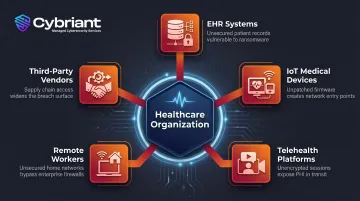
The 2025 Verizon Data Breach Investigations Report notes that ransomware attacks rose 37% from the previous year and are now present in 44% of healthcare breaches. The 2024 Change Healthcare ransomware attack demonstrated this vulnerability on a national scale, affecting 192.7 million individuals and causing $6.3 billion in claims value losses in just three weeks.
Understaffed Security Teams Can't Keep Up
That expanding attack surface demands more monitoring capacity - but most healthcare organizations don't have it. Many small practices and community hospitals cannot staff a full internal Security Operations Center (SOC).
A 2024 Ponemon Institute study.pdf>) found that 55% of healthcare respondents cited lack of in-house expertise and 42% cited insufficient staffing as primary deterrents to achieving strong cybersecurity posture. The result: organizations remain under-monitored and slower to detect breaches, contributing to an average 279-day breach lifecycle.
How HIPAA Defines Security Monitoring Requirements
The Three Safeguard Categories
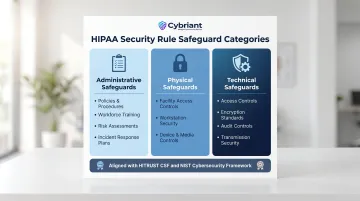
The HIPAA Security Rule establishes three safeguard categories that form the compliance backbone for any MSSP engagement:
- Administrative Safeguards: Policies, workforce training, risk assessments, incident response plans
- Physical Safeguards: Facility access controls, workstation security, device and media controls
- Technical Safeguards: Access controls, encryption, audit controls, transmission security
The Technical Safeguards specifically mandate audit controls and information system activity review - essentially requiring continuous security monitoring. According to 45 CFR 164.312(b), covered entities must "implement hardware, software, and/or procedural mechanisms that record and examine activity in information systems that contain or use electronic protected health information."
Ongoing Risk Analysis Requirement
HIPAA requires a continuous process, not a one-time compliance checkbox. HHS OCR guidance states: "The risk analysis process should be ongoing. In order for an entity to update and document its security measures 'as needed,' which the Rule requires, it should conduct continuous risk analysis."
An MSSP puts this into practice through:
- Real-time security monitoring and log analysis
- Periodic vulnerability assessments
- Threat intelligence integration
- Continuous compliance validation
Business Associate Agreement (BAA) Requirement
Any MSSP that accesses, stores, or transmits ePHI on behalf of a healthcare organization must sign a Business Associate Agreement. According to 45 CFR 164.502(e) and 164.504(e), business associates must ensure subcontractors agree to the same restrictions to safeguard PHI.
This contractual obligation makes the MSSP legally accountable as a business associate. Verify BAA readiness and review specific security commitments before engaging any provider. As a healthcare-focused MSSP, Cybriant signs a BAA as a standard part of every engagement involving ePHI, taking on that business associate accountability directly.
Breach Notification Implications
Under HIPAA's Breach Notification Rule, organizations must report breaches affecting 500 or more individuals within 60 days to OCR, with shorter timelines for notifying affected individuals. An MSSP with 24/7 monitoring and rapid incident response accelerates detection and containment, reducing both breach scope and the likelihood of triggering notification requirements.
Beyond Baseline HIPAA
Meeting HIPAA's minimum requirements is a starting point, not an endpoint. Many healthcare organizations pursue HITRUST CSF certification or align with the NIST Cybersecurity Framework to build a more defensible security posture - both of which demand the same continuous monitoring and risk analysis capabilities that HIPAA requires. An MSSP with established processes for HIPAA should be able to extend that coverage to support these frameworks without significant added friction.
Core Services a Healthcare MSSP Should Provide
24/7 Security Information and Event Management (SIEM)
SIEM is the operational center of HIPAA-compliant monitoring - aggregating log data from across the environment and correlating events to detect anomalies.
What SIEM covers:
- EHR system access logs
- Endpoint activity (workstations, servers, mobile devices)
- Network device logs (firewalls, routers, switches)
- Cloud service authentication and activity
- Medical device network traffic
Effective SIEM requires more than tool deployment - it demands live analysis by security analysts who distinguish genuine threats from false positives. Cybriant's 24/7 Managed SIEM pairs continuous log monitoring with expert analyst review, so healthcare organizations get actionable alerts rather than noise.
Vulnerability Management and Patch Management
Continuous vulnerability scanning identifies weaknesses in systems storing or transmitting ePHI before attackers exploit them. However, healthcare environments present unique challenges: legacy systems and medical devices often cannot be patched on standard IT schedules.
Key capabilities:
- Continuous automated scanning across all assets
- Risk-based prioritization considering asset criticality and threat context
- Compensating controls for unpatchable systems (network segmentation, additional monitoring, access restrictions)
- Coordinated patching schedules that account for clinical workflow constraints
MITRE guidance notes that "since legacy risks likely cannot be mitigated sufficiently through patching and updating due to outdated technology and compatibility issues, other approaches to managing these risks may be required."
Managed Detection and Response (MDR)
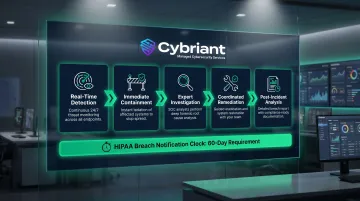
MDR is the active counterpart to monitoring. When a threat is detected, the MSSP contains it, investigates scope, and coordinates remediation. In healthcare, speed matters: under HIPAA's breach notification rule, the clock starts at discovery - slower response means broader exposure and tighter reporting deadlines.
MDR capabilities include:
- Real-time threat detection across endpoints and networks
- Immediate containment to prevent lateral movement
- Expert-led investigation to determine scope and impact
- Coordinated remediation with documented response actions
- Post-incident analysis and recommendations
Compliance Reporting and Audit Support
An MSSP should produce documentation that maps security activity to HIPAA safeguard requirements, enabling organizations to demonstrate compliance without emergency preparation when audits arrive.
Audit-ready documentation includes:
- Access logs showing who accessed ePHI and when
- Security incident tracking reports
- Risk assessment evidence and remediation tracking
- Security control effectiveness validation
- Safeguard implementation proof mapped to Administrative, Physical, and Technical categories
Endpoint and Network Security Management
Comprehensive protection requires multiple defensive layers working together - and in healthcare, how those layers connect matters as much as the individual tools.
Network segmentation is especially critical for healthcare. CISA's HPH Mitigation Guide recommends isolating IT and OT devices, using DMZs and firewalls to shield networks, and creating VLANs to contain vulnerable solution stacks. The goal is straightforward: a breach on an administrative workstation should never reach imaging systems or infusion pumps.
Additional security layers:
- Firewall management and configuration
- Intrusion detection and prevention systems (IDS/IPS)
- Endpoint protection with real-time threat response
- Secure remote access controls
How to Choose the Right Healthcare MSSP
Verify Healthcare-Specific Experience and Certifications
A general-purpose MSSP may lack the contextual knowledge to interpret healthcare-specific threat patterns, understand clinical workflow constraints, or know which HIPAA safeguards apply to a given system.
What to verify:
- Healthcare client roster and references
- Relevant certifications (SOC 2 Type 2, HITRUST experience)
- BAA signing experience and readiness
- Understanding of medical device security challenges
- Familiarity with EHR platforms and healthcare technology ecosystems
Look for providers with SOC 2 Type 2 certification and verifiable third-party recognition. Cybriant, for example, holds SOC 2 Type 2 certification and has been named to MSSP Alert's Top 250 MSSPs list for five consecutive years - the kind of documented track record that signals genuine healthcare security competence.
Assess Monitoring Depth and Response Speed
Confirm the MSSP provides true 24/7/365 live monitoring with defined SLAs for alert response and incident escalation - not just automated alerting with daytime-only analyst coverage.
Critical questions:
- How long does it take from detection to containment?
- What is the escalation path for critical incidents?
- Are analysts monitoring in real-time or reviewing alerts periodically?
- What are the guaranteed response times for different alert severities?
Evaluate Transparency and Reporting Quality
Effective MSSPs provide clear, regular reporting that translates security events into compliance-relevant terms - not just raw data dashboards.
Reporting should include:
- Executive summaries with actionable insights
- Compliance mapping to HIPAA safeguard categories
- Incident timelines and resolution documentation
- Trend analysis showing security posture improvements
- Audit-ready evidence packages
Request sample reports during the evaluation process to assess whether the MSSP's reporting meets your documentation needs.
Conduct Cost-Benefit Analysis vs. Building In-House
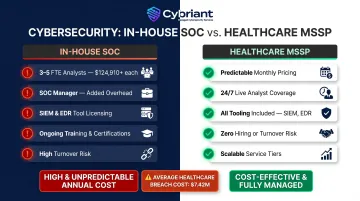
Staffing a 24/7 internal SOC is financially prohibitive for most small-to-mid-sized healthcare organizations. According to the Bureau of Labor Statistics, the median annual wage for Information Security Analysts is $124,910, with top earners exceeding $186,420.
True SOC costs include:
- Multiple security analysts per shift (minimum 3-5 FTEs for 24/7 coverage)
- SOC manager and incident response lead
- Security tools and infrastructure (SIEM, EDR, threat intelligence)
- Ongoing training and certifications
- Recruitment costs and turnover
For most organizations, the MSSP model delivers better security outcomes at lower total cost - with predictable monthly pricing and no hiring risk.
Check Scalability and Vendor Ecosystem Fit
Beyond cost, vendor fit determines whether your MSSP investment holds up long-term. Verify that the provider works with your existing EHR, cloud infrastructure, and device inventory rather than requiring complete overhauls.
Scalability considerations:
- Can the MSSP grow with you as you adopt new technologies?
- How does pricing scale with additional endpoints or locations?
- What happens when you add telehealth platforms or IoMT devices?
- Will you need to re-contract or can services expand seamlessly?
Frequently Asked Questions
What does MSSP mean in healthcare?
In a cybersecurity context, MSSP stands for Managed Security Service Provider - a third-party firm that handles security monitoring, threat detection, and HIPAA compliance support for healthcare organizations on an ongoing basis. These specialized providers operationalize the security controls required by HIPAA's Security Rule.
Is MSSP the same as Medicare?
No. In healthcare administration, "MSSP" can also refer to the Medicare Shared Savings Program - a CMS accountable care organization model focused on coordinating care and reducing costs. According to CMS, these are "groups of doctors, hospitals, and other health care providers who collaborate to give coordinated high-quality care." This is entirely separate from a cybersecurity Managed Security Service Provider.
What is the difference between MSP and MSSP?
An MSP (Managed Service Provider) handles general IT operations like help desk support, infrastructure management, and cloud services. An MSSP (Managed Security Service Provider) specializes exclusively in cybersecurity - including threat monitoring, incident response, vulnerability management, and compliance. For healthcare organizations, that security specialization is what makes HIPAA compliance achievable.
What makes a patient MSSP eligible?
"MSSP eligibility" in the Medicare context refers to patient attribution rules under the Medicare Shared Savings Program - unrelated to cybersecurity. From a security standpoint, any covered entity or business associate that handles ePHI qualifies for MSSP-supported HIPAA monitoring.
How much does an MSSP usually cost?
Pricing varies by organization size, monitored endpoints, and service tier (monitoring-only vs. full MDR). Per MSSP Alert's 2024 Benchmark Pricing Report, per-endpoint, per-user, and flat monthly retainer models are all common. Given that the average healthcare breach costs $7.42 million - plus OCR fines that can exceed $1.5 million - MSSP fees typically represent a fraction of breach exposure.
Cybriant has been named to MSSP Alert's Top 250 MSSPs List five consecutive years - and our healthcare clients get 24/7 managed SIEM, vulnerability management for legacy medical devices, and compliance reporting mapped directly to HIPAA requirements. Call 844-411-0404 to discuss your security needs.