Introduction
Attackers are moving faster than ever. In 2022, the median time from vulnerability disclosure to active exploitation was just one day, according to Rapid7's Vulnerability Intelligence Report. A decade ago, organizations had 38 days between vulnerability publication and active exploitation. Today, that window has collapsed to minutes. Traditional 30-to-60-day patch cycles simply can't keep up.
Many organizations still treat vulnerability scanning and patching as separate, siloed activities - security teams identify weaknesses using one set of tools while IT operations deploys fixes using completely different systems and priorities. This disconnect creates dangerous gaps where critical vulnerabilities fall through the cracks, leaving systems exposed during the precise window when attackers are most aggressive.
Closing that gap requires treating vulnerability management and patch management as a single, integrated program - not two separate workflows. Here's how to build one. If running this in-house isn't realistic, see how patch management as a service delivers the same cycle as a managed service, and vulnerability management services for SMBs for resource-constrained teams.
Overview:
- Attackers exploit new vulnerabilities within 1-5 days, far faster than most organizations patch
- Vulnerability management identifies and prioritizes risks; patch management deploys the fixes
- Effective programs require continuous scanning, risk-based prioritization, and automated deployment
- Use the CISA KEV catalog and asset criticality to guide remediation timelines
- Integrating both disciplines under a unified workflow is the foundation of any mature security program
What Is Vulnerability and Patch Management?
Vulnerability management and patch management are distinct disciplines - but they only work when treated as a unified program. Here's what each one covers and how they connect.
Patch Management Defined
Patch management is the operational process of identifying, testing, and deploying software updates (patches) to fix known security vulnerabilities, bugs, and stability issues across operating systems, applications, and firmware.
Core activities include:
- Maintaining an accurate inventory of all systems and software
- Monitoring vendor security advisories for new patches
- Scheduling and testing patches in controlled environments
- Deploying approved updates using staged rollout strategies
- Verifying successful installation and documenting results
Effective patch management ensures that known software flaws are closed quickly and reliably across the entire IT environment.
Vulnerability Management Defined
Vulnerability management is a broader, continuous discipline. It covers identifying, classifying, prioritizing, and tracking all security weaknesses across an organization's environment: misconfigurations, weak credentials, architectural flaws, and patchable software bugs alike.
This strategic layer tells security teams:
- What is broken (the specific vulnerability or exposure)
- How serious it is (severity, exploitability, business impact)
- Which risks to address first (even when no vendor patch exists)
Vulnerability management provides the intelligence and prioritization framework that guides all remediation decisions, including implementing compensating controls when patches aren't available.
How They Work Together
Vulnerability management is the overarching program that drives remediation decisions. Patch management is one of the primary remediation mechanisms within that program. You can have vulnerability management without a formal patch process (relying on other mitigations), but effective patching requires vulnerability management to guide prioritization.
The workflow between them follows a clear sequence:
- Vulnerability scanning identifies a critical CVE on a web-facing server
- Risk assessment determines the vulnerability requires immediate remediation
- Patch management tests and deploys the vendor fix using a staged rollout
- Verification scan confirms the vulnerability is closed
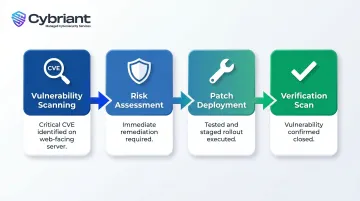
Without this integration, organizations end up scanning continuously but patching slowly, or patching blindly without knowing which vulnerabilities actually pose the greatest risk.
Vulnerability Scanning vs. Patch Management: Key Differences
Vulnerability scanning is the detection activity within vulnerability management - automated tools probe systems for weaknesses and produce findings. Patch management is the remediation activity that acts on those findings. Scanning tells you where the gaps are. Patching closes them.
Key operational differences:
| Dimension | Vulnerability Scanning | Patch Management |
|---|---|---|
| Scope | Misconfigurations, weak credentials, architectural flaws, and patchable software bugs | Only software flaws with available vendor-released fixes |
| Timing | Continuous or scheduled (weekly/monthly) | Triggered by scan results and vendor release cycles |
| Ownership | Typically owned by security teams | Typically owned by IT operations |
| Output | Risk reports and prioritized finding lists | Deployed patches and compliance verification |
The coordination risk: When these activities run on separate teams using different tools, critical vulnerabilities can fall through the cracks between discovery and remediation. According to the Verizon 2024 DBIR, organizations take an average of 55 days to remediate 50% of critical vulnerabilities. Attackers move in under 20 days - meaning most organizations are operating well inside the exploitation window before a patch is ever deployed.
Closing that gap requires more than good tools. Shared dashboards, agreed-upon SLAs between security and IT ops, and unified workflows ensure that what gets discovered doesn't sit idle while attackers take advantage.
Building a Vulnerability and Patch Management Program: Step by Step
An effective program requires both disciplines to work together through repeatable, integrated processes.
Step 1: Build and Maintain a Complete Asset Inventory
Asset inventory is the prerequisite for everything else. A complete inventory includes:
- Endpoints (Windows, macOS, Linux workstations and laptops)
- Physical and virtual servers
- Cloud workloads (IaaS, PaaS, SaaS applications)
- Mobile devices
- Third-party applications
- Network infrastructure (routers, switches, firewalls)
- IoT and OT devices
Critical requirements:
- Update inventory automatically - not just at audit time
- Cross-check against procurement records, HR onboarding data, and cloud resource tags to catch unmanaged devices and shadow IT
- Use automated discovery; manual inventories become outdated immediately as assets are added, removed, or reconfigured
Cybriant's vulnerability management service includes continuous asset discovery that identifies and monitors assets across cloud, endpoints, applications, and remote environments - maintaining a live view that expands and contracts as your infrastructure evolves.
Step 2: Conduct Regular Vulnerability Scanning
Scanning methods:
- Authenticated scans use system credentials to examine installed software, configurations, and patch levels with high accuracy
- Unauthenticated scans probe systems over the network without credentials, surfacing externally visible vulnerabilities
- Agent-based scans deploy lightweight agents on endpoints for continuous visibility regardless of network location - critical for remote and mobile devices
Recommended cadence:
- Continuous scanning for critical assets and internet-facing systems
- Weekly at minimum for high-priority production systems
- Monthly for lower-risk internal assets
Don't forget third-party and browser-based applications - these are common, under-patched attack vectors. Cybriant's comprehensive scanning covers up to 800 third-party applications in addition to operating systems.
Step 3: Assess Risk and Prioritize Remediation
Raw scan output must be filtered through a risk assessment process - not every finding warrants the same response speed.
Prioritization factors:
- CVSS score as a baseline severity rating (see detailed framework below)
- Active exploitation status - the CISA KEV catalog is the most reliable signal here
- Asset criticality: internet-facing vs. internal, business-critical vs. supporting
- Data sensitivity: systems holding PII, payment data, or regulated information
- Compensating controls that reduce real-world exploitability
Cybriant's risk-based prioritization framework evaluates asset criticality, threat context (incorporating real-world threat intelligence), exposure pathways, and business impact to focus remediation on the risks that matter most.
Step 4: Test Patches Before Wide Deployment
Installing patches without testing can lead to disastrous results - application failures, system crashes, and fleet-wide outages.
Structured testing workflow:
- Lab validation: Confirm the patch installs correctly on representative OS builds and configurations
- Application compatibility testing: Verify core business applications still function after patching
- Pilot group deployment: Deploy to 5-10% of production endpoints (ideally IT staff) and monitor for 24-48 hours before broader rollout
Teams typically validate patches in sandbox environments before touching production networks - catching compatibility issues before they affect users at scale.
Step 5: Deploy Using a Staged Rollout
A ring-based deployment model contains risk and allows for early detection of issues.
Deployment rings:
- Ring 0: IT/security team (immediate deployment)
- Ring 1: Cross-functional pilot group (24 hours later)
- Ring 2: General user population by department (48-72 hours)
- Ring 3: Critical infrastructure and production servers (during scheduled maintenance windows)
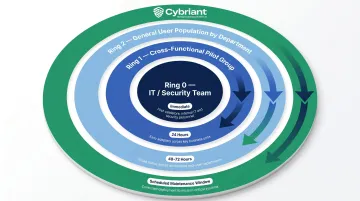
Rollback procedures: Each ring should have a defined rollback plan. If patching fails or creates issues during reboots, system restore points and database backups allow you to restore systems to their original state and retest patches before attempting installation again.
Cybriant's automated patch management can distribute patches to thousands of machines in minutes with minimal network impact, across Windows, Mac, and Linux environments.
Step 6: Verify Remediation and Document Results
After deployment, a follow-up vulnerability scan should confirm that the patched vulnerability is closed.
Why verification matters:
- Confirms patches actually deployed - not just that they were pushed
- Catches silent failures where patches don't install without generating obvious errors
- Supports audit requirements for frameworks like PCI DSS, NIST, and CMMC
Cybriant's service includes verification scanning that confirms remediation and provides patch compliance reporting to verify patching enterprise-wide and meet regulatory requirements.
How to Prioritize Vulnerabilities and Patches Effectively
Not all vulnerabilities require the same urgency. Effective prioritization combines severity scoring, threat intelligence, and asset context.
CVSS Scoring System
The Common Vulnerability Scoring System (CVSS) provides baseline severity ratings:
| Rating | CVSS Score | Description |
|---|---|---|
| Critical | 9.0 - 10.0 | Severe vulnerabilities requiring immediate action |
| High | 7.0 - 8.9 | Significant vulnerabilities requiring prompt remediation |
| Medium | 4.0 - 6.9 | Moderate vulnerabilities requiring scheduled remediation |
| Low | 0.1 - 3.9 | Minor vulnerabilities with limited exploitability |
CVSS measures theoretical severity, not real-world exploitability. A high CVSS score on an isolated internal system may pose less risk than a medium-severity vulnerability on an internet-facing payment server.
CISA Known Exploited Vulnerabilities (KEV) Catalog
The CISA KEV catalog is the authoritative list of vulnerabilities actively exploited in the wild. As of 2024, it contains over 1,590 confirmed exploited vulnerabilities.
Any vulnerability listed in the KEV catalog has confirmed active exploitation and should be treated with maximum urgency, regardless of CVSS score. Check the KEV catalog during every patch cycle. As the 2024 Verizon DBIR puts it plainly: "if it goes into the KEV, go fix it ASAP."
Recommended Remediation SLAs
Translate risk levels into actionable timelines:
- Critical (CVSS 9.0-10.0 or KEV-listed): Remediate within 24-48 hours
- High (CVSS 7.0-8.9): Remediate within 7 days
- Medium (CVSS 4.0-6.9): Remediate within 30 days
- Low (CVSS 0.1-3.9): Remediate within 90 days
These timelines align with frameworks like NIST SP 800-40 and PCI DSS Requirement 6.3.3, which mandates patching critical and high-severity vulnerabilities within one month of release.
Asset Criticality as a Multiplier
A medium-severity vulnerability on an internet-facing server processing payment data may warrant higher priority than a high-severity flaw on an isolated internal workstation.
Tagging assets by criticality:
- Internet-facing vs. internal
- Production vs. development/test
- Regulated data vs. general business data
- Mission-critical services vs. supporting systems
Asset tags give your team a consistent framework for making these calls quickly - without relitigating context during every patch cycle.
Addressing Zero-Days and Unpatched Vulnerabilities
When no vendor patch exists, vulnerability management's role is to implement compensating controls:
- Network segmentation to limit exposure
- Enhanced monitoring and logging
- Access restrictions and privilege reduction
- Web application firewalls or intrusion prevention systems
Patch management addresses known fixes. Vulnerability management covers the gaps in between, reducing exposure through compensating controls until a vendor patch is available.
Common Challenges and How to Address Them
Visibility Gaps
Challenge: Unmanaged and remote endpoints that fall outside legacy on-premises patch tools represent silent risk. Remote workers, BYOD devices, and cloud workloads often escape traditional vulnerability scanning and patching.
Solution: Agent-based management tools and cloud-native patching platforms close this gap by managing endpoints regardless of network location. Cybriant's managed vulnerability scanning and patch management service provides continuous, real-time visibility across distributed environments - patching devices whether they're behind the firewall, on the road, at remote sites, or offline - without requiring large internal teams.
IT and Security Silos
Challenge: When security teams identify vulnerabilities but rely on separate IT operations teams working from different tools and priorities to deploy fixes, remediation stalls. Research shows that weaponized vulnerabilities are patched within 30.6 days on average, but attackers weaponize the same vulnerabilities in just 19.5 days - creating an 11.1-day exploitation gap.
Solution: Establish shared ownership through:
- Unified remediation dashboards visible to both teams
- Agreed-upon MTTR (mean time to remediate) metrics tied to performance reviews
- Regular cross-team reviews of open critical items
- Automated workflows that trigger patching when vulnerabilities meet defined thresholds
Slow Remediation Cycles
Challenge: Organizations take an average of 55 days to remediate 50% of critical known exploited vulnerabilities, yet 56% of vulnerabilities are exploited within seven days of disclosure. Main causes include manual approval processes, limited test environments, and reboot coordination challenges.
Solution: Automated patching reduces mean time to remediation by over 14 days - from 39.8 days for manual processes to 25.5 days for automated workflows - and increases patch success rates from 49.8% to 72.5%.
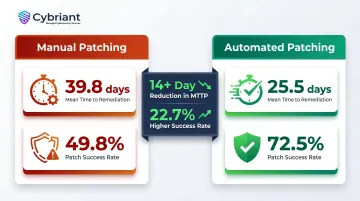
Automate approval for low-risk, vendor-signed updates while reserving manual review for high-risk patches affecting critical systems. As NIST SP 800-40 makes clear:
"There is no way that an organization can keep up with patching without automation because of the sheer number of assets, software installations, vulnerabilities, and patches."
Key Metrics to Measure Your Program's Effectiveness
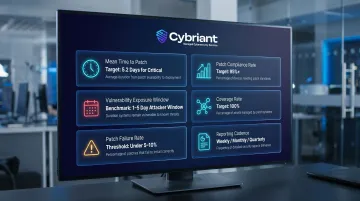
Tracking the right KPIs turns your patch management program from a reactive checklist into a measurable risk reduction engine. These six metrics give security and IT teams a clear picture of where the program stands - and where it's breaking down.
Critical metrics to track:
Mean Time to Patch (MTTP):
- Average time from patch release to successful deployment, measured by severity tier
- NIST's example matrix shows 5.2 days average for Critical vulnerabilities on High-importance assets, 80.4 days for Low vulnerabilities on Low-importance assets
- Track separately for each severity band to identify bottlenecks
Patch Compliance Rate:
- Percentage of endpoints with all applicable patches installed within SLA windows
- Target: 95%+ for critical vulnerabilities (aligned with NIST benchmarks)
- Measure across asset criticality tiers
Vulnerability Exposure Window:
- Time between vulnerability disclosure and verified remediation
- Compare against attacker exploitation timelines (1-5 days median)
Coverage Rate:
- Percentage of endpoints actively enrolled in patch management program
- Anything under 100% represents unmanaged risk
- Critical for identifying shadow IT and forgotten systems
Patch Failure Rate:
- Percentage of deployments that fail on first attempt
- Signals tool misconfiguration, compatibility issues, or inadequate testing
- Investigate any failure rate above 5-10%
Reporting cadences:
- Weekly or monthly operational reviews by security and IT teams keep the program on track
- Quarterly reports to executive leadership should cover MTTP trends, compliance improvements, and measurable risk reduction
- Trend data over time shows program maturity more clearly than any single data point.
Frequently Asked Questions
What is patch and vulnerability management?
Patch management is the process of deploying software fixes to known security flaws, while vulnerability management is the broader, continuous discipline of identifying, prioritizing, and remediating all security weaknesses. Patch management is one key remediation activity within the larger vulnerability management program.
What is the difference between vulnerability scanning and patch management?
Vulnerability scanning is the detection activity - automated tools identify weaknesses across systems - while patch management is the remediation activity that deploys vendor-released fixes to close those weaknesses. Scanning without patching leaves risks unaddressed; patching without scanning means you lack a prioritized roadmap.
How do you patch a vulnerability?
Confirm the patch applies to the affected system, then test it in a lab or pilot environment to verify compatibility. Deploy using a staged rollout - starting with a small pilot group - then run a follow-up scan to confirm the vulnerability is closed.
What is patch and vulnerability assessment?
A vulnerability assessment identifies and ranks security weaknesses across an environment. A patch assessment (or patch audit) evaluates which patches are missing or outdated. Together, they form the discovery and analysis foundation that drives remediation planning.
What are the best practices for patch management?
Key patch management best practices include:
- Maintain a complete, current asset inventory
- Prioritize patches using CVSS scores and the CISA KEV catalog
- Test in a non-production environment before wide deployment
- Use a staged ring-based rollout to contain risk
- Verify remediation with post-deployment scans
What are vulnerability management best practices?
Run continuous or regularly scheduled scans across all assets, and prioritize findings using a risk-based framework that factors in exploitability and asset criticality. Define SLA timelines by severity (24-48 hours for Critical, 7 days for High) and track progress with KPIs like mean time to patch (MTTP) and patch compliance rate.
Cybriant's Vulnerability and Patch Management Services
Named to MSSP Alert's Top 250 MSSPs list and SOC 2 Type 2 certified, Cybriant provides continuous scanning, risk-based prioritization, and automated remediation across distributed environments. Our managed service is built for organizations that need enterprise-grade vulnerability coverage without building a large internal security team. Call 844-411-0404 to learn how we can help.