Introduction
Security teams are under siege in 2026. The cybersecurity skills gap has reached critical mass - with 67% of organizations reporting staffing shortages and 90% struggling with skills gaps on their teams - while alert volumes continue to climb. Organizations receive an average of 22,111 security alerts per week, yet investigate only 35% of them - a gap that leaves most environments functionally blind to active threats. The traditional in-house Security Operations Center (SOC) has become unsustainable for most organizations.
Managed Extended Detection and Response (MXDR) addresses this directly - combining broad threat visibility across endpoints, networks, and cloud environments with 24/7 expert response, without requiring organizations to build that capability in-house. This guide breaks down how MXDR works, how it differs from XDR, MDR, and EDR, and what it takes to adopt it effectively in 2026.
Overview: Quick Takeaways
- MXDR combines XDR technology with 24/7 human-led monitoring, threat hunting, and response delivered by an external provider
- Covers endpoints, cloud, networks, email, and identity in a single unified service, not endpoint security alone
- Bridges the gap between technology and talent without building an in-house SOC
- Compresses breach lifecycles and reduces costs significantly compared to internal capabilities
- Built for organizations that need enterprise-grade protection but lack the in-house staff or budget to run a full SOC
What Is Managed XDR (MXDR)?
Managed XDR is a fully outsourced security service that combines Extended Detection and Response (XDR) technology with continuous human-led monitoring, threat hunting, and incident response - delivered 24/7 by a managed security provider.
The "extended" component differentiates MXDR from older approaches. Unlike tools that focus only on endpoints, MXDR ingests and correlates telemetry from multiple layers - endpoints, cloud workloads, networks, email, SaaS applications, and identities - into a single unified view. This cross-domain correlation enables detection of attack patterns that siloed tools would miss.
The "managed" component matters just as much. Organizations don't just get software - they get a team of security analysts and threat hunters who actively monitor the environment, triage alerts, investigate incidents, and respond to threats on their behalf.
That human layer is what makes MXDR effective. According to CrowdStrike's threat hunting research, automated detection techniques are inherently predictable, and attackers continuously develop bypass methods to exploit that predictability.
Key Features of MXDR Platforms
- AI-powered threat detection and analytics - Correlates activity across all telemetry sources
- 24/7 real-time monitoring - Continuous oversight by security analysts
- Automated response and containment - Playbooks handle immediate actions like device isolation or domain blocking
- Threat intelligence feeds - Updated continuously based on emerging attacker tactics
- Vulnerability management - Identifies and prioritizes remediation
- Compliance reporting dashboards - Audit-ready logs and documentation
MXDR vs. XDR vs. MDR vs. EDR: Key Differences
Understanding the relationships between these technologies requires starting at the foundation.
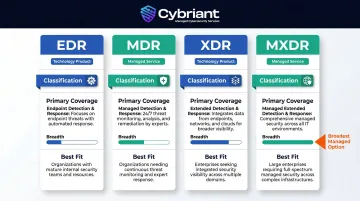
EDR (Endpoint Detection and Response) focuses exclusively on endpoint-level monitoring - laptops, desktops, servers. EDR records and stores endpoint behaviors, uses analytics to detect suspicious activity, and provides remediation suggestions. It's the baseline technology that later generations built upon.
XDR (Extended Detection and Response) evolves from EDR by extending detection across the full environment - networks, cloud, email, identity - and unifies that data into correlated insights. XDR is a technology product, not a service. Organizations deploy and manage it themselves.
MDR (Managed Detection and Response) takes EDR and wraps it in a managed service with a dedicated analyst team - but the telemetry scope stays narrow, covering endpoints and limited network visibility.
MXDR (Managed Extended Detection and Response) is XDR delivered as a managed service - broader scope, deeper correlation, and greater automation combined with expert human oversight.
Comparison Table
| Category | Classification | Primary Coverage | Response Type | Best Fit |
|---|---|---|---|---|
| EDR | Technology Product | Endpoints only | Manual | Organizations with in-house security teams needing endpoint visibility |
| MDR | Managed Service | Endpoints (primarily) | Analyst-led | Organizations needing managed endpoint security without full SOC |
| XDR | Technology Product | Endpoints, Network, Cloud, Identity, Email | Automated + Manual | Organizations with mature security teams wanting unified detection |
| MXDR | Managed Service | Endpoints, Network, Cloud, Identity, Email | Automated + Analyst-led | Organizations wanting enterprise-grade protection without building internal SOC |
MDR and MXDR mirror the EDR-to-XDR progression - same logic, delivered as a service. If your organization has outgrown endpoint-only coverage but lacks the internal team to run XDR, MXDR fills that gap directly.
How Managed XDR Works
Telemetry Collection and Correlation
MXDR begins by ingesting telemetry data from all connected environments - endpoints, cloud workloads, networks, email systems, and identity platforms. This data is normalized into a single centralized platform where AI and machine learning algorithms detect anomalies and indicators of compromise across all sources simultaneously.
A suspicious login attempt, for example, correlates with unusual network traffic and cloud API calls to reveal the complete attack pattern - not just isolated events.
Threat Investigation and Hunting
Security analysts and threat hunters use the correlated data to proactively search for threats that evade automated detection. They assess severity, determine incident scope, and add human judgment where automated systems cannot.
With adversary breakout times falling to 48 minutes on average - and as fast as 51 seconds in some cases - human hunters are essential for catching fast-moving attackers before they establish persistence or exfiltrate data.
Automated and Analyst-Driven Response
Once a threat is understood, MXDR responds through a two-tier model that matches the remedy to the complexity of the threat:
- Automated playbooks handle immediate containment for high-confidence, lower-complexity threats such as isolating a device, blocking a domain, or quarantining files
- Analyst-led response manages complex or high-severity incidents where human judgment guides detailed investigation and remediation plans
The result: automated speed for routine containment, human precision where the stakes are highest.
Key Benefits of Managed XDR
Broader Visibility and Reduced Alert Fatigue
MXDR eliminates data silos by correlating telemetry from all security layers into a single pane of glass. This sharply cuts false positives and helps teams prioritize real threats.
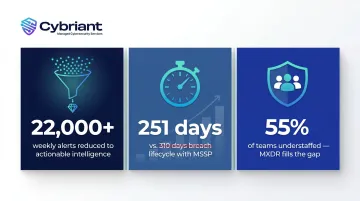
Consider the scale of the problem: organizations face over 22,000 alerts weekly with nearly 10,000 false positives. This volume drives burnout - 71% of analysts experience some level of burnout. MXDR places expert analysts between the technology and your team, filtering noise and delivering only actionable intelligence.
Faster Detection and Response with Lower Total Cost
MXDR compresses Mean Time to Detect (MTTD) and Mean Time to Respond (MTTR) by combining automation with expert oversight. Organizations working with MSSPs identify and contain breaches in 251 days compared to 310 days without - a 21% shorter breach lifecycle.
The cost case is equally compelling. Extensive use of security AI and automation delivered nearly $1.8 million in breach cost savings and cut identification and containment time by more than 100 days. Outsourcing these capabilities is typically more cost-effective than building equivalent in-house resources, which require:
- 24/7 staffing across multiple shifts
- Continuous technology licensing and upgrades
- Ongoing analyst training and certification
Scalable, Expert-Driven Protection for Organizations of Any Size
MXDR levels the playing field. Small and mid-sized businesses gain access to the same quality of threat detection and response capabilities as large enterprises without hiring a full internal security team. This matters because 55% of cybersecurity teams are understaffed and 65% have unfilled positions - gaps that MXDR fills without requiring a single new hire.
MXDR Use Cases
Integrated Security Orchestration Across Complex Environments
Modern organizations running hybrid cloud setups, remote workforces, and multiple security tools benefit from MXDR's ability to ingest and orchestrate signals across all systems into a single coordinated response. This unified visibility is where MXDR earns its keep - catching lateral movement and cross-domain attack patterns that no single-tool deployment can track alone.
Cross-domain coverage typically spans:
- Endpoints - workstations, laptops, and servers running EDR agents
- Cloud APIs and SaaS platforms - identity providers, storage buckets, and collaboration tools
- Network telemetry - east-west traffic, DNS anomalies, and VPN access logs
- Identity systems - Active Directory, SSO, and privileged access management
Proactive Threat Hunting and Advanced Persistent Threat (APT) Defense
MXDR excels at detecting APTs and stealthy, slow-moving attackers that bypass automated detection. While global median dwell times have decreased to 11 days (Mandiant) and 7 days (Unit 42), those windows are closing fast. MXDR teams combine global threat intelligence with continuous human analysis to surface attacker activity before it reaches critical systems.
Speed is the other pressure point. Unit 42 found some attackers obtained domain administrator rights in under 40 minutes without deploying a single piece of malware - meaning signature-based detection misses them entirely. Human threat hunters working continuous shifts are the practical answer.
Compliance-Driven Security for Regulated Industries
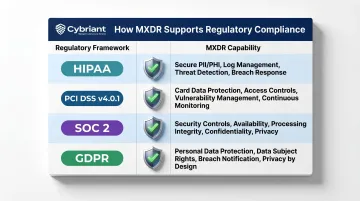
MXDR services support compliance requirements through continuous monitoring, audit-ready reporting, and documented incident response. This is valuable for healthcare (HIPAA), finance (PCI-DSS), and other regulated sectors.
Regulatory alignment examples:
| Framework | Key Requirements Addressed by MXDR |
|---|---|
| HIPAA | Regular review of system activity logs and procedures to respond to security incidents |
| PCI DSS v4.0.1 | 24/7 personnel availability for incident response (Req. 12.10.3) and comprehensive logging/monitoring |
| SOC 2 | Monitoring for anomalies and responding to security incidents (CC7 System Operations) |
| GDPR | Technical measures for security including activity logs and real-time monitoring (Article 32) |
PCI DSS explicitly mandates 24/7 incident response availability - a requirement highly resource-intensive to meet internally but standard in MXDR agreements.
Best Practices for Adopting Managed XDR in 2026
Conduct a Visibility and Coverage Audit Before Selecting a Provider
Map your current attack surface - all endpoints, cloud environments, identity systems, email platforms - and ensure any MXDR solution can ingest telemetry from all these sources. Gaps in telemetry coverage mean gaps in protection. Document what security tools are already deployed and confirm integration compatibility.
Prioritize Providers with Proven 24/7 Human-Led Response Capabilities
Avoid vendors offering automation-only solutions branded as MXDR. Effective MXDR requires continuous human analyst oversight. Look for providers who demonstrate real MTTD and MTTR benchmarks, document SOC team availability, and can describe their analyst escalation workflows clearly.
Demand Transparency in Threat Intelligence and Detection Logic
The best MXDR providers continuously update detection rules based on emerging adversary tactics, techniques, and procedures (TTPs). Ask prospective vendors how often detection policies are updated and how they incorporate frontline threat intelligence. Daily updates - or more frequent - should be the baseline expectation, not a premium feature.
Clarify Incident Response Ownership and Escalation Protocols Upfront
Before signing, establish clear SLAs for response times, escalation workflows, and what the provider can act on autonomously versus what requires your approval. Define each severity tier with specific response time commitments:
- Critical: Immediate containment action, notification within 15 minutes
- High: Response initiated within 1 hour, customer notified
- Medium/Low: Investigated within SLA window, documented in reporting
Ambiguity here slows response when it matters most.
Choose a Provider Aligned to Your Organization's Size, Compliance Needs, and Integration Requirements
For SMBs, look for an MXDR provider experienced in making enterprise-grade security accessible - one with relevant certifications (such as SOC 2 Type 2), a track record across industries, and flexibility to integrate with your existing security stack.
Cybriant, for example, is a SOC 2 Type 2-certified MSSP with over 10 years of experience delivering enterprise-grade managed security to businesses of all sizes. Their CybriantXDR service combines 24/7 Managed SIEM, MDR, and real-time vulnerability management into a unified platform with coverage across endpoints, networks, and cloud workloads.
With a track record spanning healthcare, financial services, manufacturing, and other regulated industries, Cybriant provides the compliance support and integration flexibility mid-market organizations need.

Frequently Asked Questions
What is the difference between XDR and EDR?
EDR focuses on endpoint-level monitoring and threat detection for devices like laptops and servers. XDR extends that capability across the entire environment - including networks, cloud, email, and identity - unifying data from multiple sources for broader visibility and more effective threat detection.
What is the difference between XDR and MXDR?
XDR is a technology platform organizations deploy and manage themselves. MXDR is XDR delivered as a fully managed service - a third-party team of security experts handles monitoring, threat hunting, and incident response on the organization's behalf, around the clock.
What is the difference between Managed Detection and Response (MDR) and EDR?
EDR is a software tool installed on endpoints to detect and respond to threats on those devices. MDR is a managed service that wraps human-led monitoring and response around endpoint security tools, providing a team of analysts rather than software alone.
Is MXDR suitable for small and mid-sized businesses?
Yes. MXDR is especially well-suited for SMBs because it gives them access to enterprise-grade threat detection and expert security teams without the cost or complexity of building an in-house SOC. This levels the playing field against sophisticated threats that don't discriminate by company size.
How does MXDR help reduce mean time to detect and respond (MTTD/MTTR)?
MXDR compresses MTTD and MTTR by combining AI-powered automated detection with 24/7 human analyst oversight. Automated playbooks handle immediate containment while analysts simultaneously investigate root cause. This dual approach closes the exposure window far faster than manual processes or automated-only tools.
What should organizations look for when evaluating an MXDR provider?
Prioritize providers that offer:
- 24/7 human-led coverage with documented response SLAs
- Broad telemetry support across endpoints, cloud, network, email, and identity
- Integration flexibility with your existing security stack
- Transparent threat intelligence with frequent updates
- Relevant compliance certifications
- Proven experience with organizations of similar size and industry