Introduction
The financial stakes of cybersecurity failures have never been higher. In 2024, the global average cost of a data breach reached $4.88 million, while U.S. organizations faced an average breach cost of $9.36 million. Yet despite these escalating costs, many businesses still struggle with a fundamental challenge: knowing where to start.
Without a structured process for identifying their highest-priority threats, security investments tend to miss critical vulnerabilities while addressing lower-impact issues. Resources get misallocated, blind spots go undetected, and organizations remain exposed to incidents that a formal risk assessment would have surfaced.
The missing piece, for most businesses, is a repeatable framework.
This guide provides a practical roadmap for conducting cybersecurity risk assessments. You'll learn what a risk assessment actually is, how to perform one step-by-step, which industry frameworks to consider, and the best practices that businesses of all sizes can apply to build a defensible, continuously improving security posture.
Overview
- A cybersecurity risk assessment systematically identifies, analyzes, and prioritizes threats to your digital assets, giving security teams the data they need to make informed decisions and allocate resources where they matter most
- Six core steps drive the process: scope definition, asset inventory, threat and vulnerability identification, risk analysis, prioritization, and documented control implementation
- Leverage established frameworks like NIST CSF 2.0, ISO 27001, or CIS Controls to ensure comprehensive coverage and audit readiness
- Keeping assessments accurate requires ongoing monitoring and input from stakeholders across IT, legal, operations, and leadership
- Reassess annually at minimum, and trigger additional assessments after major infrastructure changes, vendor integrations, or security incidents
What Is a Cybersecurity Risk Assessment - and Why Does It Matter?
A cybersecurity risk assessment is the systematic process of identifying, analyzing, and prioritizing potential threats and vulnerabilities to an organization's digital assets, systems, and data. The goal isn't simply to generate a compliance report - it's to understand your exposure in concrete terms and take informed action to reduce risk.
Why Risk Assessments Drive Business Outcomes
Cybersecurity risk directly translates to financial loss, regulatory penalties, operational downtime, and reputational damage. The 2024 IBM Cost of a Data Breach Report found that breaches with lifecycles exceeding 200 days cost an average of $5.46 million, meaning detection and containment speed directly affect total breach costs.
Beyond the financial exposure, risk assessments help leadership allocate limited resources to the threats that could cause the most harm. Organizations that skip formal assessments typically discover their vulnerabilities only after an incident occurs - at which point the damage is already done.
Compliance Is Not Optional
Multiple regulatory frameworks explicitly require or strongly recommend formal risk assessments. Under the HIPAA Security Rule, covered entities must "conduct an accurate and thorough assessment of the potential risks and vulnerabilities" to electronic protected health information (45 CFR §164.308). In 2026, the HHS Office for Civil Rights settled four ransomware investigations for $1.165 million, explicitly citing organizations' failure to conduct accurate and thorough risk analyses.
Similarly:
- GDPR Article 35 requires Data Protection Impact Assessments (DPIAs) for processing operations likely to result in high risk to individuals' rights and freedoms
- PCI DSS v4.0 Requirement 12.3.1 mandates a Targeted Risk Analysis (TRA) for any requirement with flexible timing, reviewed at least annually
- NIST frameworks and CMMC for defense contractors all embed risk assessment as a foundational requirement
Failing to document a formal assessment doesn't just create security gaps - it gives regulators clear grounds for enforcement action when a breach occurs.
How to Conduct a Cybersecurity Risk Assessment: A Step-by-Step Guide
Step 1 - Define Scope and Objectives
Start by grounding your scope in business function, not just technical perimeter. Define which systems, data types, business units, and third-party connections are included in the assessment - and document any explicit exclusions with stakeholder sign-off.
Critical scope considerations:
- Which business processes depend on the systems being assessed?
- What types of data (customer records, financial data, intellectual property) are in scope?
- Are cloud environments, APIs, and third-party integrations included?
- Which departments or business units will be covered?
Cybriant follows NIST guidelines for this process - conducting stakeholder interviews, documentation reviews, and physical walkthroughs to establish a true baseline of the security program. Without structured scoping, assessments routinely miss critical systems or waste effort on low-value assets.
Step 2 - Identify and Prioritize Assets
Catalog all critical assets - hardware, software, cloud resources, data repositories, APIs, and third-party integrations. Classify them based on business value and sensitivity, not just technical specifications.
Common blind spots to watch for:
- Unauthorized apps employees install for convenience (shadow IT) that bypass security controls
- Endpoints missing from your inventory - BYOD devices are a frequent gap
- Cloud workloads and containers that legacy scanning tools often overlook
- Vendor and third-party connections that introduce supply chain exposure
The hardest part is often full visibility. Assets now span cloud platforms, containers, web applications, mobile devices, and IoT/OT systems - far beyond the traditional laptop-and-server inventory. ISC2 research reveals that 10% of organizations have no formal approach to managing supply chain risk, and 16% address risks only case-by-case.
Best practice: Prioritize "crown jewel" assets - systems and data whose compromise would cause disproportionate damage. This ensures assessment depth focuses where it matters most.
Step 3 - Identify Threats and Vulnerabilities
This step has two parts: identifying external and internal threats, then mapping the vulnerabilities those threats could exploit.
Prevalent threat categories to address:
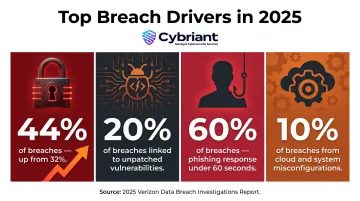
According to the 2025 Verizon Data Breach Investigations Report:
- Ransomware: Present in 44% of all breaches, up from 32% the previous year
- Vulnerability exploitation: Now present in 20% of breaches, overtaking phishing as an initial access vector
- The human element: Involved in approximately 60% of breaches, with median phishing response time under 60 seconds
- Misconfigurations: Account for roughly 10% of breaches
Vulnerability identification methods:
- Automated scanning tools: Continuous vulnerability scanners (Cybriant leverages Tenable for vulnerability discovery and risk prioritization)
- Configuration audits: Identify misconfigured access controls, weak credentials, and insecure settings
- Threat intelligence sources: Consult authoritative databases like CISA's Known Exploited Vulnerabilities Catalog, MITRE ATT&CK, and the National Vulnerability Database
Organizations currently take around 55 days to remediate 50% of critical vulnerabilities after patches become available. That gap is exactly what attackers exploit. Prioritize vulnerabilities listed in CISA's KEV catalog first - these are confirmed to be actively exploited in the wild.
Step 4 - Analyze Likelihood and Business Impact
Evaluate each risk scenario along two dimensions: likelihood of exploitation and potential business impact. Both qualitative and quantitative methods have value depending on organizational maturity.
Qualitative and semi-quantitative approaches:
NIST SP 800-30 provides standard scales (Very Low to Very High, or 0–10 numeric) for rating likelihood and impact. Many organizations use qualitative 5×5 risk matrices for speed and stakeholder accessibility. The tradeoff: researchers warn of "range compression," where quantitatively different risks end up with the same rating.
Quantitative approaches:
- Annualized Loss Expectancy (ALE): Calculates expected annual financial loss for each risk scenario
- Factor Analysis of Information Risk (FAIR): Expresses risk in monetary terms by defining risk as "the probable frequency and probable magnitude of future loss"
Quantitative methods produce defensible, financial-based risk data - valuable for board reporting and cyber insurance conversations. The challenge is that most organizations lack sufficient historical data to perform accurate quantitative analysis initially.
For most organizations, the right move is to start with qualitative assessments, then layer in quantitative analysis as your program matures and historical data accumulates.
Step 5 - Prioritize Risks and Assign Ownership
Build a risk register that assigns each finding a priority level, a business owner, and a target remediation timeline. Understand the difference between inherent risk (before controls) and residual risk (after current controls are applied).
Prioritization principles:
- Business impact drives priority, not just technical severity scores alone
- Incorporate asset criticality, threat intelligence, and exploitability data
- Consider regulatory obligations and potential compliance penalties
- Factor in operational risk and reputational impact
With priorities set, document each risk in your register with the following fields:
- Risk description and affected assets
- Likelihood and impact ratings
- Current controls in place (if any)
- Residual risk level
- Assigned business owner (not just IT - the business unit that would be impacted)
- Target remediation date
- Remediation status
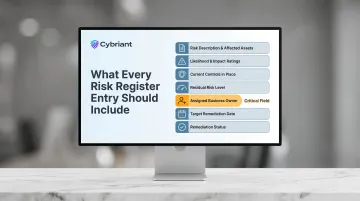
Cybriant's approach emphasizes that remediation decisions must align with operational risk, regulatory obligations, and potential financial or reputational impact - not just CVE scores and patch counts.
Step 6 - Implement Controls and Document Findings
Translate risk findings into specific, actionable security controls - both technical (firewalls, encryption, access controls) and administrative (policies, training, procedures).
Documentation requirements:
- Full assessment methodology and scope
- Complete asset inventory with classifications
- Identified threats and vulnerabilities
- Risk analysis results and prioritization rationale
- Recommended controls mapped to each risk
- Implementation timeline and ownership assignments
- Executive summary in business terms (financial loss, operational disruption, compliance exposure)
The executive summary determines whether anything actually gets done. Present top risks in terms of dollar loss, days of downtime, regulatory penalties, and customer impact - not raw vulnerability counts. Leadership acts on business consequences, not technical detail.
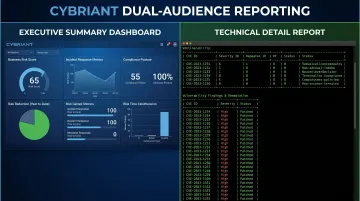
Cybriant's delivery approach includes both executive and technical reporting, providing clear insight into risk posture, remediation progress, and compliance readiness for different stakeholder audiences.
Key Cybersecurity Risk Assessment Frameworks Businesses Should Know
Aligning with established frameworks ensures comprehensive coverage and provides audit defensibility.
| Framework | Version | Best For |
|---|---|---|
| NIST SP 800-30 | Rev. 1 (2012) | Foundational risk assessment methodology with detailed scales and process guidance |
| NIST CSF | 2.0 (Feb 2024) | Organizing security outcomes across six functions: Govern, Identify, Protect, Detect, Respond, Recover |
| ISO/IEC 27001 | 2022 | International ISMS standard; required for formal certification or global operations |
| ISO/IEC 27005 | 2022 | Risk management guidance supporting ISO 27001 implementation |
| FAIR | v3.0 (2025) | Quantitative financial risk modeling for board reporting and insurance conversations |
| CIS Controls | v8 (2021) | Prioritized baseline of 18 practices; excellent SMB starting point that maps to NIST |
NIST SP 800-30 and NIST CSF
NIST SP 800-30 is a dedicated Guide for Conducting Risk Assessments that provides the foundational methodology, risk models, and assessment scales most U.S. organizations reference. The broader NIST Cybersecurity Framework 2.0 organizes cybersecurity activities into six Core Functions (Govern was added in version 2.0), making it flexible for businesses of any size.
Cybriant recommends NIST CSF as the go-to starting framework for most clients. Their CybriantXDR platform maps directly to NIST CSF's technical controls, automating coverage across scanning, monitoring, configuration auditing, and risk assessment.
ISO/IEC 27001 and ISO/IEC 27005
ISO 27001 specifies requirements for establishing, implementing, maintaining, and continually improving an Information Security Management System (ISMS). ISO 27005 provides specific risk assessment guidance to support ISO 27001 implementation. These standards are well-suited for organizations seeking formal certification or operating in global markets with international compliance expectations.
FAIR (Factor Analysis of Information Risk)
FAIR is a quantitative framework that expresses risk in financial terms - potential monetary loss. This makes it particularly valuable for board-level reporting and cyber insurance conversations where decision-makers need dollar-denominated risk data. FAIR requires more data maturity to implement than most qualitative frameworks, but the tradeoff is risk output that finance leaders and insurers can act on directly.
CIS Controls
The 18 CIS Critical Security Controls offer a prioritized, practical baseline especially useful for SMBs. They map directly to NIST CSF, making them an excellent starting point before adopting a more comprehensive framework. CIS Controls are organized into three Implementation Groups (IGs), so teams can start with IG1 - the essentials - and expand as their security program matures.
Cybersecurity Risk Assessment Best Practices
Involve Cross-Functional Stakeholders from the Start
Risk assessments fail when they're siloed in IT. Business unit leaders, legal, finance, and operations must participate to validate which assets are truly critical, confirm acceptable risk thresholds, and approve remediation plans.
Why this matters:
- IT may identify a system as high-risk, but only the business owner knows if downtime would halt operations or just cause minor inconvenience
- Legal understands regulatory exposure and contractual obligations that IT may not track
- Finance can translate technical risks into budget priorities and justify security investments
Cybriant's NIST-guided assessments include structured interviews with cross-functional stakeholders, ensuring findings reflect actual business impact rather than purely technical exposure.
Tier Assets by Business Criticality Before Assessing
Not all assets deserve equal assessment depth. Identify your "crown jewel" assets - systems and data whose compromise would cause disproportionate damage - and prioritize assessment resources accordingly.
This prevents wasted effort on low-value systems while high-impact targets go underexamined. A printer may have vulnerabilities, but a customer database breach could end the business. Allocate your assessment time based on this reality.
Combine Qualitative and Quantitative Methods for a Complete Picture
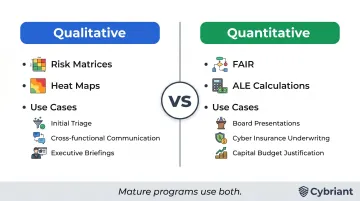
Qualitative assessments (risk matrices, heat maps) are faster and more accessible for stakeholder communication. Quantitative methods (FAIR, ALE calculations) provide defensible, financial risk data useful for budget justification and insurance underwriting.
Mature programs use both: qualitative for initial triage and stakeholder communication, quantitative for high-priority risks requiring board-level attention or insurance coverage decisions.
When to use each:
- Qualitative (risk matrices, heat maps): Initial triage, cross-functional communication, executive briefings
- Quantitative (FAIR, ALE): Board presentations, cyber insurance underwriting, capital budget justification
Make Continuous Monitoring a Standard, Not an Afterthought
Point-in-time assessments go stale quickly as cloud configurations shift, new vendors are onboarded, and threat actors adapt. NIST SP 800-137 emphasizes that initial authorizations are based on evidence available at one point in time, but systems, threats, and vulnerabilities constantly change.
NIST CSF 2.0 places Continuous Monitoring within the Detect function, requiring that assets, networks, and physical environments be monitored to find potentially adverse events.
Continuous monitoring components:
- Vulnerability scanning that surfaces new exposures as they emerge
- Configuration monitoring for controls that shift frequently (cloud, remote access, identity)
- 24/7 SIEM-based event monitoring to catch active threats before they escalate
Cybriant's 24/7 Managed SIEM provides this continuous visibility layer - security analysts review alerts in real time, identify behavioral deviations, and respond before threats escalate. Combined with Tenable-powered vulnerability scanning, this keeps risk assessments accurate between formal annual cycles.
Translate Findings into Business Language for Leadership
The most technically thorough assessment fails if leadership can't act on it. Risk findings should be expressed in terms of potential financial loss, operational disruption, and compliance exposure - not just CVE scores and patch counts.
Executive risk summary components:
- Top 5-10 risks ranked by business impact
- Potential financial loss range for each risk
- Estimated downtime or operational disruption
- Regulatory penalty exposure
- Recommended controls with cost and timeline
- Residual risk after proposed controls are implemented
Cybriant's reporting framework addresses the questions security leaders must answer for executives: "Where are we exposed?", "Where should we prioritize based on risk?", and "How are we reducing exposure over time?" That structured output gives senior management the context to make informed security investment decisions.
Common Mistakes to Avoid - and How Often Businesses Should Reassess
Three Critical Assessment Pitfalls
Scope imbalance - either too broad or too narrow - is a consistent starting-point failure. Broad scopes produce shallow coverage that misses critical detail; narrow scopes exclude systems that matter. Tier your assets and concentrate assessment effort on crown jewels.
Treating assessment as a one-time compliance checkbox is the most damaging mistake. Based on Cybriant's client experience, most companies pay for third-party audits, then do nothing to resolve what's found. A high percentage of organizations fail to close documented gaps. Attackers actively exploit this pattern.
Burying findings in technical reports ensures nothing changes. Without executive-facing summaries in plain business terms, security improvements stay unfunded and vulnerabilities persist.
Reassessment Frequency Best Practices
Conduct a full risk assessment annually at minimum. However, PCI DSS v4.0 Requirement 12.3.1 and NIST SP 800-30 both recommend trigger-based reassessments following significant changes.
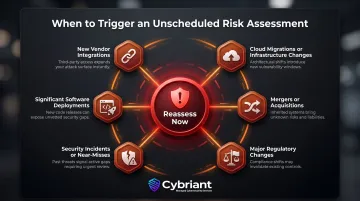
Trigger reassessment after:
- New vendor integrations or third-party connections
- Cloud migrations or infrastructure changes
- Significant software deployments or architecture updates
- Mergers, acquisitions, or organizational restructuring
- Security incidents or near-miss events
- Major regulatory changes affecting your industry
ISACA research indicates that only 8% of organizations conduct cyber risk assessments monthly, while 40% conduct them annually. Given the pace of change in modern IT environments, annual assessments combined with continuous monitoring represent the baseline requirement.
The SMB Resource Challenge
Maintaining that baseline is harder than it sounds. As businesses expand their digital footprint, the attack surface grows - but security team sizes rarely keep pace. Close to zero percent of small businesses have a dedicated CISO, and 56% of organizations report difficulties retaining qualified cybersecurity professionals.
For resource-constrained SMBs, partnering with a managed security provider is a practical way to maintain continuous assessment and monitoring without building a large in-house team. Cybriant's CybriantXDR solution was built for midsize organizations navigating daily cyber threats, compliance requirements, and staffing gaps - delivering 24/7 security professionals and managed detection in a single service.
Frequently Asked Questions
What is a cybersecurity risk assessment?
A cybersecurity risk assessment is a structured process to identify, evaluate, and prioritize threats and vulnerabilities to an organization's digital assets. The output informs security investment decisions so teams can direct resources toward the threats most likely to cause real damage.
What are the steps of a cybersecurity risk assessment?
The core steps are: define scope and objectives, identify and prioritize assets, identify threats and vulnerabilities, analyze likelihood and business impact, prioritize risks and assign ownership, and implement controls with full documentation.
What is the NIST SP 800-30 risk assessment?
NIST SP 800-30 is a risk assessment guide published by the National Institute of Standards and Technology that provides a structured process for identifying, assessing, and responding to information security risks. Federal agencies are required to follow it, and many private-sector organizations adopt it as a baseline because it offers concrete risk models, scoring scales, and documentation templates.
What is the main purpose of a cybersecurity risk assessment?
The main purpose is to give organizations a clear, prioritized view of their cybersecurity exposures so they can allocate resources effectively, reduce the likelihood of damaging incidents, and meet compliance obligations.
What are the 4 types of risk assessment?
The four common types are: qualitative (using descriptive scales like high/medium/low), quantitative (assigning numerical or financial values), semi-quantitative (hybrid approaches that assign numerical scores mapped to qualitative categories), and asset-based or threat-based (organized around specific assets being protected or specific threat actors being defended against).
What is the 5-point risk assessment matrix?
The 5-point risk matrix is a semi-quantitative tool that rates both the likelihood and impact of each risk on a 1-5 scale, then multiplies or combines these scores to produce an overall risk rating. This creates a heat map that helps teams prioritize which risks require immediate action versus monitoring or acceptance.