Introduction
The numbers are hard to ignore. Check Point's Cyber Security Report 2026 documents an 18% year-over-year increase in global cyberattacks and a 48% surge in ransomware incidents. IBM's 2024 Cost of a Data Breach Report puts the average breach cost at USD 4.88 million globally - and USD 9.36 million for US organizations. No company, regardless of size or sector, sits outside that risk.
Most executives understand the need for stronger security. The challenge is execution. Building an in-house security operation demands specialized talent, constant tool investment, and 24/7 coverage - none of which most IT teams can sustain alone.
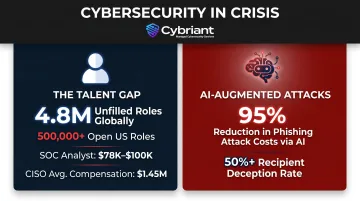
The talent problem compounds this further. With 4.8 million unfilled cybersecurity positions globally and over 500,000 open roles in the US alone, hiring your way to security maturity isn't a realistic path for most organizations.
This article explains how managed security services deliver measurable operational impact: faster threat detection, access to scarce expertise, significant cost savings, and built-in compliance support. For businesses navigating today's threat environment, they've become less of an option and more of a structural necessity.
What Are Managed Security Services?
Managed security services (MSS) represent a model where businesses outsource cybersecurity monitoring, threat detection, incident response, and risk management to external specialists. This gives organizations immediate access to dedicated security teams who operate around the clock, backed by advanced tools and deep expertise.
MSS applies across the entire security surface: protecting networks, endpoints, cloud environments, and data. Organizations in healthcare, finance, manufacturing, and retail now rely on managed security to defend against threats that internal teams cannot address alone.
An MSSP differs from a general Managed Service Provider (MSP) in one fundamental way: focus. Key distinctions include:
- MSSPs operate dedicated Security Operations Centers (SOCs) staffed 24/7/365 with certified security professionals
- MSPs handle broader IT infrastructure - helpdesk, networking, backups - where security is one component among many
- MSSPs like Cybriant deliver SOC 2 Type 2-certified services through specialists who do nothing but security
That singular focus matters when threats move fast and response time determines the outcome.
The result is a security posture that keeps pace with the threat landscape and scales alongside the business - without requiring organizations to hire, train, or retain an internal security team.
Key Benefits of Managed Security Services for Modern Businesses
Managed security services address the outcomes businesses actually measure: cost efficiency, risk reduction, operational continuity, and compliance readiness. Each benefit reinforces the others - and together, they produce a security posture that internal teams rarely have the resources to replicate on their own.
Benefit 1: 24/7 Continuous Threat Monitoring and Rapid Incident Response
Cyberattacks don't respect business hours. Adversaries actively target off-hours when defenses are thinnest, which makes around-the-clock monitoring a baseline requirement. An MSSP operates a Security Operations Center that monitors networks, endpoints, and cloud environments 24/7/365 - coverage that most internal IT teams cannot sustain given competing responsibilities and fixed schedules.
MSSPs deliver this through automated platforms like SIEM (Security Information and Event Management), XDR (Extended Detection and Response), and SOAR (Security Orchestration, Automation, and Response). These tools filter false positives, correlate threat data across environments, and surface real threats for analyst review. Cybriant's 24/7 Managed SIEM with live monitoring demonstrates how continuous coverage works in practice: security professionals review logs and alerts in real time, assess their nature, and initiate remediation when threats emerge.
Why this matters:
The average SOC analyst is drowning in alerts. Organizations face 960 security alerts daily, with enterprises exceeding 20,000 employees seeing more than 3,000 alerts per day. The consequence is severe: 40% of alerts are never investigated, and 61% of security teams have admitted to ignoring alerts that later proved critical. This alert fatigue creates blind spots that attackers exploit.
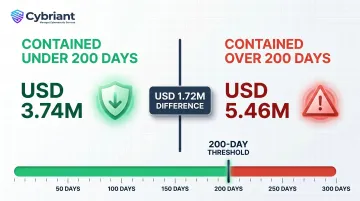
Speed of response directly determines breach cost. IBM found that breaches contained in under 200 days cost USD 3.74 million, while those exceeding 200 days cost USD 5.46 million - a difference of USD 1.72 million. Faster containment shrinks the window attackers have to move laterally, exfiltrate data, or deploy ransomware, reducing both direct costs and long-term reputational damage.
KPIs impacted:
- Mean time to detect (MTTD)
- Mean time to respond (MTTR)
- Number of unresolved alerts
- Cost per incident
- System downtime
When this benefit matters most:
Organizations with small or overloaded IT teams, businesses operating outside regular hours (e-commerce, healthcare, financial services), and companies that have recently experienced a breach or near-miss gain the most immediate value from 24/7 monitoring.
Benefit 2: Immediate Access to Specialized Expertise and Advanced Security Technology
Partnering with an MSSP gives businesses instant access to certified cybersecurity professionals and enterprise-grade security tools - without the time, expense, and risk of building those capabilities from scratch.
MSSPs maintain teams that work across multiple clients and industries, developing deep expertise in threat trends, compliance frameworks, and attack methodologies. They absorb the cost of AI-driven detection platforms, threat intelligence feeds, and vulnerability management systems - then pass that value to clients at a fraction of the standalone cost.
Cybriant's use of Google SecOps, SentinelOne, and AI-augmented detection platforms reflects how MSSPs build technology stacks that individual organizations typically cannot justify acquiring on their own.
Why this is critical:
The cybersecurity talent gap shows no sign of closing. ISC2's 2024 study found 4.8 million unfilled cybersecurity positions globally, with over 500,000 open roles in the US alone. Recruiting and retaining qualified professionals is prohibitively expensive: SOC analysts command USD 78,000–100,000 annually, while CISOs average USD 1.45 million in total compensation.
The stakes are higher for organizations facing talent gaps. IBM's 2024 report found that 53% of organizations deal with high-level security skills shortages, and those organizations pay USD 1.76 million more per breach than adequately staffed peers. Skills shortages directly amplify breach costs.
Attackers are also scaling faster than defenders. Harvard researchers found that AI-automated phishing reduces attack costs by approximately 95% while maintaining effectiveness. Adversaries now use LLMs to generate convincing phishing emails that fool over 50% of recipients - volume and sophistication that individual security teams cannot match. MSSPs provide access to the same AI-driven defensive tools, with no procurement, integration, or training overhead required.
KPIs impacted:
- Vulnerability remediation rate
- Number of unpatched systems
- Time to deploy new security controls
- Staff-to-threat ratio
- Training costs avoided
When this benefit matters most:
Small and mid-market businesses that cannot compete for top security talent, organizations undergoing digital transformation or cloud migration, and any business facing sophisticated, AI-augmented threats gain the most from MSSP expertise.
Benefit 3: Cost Efficiency and Built-In Compliance Assurance
MSSPs replace the high fixed cost of building an in-house SOC with a predictable, scalable service model. They deliver enterprise-grade protection at lower per-client cost by spreading infrastructure, tooling, and staffing expenses across multiple clients.
On compliance, MSSPs bring working knowledge of frameworks like NIST, SOC 2, HIPAA, and PCI DSS, maintaining audit-ready documentation, flagging control gaps, and guiding remediation. Cybriant's compliance services cover readiness assessments, gap analysis, continuous monitoring, and audit preparation across CMMC, HIPAA, PCI DSS, and ISO 27001.
Why this matters financially:
Industry estimates place in-house SOC costs at USD 1.5–2 million annually before accounting for tooling, training, and turnover. MSSP services operate on subscription models at a fraction of that cost, making enterprise-grade security financially viable for mid-market firms.
Security budgets are under pressure. IANS Research found that security spending as a percentage of IT budgets rose from 8.6% in 2020 to 13.2% in 2024, but growth slowed to just 2 percentage points in 2024, and 12% of CISOs faced budget cuts. Organizations need to accomplish more with constrained resources - MSSPs make that possible.
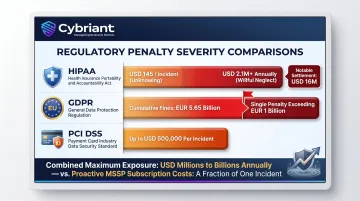
Compliance risk carries severe financial consequences. HIPAA violations range from USD 145 per incident for unknowing violations to over USD 2.1 million annually for willful neglect, with recent settlements exceeding USD 16 million. GDPR fines have reached EUR 5.65 billion cumulatively, with single penalties exceeding EUR 1 billion. PCI DSS non-compliance can trigger fines up to USD 500,000 per incident. These penalties far exceed the investment in managed security services.
KPIs impacted:
- Total security spend
- Cost per security FTE avoided
- Compliance audit pass rate
- Time to remediate compliance gaps
- Number of regulatory findings
When this benefit matters most:
Businesses operating under HIPAA, PCI DSS, GDPR, or similar frameworks, organizations with limited IT budgets, and companies evaluating the build-versus-buy decision for security operations gain the greatest financial and compliance value from MSSPs.
What Happens When Managed Security Is Missing or Ignored
Attempting to manage security with an understaffed, under-resourced internal team produces predictable operational consequences: alert overload leads to missed threats, slow response times allow attackers to dwell undetected, and the lack of proactive monitoring turns security into reactive firefighting.
The financial exposure is severe. The US average breach cost now stands at USD 9.36 million, the highest globally. Breach costs compound for organizations without mature detection capabilities - those with severe staffing shortages pay USD 1.76 million more, and slow containment adds another USD 1.72 million. These cost amplifiers stack, meaning an understaffed organization with slow detection could face both penalties simultaneously.
The damage doesn't stop at direct costs. IBM found that 70% of breached organizations experienced significant operational disruption - and that's before accounting for:
- Regulatory investigations and fines
- Customer churn and lost contracts
- Reputational harm that outlasts the incident itself
The scaling problem intensifies as businesses grow. Adding cloud infrastructure, onboarding remote workers, and entering regulated industries expands the attack surface - but internal teams rarely scale at the same rate. Connected IoT devices alone are growing 14% year-over-year to reach 21.1 billion globally in 2025, with projections exceeding 39 billion by 2030. Each new endpoint represents potential exposure.
Without managed security services, that widening gap doesn't stay unnoticed. Attackers now use AI and automation to scan for exposed organizations at scale - and understaffed teams are precisely the targets they find first.
How to Get Maximum Value from Your MSSP Partnership
Managed security services deliver compounding value when treated as a strategic partnership rather than a vendor transaction. Businesses that share context about their environment, risk tolerance, and priorities allow their MSSP to tailor coverage and focus on the threats that matter most to their specific operations.
That tailored coverage only pays off when insights lead to action. Set a regular review cadence - monthly or quarterly - and use those sessions to go through:
- Threat reports and trending attack patterns in your environment
- Vulnerability scan results and remediation progress
- Incident summaries with lessons learned
Each meeting should close with concrete next steps, not just documentation.
The MSSP relationship should evolve with your business. As new systems come online, regulations shift, or the threat landscape changes, revisit your service scope accordingly.
Cybriant is built for exactly this kind of growth - engagements can start narrowly scoped for a specific project or expand to cover the full security environment, with models ranging from short-term advisory work to long-term strategic partnerships.
Conclusion
Managed security services deliver value through three compounding advantages that reinforce each other over time:
- Continuous coverage that internal teams cannot sustain around the clock
- Specialized expertise and technology that most in-house budgets cannot support independently
- Cost structures that make enterprise-grade security financially viable for businesses of all sizes
Each advantage strengthens the others in measurable ways:
- Faster threat detection cuts average breach costs by $1.72 million
- Consistent compliance reduces regulatory exposure and avoids penalties that can exceed $2 million annually
- Ongoing expert guidance builds security maturity year over year, so defenses grow stronger as threats grow more sophisticated
For businesses looking to strengthen their security posture without the overhead of building an in-house SOC, Cybriant delivers SOC 2 Type 2-certified managed security services - including 24/7 Managed SIEM, real-time vulnerability scanning with patch management, and comprehensive compliance support across HIPAA, PCI DSS, CMMC, and other frameworks. A dedicated team of security professionals operates around the clock, giving organizations of all sizes access to protection that scales with their risk environment. Reach out to explore how Cybriant's customizable services can be tailored to your specific risk environment.
Frequently Asked Questions
What is a managed security service provider in cybersecurity?
An MSSP is a third-party organization that takes over cybersecurity monitoring, threat detection, and incident response for businesses. MSSPs operate dedicated Security Operations Centers staffed with specialized teams and advanced tools, so companies don't need to build those capabilities in-house.
Is MSSP worth it?
MSSPs are typically worth the investment when you consider that a single US data breach averages $9.36 million, while managed services operate on predictable subscription models at a fraction of in-house SOC costs ($1.5–2 million annually). For businesses without mature in-house security teams, MSSPs often provide higher protection at lower total cost.
What are the benefits of managed security services?
The top benefits include:
- 24/7 threat monitoring and rapid incident response
- Immediate access to expert talent and enterprise-grade tools
- Significant cost savings over building in-house security
- Built-in compliance support across HIPAA, PCI DSS, SOC 2, and other frameworks
What is the purpose of continuous monitoring for security?
Continuous monitoring detects threats the moment they emerge, reducing the time attackers have to move undetected inside a network. IBM data shows that breaches contained in under 200 days cost $1.72 million less than those exceeding 200 days, making continuous monitoring essential for cost containment.
What are the benefits of conducting regular cybersecurity audits?
Regular audits identify unpatched vulnerabilities, configuration gaps, and compliance exposures before attackers exploit them. MSSPs typically include vulnerability scanning and audit support as part of their service scope, providing ongoing visibility into risk posture and remediation progress.
What are the benefits of using an MSSP over building an in-house security team?
MSSPs provide immediate access to certified professionals and advanced tools with no recruitment or training overhead, 24/7 coverage that internal teams struggle to maintain, and a predictable cost model. Replicating these advantages in-house takes years and significant capital investment.