Introduction
Cybriant's SIEM as a Service gives you enterprise-grade security monitoring - 24/7 log aggregation, correlation, and live analyst response - without buying, building, or staffing a SIEM platform yourself. For most small and mid-sized teams, that is the fastest path from alert overload to real threat detection.
Modern businesses face an unrelenting security challenge: attack surfaces expand as cloud environments proliferate, yet small security teams remain stretched thin managing infrastructure instead of detecting threats. Organizations face an average of 2,992 alerts per day, with 63% going unaddressed, while 67% report cybersecurity staffing shortages. This creates a painful trade-off: comprehensive security monitoring is no longer optional, but traditional approaches force businesses to choose between coverage and cost.
SIEM as a Service (SIEMaaS) resolves this tension by shifting infrastructure management to a specialized provider, so in-house teams can focus on detecting and responding to real threats. This article covers how SIEMaaS works, how it compares to on-premises SIEM, and what to look for when choosing a provider.
Overview
- Replaces on-premises hardware with a cloud-based subscription covering log collection, correlation, alerting, and reporting
- Fills the gap for SMBs without dedicated staff to manage SIEM infrastructure in-house
- Cuts operational overhead, scales on demand, deploys faster, and updates threat intelligence automatically
- Choose providers with 24/7 analyst monitoring, SOC 2 Type 2 certification, and transparent detection methods
What Is SIEM as a Service?
Security Information and Event Management (SIEM) aggregates, analyzes, and correlates security event data from across an organization's IT environment - endpoints, network devices, cloud platforms, and applications - to surface potential threats and support incident response.
Traditional SIEM deployments required significant hardware investment, dedicated maintenance staff, and ongoing configuration. SIEM as a Service delivers the same capabilities through a cloud-based model managed by the provider, converting capital expenditure into a predictable subscription.
That shift matters - but so does how the service is delivered. Not all SIEM-as-a-Service offerings are the same. With SaaS SIEM, organizations get a cloud-hosted platform but still manage configuration, tuning, and monitoring themselves. With managed SIEM (often delivered by MSSPs), the provider supplies the technology plus security expertise, 24/7 monitoring, and incident triage. Cybriant's 24/7 Managed SIEM falls into this second category, pairing technology with expert human oversight to filter false positives and identify the right response path.
How SIEM as a Service Works
SIEMaaS operates through a four-stage pipeline:
- Data Collection – The platform pulls logs and events from firewalls, endpoints, cloud services, identity providers, and applications
- Normalization – Different log formats are standardized into a consistent schema so data from multiple sources can be compared
- Correlation – Rules and behavioral analytics cross-reference events across sources to detect multi-stage threat patterns
- Alerting and Response – Correlated threats generate prioritized alerts for analyst review or automated response actions
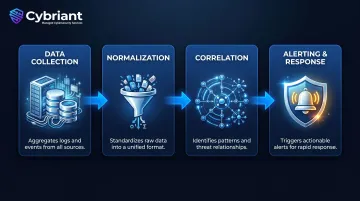
In a managed SIEMaaS model, the provider handles the infrastructure powering all four stages. Security analysts - whether in-house or provider-side - focus on what matters: tuning detection rules, investigating alerts, and making response decisions. Platform maintenance stays off their plate entirely.
Key Benefits of SIEM as a Service for Modern Businesses
Cost Efficiency
SIEMaaS converts expensive capital expenditure - hardware, licensing, dedicated infrastructure staff - into a predictable operating expense subscription. Organizations avoid upfront hardware procurement, reduce staffing costs for platform management, and pay only for capacity consumed. A Forrester Total Economic Impact study on Microsoft Sentinel reported a 44% TCO reduction versus legacy on-premises SIEM. For SMBs that cannot justify full SIEM infrastructure investment, this shift is particularly significant.
Elastic Scalability as You Grow
Cloud-based SIEM scales elastically as log volumes grow. Adding new data sources, cloud environments, or business units doesn't require hardware procurement cycles or platform rearchitecting. This matters in modern IT environments where SaaS adoption, remote work, and multi-cloud infrastructure continuously expand an organization's data footprint.
70% of organizations now use hybrid cloud, with an average of 2.4 public clouds per organization. That ingestion complexity is exactly where elastic platforms earn their keep.
Faster Deployment and Time to Value
SIEMaaS deploys in days to weeks because the provider manages core infrastructure. On-premises SIEM typically requires months of hardware provisioning, software configuration, and staff training. Faster deployment means threat coverage begins sooner - critical when organizations face compliance pressure or have recently experienced a security incident. Cloud SIEM reduces 6-12 months of effort to weeks for onboarding.
Compliance Support
Regulated industries must satisfy requirements under frameworks like HIPAA, PCI-DSS, and SOC 2 - each mandating security monitoring, log retention, and audit reporting. SIEMaaS providers typically include built-in compliance reporting templates that simplify audit preparation and reduce the risk of penalties.
Key mandates SIEMaaS helps address:
- PCI DSS v4.0.1 requires automated audit log reviews at least once daily and log retention for 12 months
- HIPAA requires audit controls and documented access logging for covered entities
- SOC 2 requires continuous monitoring and evidence of security controls
Cybriant's SOC 2 Type 2 certification means the provider itself operates under the same standards it helps clients meet.
Continuous Expertise and Threat Intelligence
SIEMaaS providers handle platform maintenance - patching, parser updates, detection content - and integrate global threat intelligence feeds so the SIEM recognizes emerging attack vectors without manual intervention. For SMBs without a dedicated threat intelligence team, this means current, operationally relevant detection coverage without the overhead of building it in-house.
SIEM as a Service vs. On-Premises SIEM: Which Is Right for You?
The on-premises model offers full control over data residency and deep customization, but organizations bear the full burden of infrastructure procurement, software licensing, patching, and staffing. For small-to-mid-sized teams, that maintenance overhead often consumes capacity that should be spent on detection and response.
That strain shows up in the data: 69% of SOCs still rely on manual or mostly manual processes to report metrics - a sign that platform upkeep is crowding out actual security work.
On-premises SIEM may still make sense for organizations with strict data sovereignty requirements, air-gapped environments, or very large enterprises with dedicated SIEM engineering teams. For most SMBs and growing enterprises without these constraints, the case for SIEMaaS is clear: faster deployment, lower overhead, and on-demand scaling without proportional cost increases.
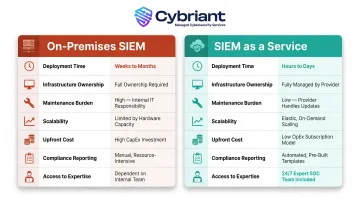
How the two models compare at a glance:
| Factor | On-Premises SIEM | SIEM as a Service / Managed SIEM |
|---|---|---|
| Deployment Time | 6-12 months | Days to weeks |
| Infrastructure Ownership | Customer owns and maintains | Provider manages |
| Maintenance Burden | Full in-house responsibility | Provider handles platform maintenance |
| Scalability | Requires hardware procurement | Elastic, on-demand scaling |
| Upfront Cost | High CapEx (hardware, licensing) | Predictable OpEx subscription |
| Compliance Reporting | Custom configuration required | Built-in templates |
| Access to Expertise | Hire and train staff | Included 24/7 analyst coverage |
Core Features to Look for in a SIEMaaS Solution
Real-Time Threat Detection and Alert Quality
Detection capability and alert accuracy are the most consequential factors - not just whether the platform detects threats, but how it reduces false positives. An independent Omdia study found 42% of alerts go uninvestigated and 46% are false positives. Alert fatigue from a poorly tuned system buries analysts in noise and causes real threats to be missed. Look for platforms with:
- Correlation-based detection
- Behavioral analytics and UEBA capabilities
- Configurable thresholds
- Documented tuning processes
Ask vendors how alert tuning is managed and what false positive rates look like in practice.
Centralized Log Management and Broad Source Coverage
The platform must ingest data from all relevant sources in your environment. Weak coverage creates blind spots that attackers exploit. At minimum, look for native support across:
- Cloud platforms (AWS, Azure, GCP)
- SaaS applications
- Network devices and firewalls
- Endpoints and servers
- Identity providers
Ask vendors for a complete connector list and how they handle non-standard source integrations.
Incident Response Capabilities and Workflow Integration
Detection without response is incomplete. The platform must support or automate the full response workflow:
- Automated alert triage and prioritization
- Integration with ticketing systems
- Playbook-driven response actions (isolating compromised endpoints, blocking malicious IPs)
- Clear escalation paths
For managed SIEM specifically, verify the provider's SLA for alert response and how incidents are handed off to the customer.
Compliance Reporting and Data Retention
The solution should include out-of-the-box report templates for common frameworks - HIPAA, PCI-DSS, SOC 2, and GDPR - along with configurable log retention periods that meet regulatory requirements.
Pay close attention to what retention is included in the base subscription versus what costs extra. For compliance-driven organizations, this distinction directly affects total cost of ownership.
How to Choose the Right SIEM as a Service Provider
Define Clear Requirements Before Evaluating Vendors
Start by establishing measurable objectives. Before speaking to any vendor, get specific about:
- Which threats you need to detect and which compliance frameworks apply
- Your log volume, data source count, and integration requirements
- Your budget ceiling and any hard contract constraints
A concrete objective like "achieve full cloud workload coverage and generate monthly PCI-DSS audit reports" gives you something to score vendors against objectively. Build these criteria into a structured scorecard and use it consistently across every evaluation.
Validate Provider Credentials and Operational Reality
Go beyond marketing claims:
- Request SOC 2 Type 2 reports (verify they are less than one year old)
- Ask about uptime SLAs
- Confirm 24/7 monitoring is staffed by human analysts, not just automated alerting
- Check third-party recognition such as industry analyst placements or MSSP-specific rankings
For example, Cybriant holds SOC 2 Type 2 certification and has earned placement on MSSP Alert's Top 250 MSSPs list for multiple consecutive years - the kind of third-party validation that confirms operational maturity rather than just marketing claims.

Run a Hands-On Proof of Concept with Real Data
Avoid selecting a vendor based solely on demos. Test with a representative subset of your actual log data, evaluate onboarding time for your specific data sources, and verify that alert quality matches vendor claims. Ask directly:
- "What happens when we exceed our data limit?"
- "If we need to migrate off your platform in two years, what does offboarding look like?"
Providers that answer these questions clearly - without deflecting or offering vague assurances - give you a reliable signal of how they'll behave when something actually goes wrong.
Frequently Asked Questions
What is replacing SIEM?
While SIEM is not being wholesale replaced, it is evolving. Extended detection and response (XDR) platforms address endpoint and cross-domain visibility gaps, and AI-augmented SIEM is incorporating automation to reduce manual workloads. For most organizations, managed SIEM or SIEMaaS remains the foundational security monitoring layer, often used alongside XDR rather than replaced by it.
What are three ways of implementing a SIEM?
Three primary deployment models exist:
- On-premises SIEM: the organization owns and manages all hardware and software
- Cloud-hosted / SaaS SIEM: the platform runs in the cloud, but the organization still manages configuration and monitoring
- Managed SIEM / SIEMaaS: a third-party provider manages the platform, monitoring, and incident response on the organization's behalf
What are the three main components of SIEM?
The three core components are:
- Log management and data collection: aggregating events from all sources into a central platform
- Correlation and analytics: applying rules and behavioral analysis to identify threat patterns
- Alerting and reporting: generating prioritized alerts and producing compliance/audit reports
What is the difference between SIEM and managed SIEM?
A standard SIEM is a technology platform the organization configures, monitors, and maintains itself. Managed SIEM (or SIEM as a Service from an MSSP) layers expert human analysts and 24/7 monitoring on top of the technology, outsourcing both the infrastructure and the day-to-day security operations function.
How long does it take to deploy SIEM as a Service?
SIEMaaS typically deploys significantly faster than on-premises SIEM because the provider manages core infrastructure. Initial deployment ranges from days to a few weeks. The remaining work centers on data source integration, log quality validation, and alert tuning for the organization's specific environment.
Is SIEM as a Service suitable for small businesses?
Yes, SIEMaaS is particularly well-suited to SMBs because it removes the infrastructure and staffing burden that makes traditional SIEM cost-prohibitive at smaller scale. Subscription-based pricing, provider-managed maintenance, and built-in compliance reporting allow smaller organizations to achieve enterprise-grade security monitoring without building an in-house security operations team.