Introduction
Manual penetration testing commonly costs between $10,000 and $50,000+ per engagement, while the average cost of a data breach reached $4.44 million in 2025. Mid-market companies face a brutal economics mismatch: they carry near-enterprise attack surface exposure yet operate on constrained security budgets. The result? Most test only once annually for compliance, leaving months-long vulnerability windows that threat actors exploit. The 2025 Verizon Data Breach Investigations Report found that vulnerability exploitation now appears in 20% of all breaches.
That exploitation gap is exactly where automated penetration testing delivers value - more frequent testing at a fraction of the per-cycle cost. But cost savings depend heavily on the decisions surrounding the program: scope definition, tool selection, testing cadence, and supporting security infrastructure. This article examines each of those dimensions and how mid-market security teams can get them right.
Overview
- Poor scoping, redundant tooling, and underestimated remediation labor quietly inflate automated pen testing costs
- Budget overruns follow two patterns: compliance-deadline spikes and slow-burn tool sprawl - both easy to miss until reviews hit
- Hybrid automated-first models cut per-cycle cost while increasing coverage frequency across critical attack surfaces
- Integrating pen testing into a managed security program removes redundancy and reduces total program spend
How Automated Pen Testing Costs Build Up for Mid-Market Companies
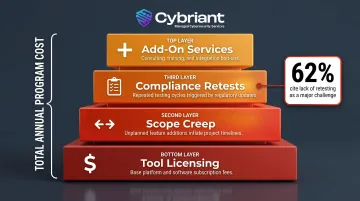
Costs rarely appear as a single line item. They accumulate across multiple spending categories that each seem justified individually but stack up fast over a 12-month cycle:
- Tool licensing - multiple point solutions with overlapping coverage
- Scope creep - engagements that expand beyond original parameters
- Compliance-triggered retests - separate engagements for each audit cycle
- Add-on services - reporting, executive summaries, and remediation guidance billed separately
The cost pattern is typically episodic - triggered by compliance deadlines or security incidents - layered on top of gradual tool sprawl. The 2024 CoreSecurity report found that 62% of respondents cited lack of follow-up or retesting as a major challenge, meaning initial testing investments are often wasted when fixes aren't validated.
The Hidden Remediation Multiplier
Post-test remediation work - triaging findings, prioritizing fixes, validating patches, managing retest cycles - is consistently underestimated and can equal or exceed the test cost itself.
Edgescan's 2024 Vulnerability Statistics Report reveals mean time to remediate a critical web application vulnerability is 35 days, while internet-facing host critical vulnerabilities average 61 days. At that pace, a mid-market team running quarterly tests is essentially carrying open critical findings for most of the year - a cost that never appears in the original testing budget.
Key Cost Drivers for Automated Penetration Testing
Scope Definition: The Primary Cost Driver
Scope definition shapes every expense that follows. Vaguely scoped engagements create two costly outcomes: over-testing (paying for coverage that adds no real risk insight) or under-testing (requiring follow-up engagements that effectively double costs).
NIST SP 800-115 emphasizes that each assessment should be addressed in an assessment plan to provide clear rules and boundaries. Yet the 2024 CoreSecurity report found a 23% increase in respondents needing to broaden scope mid-engagement - most often due to budget constraints forcing an artificially narrow starting point.
Frequency and Methodology Mix
Companies that rely solely on annual manual tests pay high per-engagement rates without the continuous coverage automated tools provide at a fraction of the cost. Conversely, companies deploying automation without strategy often pay for overlapping capabilities across vulnerability scanning, reporting, and network testing. Currently, 43% of organizations test only once or twice per year, and 17% never perform penetration testing at all.
Tool Selection and Licensing Structure
Mid-market companies frequently purchase enterprise-tier platforms they lack expertise to get full value from, or accumulate point solutions that duplicate functions. Gartner's 2025 research reports the average enterprise now operates 45 different cybersecurity tools, leaving organizations paying for redundant tools with overlapping capabilities.
Compliance Alignment Mismatches
Checkbox compliance drives many pen testing programs - and that's a costly mistake. Organizations end up repeatedly testing low-risk surfaces while neglecting the assets most likely to be targeted. PCI DSS v4.0.1 requires internal penetration testing at least once every 12 months and after any significant infrastructure change - yet many organizations run separate, siloed tests purely to satisfy auditors rather than integrating compliance checks into an ongoing risk-based program.
Cost-Reduction Strategies for Automated Penetration Testing
Cost reduction depends on correctly diagnosing where cost originates: whether in how the program was initially designed, how it's managed across testing cycles, or what security infrastructure surrounds it. Applying the wrong intervention to the wrong root cause rarely reduces cost without also reducing security value.
Strategies That Reduce Costs by Changing Decisions
These decisions - made before or during program design - determine the cost structure of automated pen testing.
Scope to Risk Profile, Not Asset Count
Define the testing boundary based on actual business risk: critical systems, public-facing assets, high-privilege access paths, and data stores holding sensitive information. Narrow, well-defined scopes reduce per-engagement cost without reducing security value for the assets that matter most. Testing the entire environment uniformly wastes budget on surfaces that generate no meaningful risk insight.
Establish an Explicit Automated-First, Manual-for-Depth Methodology Split
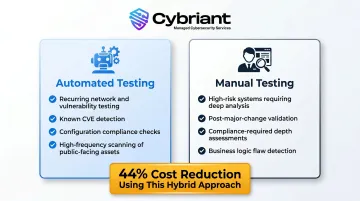
Use automated tools for:
- Recurring network and vulnerability testing (quarterly or continuous)
- Known CVE detection
- Configuration compliance checks
- High-frequency scanning of public-facing assets
Reserve manual testing for:
- High-risk systems requiring deep analysis
- Post-major-change validation
- Compliance-required depth assessments
- Business logic flaw detection
Keeping manual labor out of territory automation already covers is where the savings accumulate. Cobalt reports that a leading accounting firm cut pentesting costs by 44% using this approach.
Select Tools Sized to Internal Capacity
Evaluate platforms against your team's actual ability to act on findings, not against a feature wishlist. Platforms with capabilities exceeding internal bandwidth generate shelfware (paid-for features no one uses). Simpler tools used consistently and fully deliver better ROI than sophisticated platforms used at a fraction of their potential.
Consolidate Compliance Testing Into the Core Program
Architect the annual testing calendar so one well-scoped automated engagement produces audit evidence usable across multiple frameworks - SOC 2, PCI DSS, HIPAA - simultaneously. Separate compliance-driven engagements on top of an existing program become redundant, and so does the budget behind them.
Strategies That Reduce Costs by Changing How Pen Testing Is Managed
These operational and governance decisions shape costs while the automated pen testing program is active.
Establish a Formal Remediation Workflow Before Testing Begins
Without a pre-defined process for triaging, prioritizing, and tracking findings, mid-market teams spend disproportionate time and labor after each test. Those post-test labor costs frequently exceed the test fee itself. A pre-built remediation pipeline converts findings into action faster, reduces rework, and eliminates open-ended follow-up work.
Key workflow elements:
- Severity-based triage criteria defined upfront
- Clear ownership assignment for each finding type
- Documented validation process for confirming fixes
- Pre-agreed retest triggers and scope
Track Testing ROI Across Cycles
Maintain records of vulnerabilities found, severity distribution, time-to-remediate, and recurrence rates across successive testing cycles. This data reveals where the program generates genuine risk reduction and where budget is spent on surfaces that consistently return no meaningful findings, enabling strategic reallocation rather than across-the-board spending increases.
Integrate Automated Testing Into the Change Management Process
Trigger lightweight automated scans after infrastructure changes, major software releases, or cloud configuration updates rather than waiting for the next scheduled cycle. Distributing scans across the year reduces surprise findings in annual reports and often eliminates expensive out-of-cycle engagements entirely.
Define Retest Scope and Conditions in Advance
Retesting becomes an unbudgeted cost if not operationally scoped upfront. Agree before testing begins on which finding severity levels require formal retest, what constitutes verified remediation, and how retest results are documented. Without these guardrails, retesting cycles expand silently and inflate total program spend.
Strategies That Reduce Costs by Changing the Context Around Pen Testing
The surrounding security environment and infrastructure determine what automated pen testing actually costs to run effectively. In many mid-market environments, the context - not the testing tool - is the real cost driver.
Build Continuous Vulnerability Management as the Foundation Before Testing
Automated pen testing delivers the best cost-to-coverage ratio when it operates on top of an active vulnerability scanning and patch management program. Without this foundation, each test re-discovers the same known, unpatched issues, inflating remediation cycles and making per-engagement ROI poor.
A continuous baseline service like Cybriant's vulnerability scanning and patch management reduces what each automated pen test needs to cover from scratch. The service includes continuous asset discovery, real-time vulnerability detection, risk-based prioritization using threat intelligence, and automated patch management across operating systems and third-party applications.
What this prevents:
- Repeated discovery of known vulnerabilities across testing cycles
- Wasted manual analysis of issues that automated scanning should catch
- Extended remediation windows that leave critical exposures open
- Duplicate reporting across vulnerability management and pen testing tools
Use Threat Intelligence to Prioritize Testing Surfaces
Mid-market companies that align pen testing scope with current threat actor tactics relevant to their industry eliminate testing of low-probability attack paths. This concentrates budget where actual risk is highest rather than distributing coverage uniformly across the environment.
CIS Critical Security Control 18 advises organizations to test effectiveness and resiliency through identifying and exploiting weaknesses, but emphasizes testing should focus on areas of highest threat exposure.
Evaluate Managed Security Partnerships That Bundle Pen Testing With Monitoring
MSSPs that include vulnerability management, continuous monitoring, and periodic automated testing within a single service model often deliver lower per-capability cost than assembling the same stack from individual vendors. For mid-market companies without dedicated security staff, this also eliminates the internal labor cost of program coordination, tool management, and finding interpretation.
Research indicates that 90% of respondents plan to outsource security functions to an MSP or MSSP, with BDO noting that customers save about 56% of current spend on average by enlisting MSSP services.
Cybriant's managed security services bundle 24/7 SIEM monitoring, vulnerability management, endpoint detection and response, and penetration testing within a single integrated package. For mid-market teams, that consolidation removes the tool sprawl and coordination overhead that quietly inflate costs when each capability is sourced from a separate vendor.
Cybriant is one such partner: its managed security program bundles automated penetration testing with continuous vulnerability scanning, patch management, and 24/7 monitoring under a single model. Call 844-411-0404 to see how that consolidation lowers cost while improving coverage.
Conclusion
Reducing automated pen testing costs for mid-market companies requires accurately diagnosing whether cost originates in program design, operational management, or the surrounding security infrastructure. Cutting spend without this diagnosis typically reduces security coverage rather than inefficiency.
Shifting from annual manual-only engagements to an automated-first, hybrid model - with manual testing reserved for high-risk systems and compliance depth requirements - delivers the most significant cost reduction while maintaining or improving coverage.
When embedded within a broader managed security program that includes continuous vulnerability scanning, patch management, and monitoring, automated pen testing becomes a strategic layer rather than a redundant point-in-time check.
Cost-effective automated penetration testing is a continuous discipline. As threat landscapes, infrastructure, and compliance requirements change, the decisions, management practices, and contextual investments that determine what the program costs - and what it delivers - must be regularly reassessed rather than treated as fixed.
Cybriant builds automated pen testing into a managed program alongside continuous vulnerability scanning, patch management, and 24/7 monitoring, so testing becomes part of an ongoing security posture rather than a point-in-time expense. Call 844-411-0404 to design a cost-effective testing program for your environment.
Frequently Asked Questions
How much should a penetration test cost?
Automated pen testing tools and services typically range from a few hundred to several thousand dollars per cycle, while manual engagements run $5,000–$50,000+. Mid-market companies cut per-cycle costs by shifting recurring surface-level coverage to automation and reserving manual testing for high-risk or compliance-critical assessments.
Can you automate penetration testing?
Yes, modern automated tools can simulate real attacker behavior across networks, applications, and infrastructure at scale and low cost. However, automation handles known vulnerability patterns and recurring coverage well, but complex multi-step attack chains, business logic flaws, and novel attack paths still require human expertise.
Which is better, VAPT or SOC?
VAPT is periodic testing that identifies exploitable weaknesses at a point in time; a SOC provides continuous monitoring and incident detection. Most mid-market organizations need both - VAPT findings directly sharpen the detection priorities and alert rules your SOC acts on.
What is the difference between automated and manual penetration testing?
Automated testing rapidly scans for known vulnerability patterns at lower cost and higher frequency. Manual testing relies on skilled professionals to uncover complex, chained, or business-logic-based vulnerabilities that automated tools typically miss.
How often should mid-market companies conduct penetration testing?
Conduct quarterly automated scans at minimum, supplemented by an annual or semi-annual manual review of high-risk systems. Major infrastructure changes, new application launches, cloud migrations, or acquisitions should also trigger targeted testing outside the standard schedule.