Introduction
Defense contractors face mounting pressure to secure Controlled Unclassified Information (CUI) - sensitive but unclassified data such as technical drawings, research findings, and procurement details that adversaries actively target. NIST SP 800-171 establishes the federal cybersecurity baseline that contractors must implement to protect this information and maintain DoD contract eligibility.
Despite widespread references to the framework, confusion persists - particularly among subcontractors and small businesses - about what the 110 requirements actually entail, how NIST 800-171 connects to the Cybersecurity Maturity Model Certification (CMMC) program, and what enforcement looks like today.
The DoD relies on approximately 200,000 Defense Industrial Base companies, many of which remain uncertain about their compliance obligations or how to begin implementation.
Understanding NIST 800-171 is no longer optional - it's the foundation for CMMC Level 2 certification, now required to bid on many DoD contracts, and the legal standard by which contractors' cybersecurity practices will be judged. This guide breaks down the 110 requirements, clarifies the CMMC connection, and outlines what implementation actually looks like for defense contractors at every tier.
Overview
- NIST SP 800-171 protects CUI on non-federal systems - mandatory for all defense contractors and subcontractors handling sensitive DoD information
- Rev 2 (currently enforced) covers 110 controls across 14 families
- Rev 3 raises that to 97 requirements across 17 families - expected to take effect between 2026 and 2027
- Serves as the technical foundation for CMMC Level 2 certification required for DoD contract awards
- Risks of non-compliance: contract loss, False Claims Act liability, CMMC assessment failure, and potential debarment from future DoD work
What Is NIST SP 800-171?
NIST SP 800-171 is a National Institute of Standards and Technology publication that sets minimum cybersecurity requirements for non-federal organizations handling Controlled Unclassified Information. CUI, as defined by NARA, covers sensitive but not classified data - export-controlled technical specifications, procurement-sensitive information, and research data that federal law requires to be safeguarded.
The framework derives from NIST SP 800-53's moderate security baseline, a federal control catalog containing 1,000+ controls designed for government agencies. NIST tailored this baseline for private-sector contractors, focusing on the controls most relevant to CUI protection while keeping requirements achievable for organizations without federal-level resources.
The Relationship Between NIST 800-171, DFARS, and CMMC
These three elements work together but serve distinct roles:
- NIST SP 800-171 defines the technical security controls
- DFARS 252.204-7012 contractually mandates implementation of those controls for DoD contractors
- CMMC is the certification program that verifies contractors have actually implemented the controls through third-party assessment
Think of it as a chain: NIST 800-171 defines the requirements, DFARS makes them contractually binding, and CMMC proves you've met them.
Who Must Comply?
NIST SP 800-171 compliance extends throughout the entire defense supply chain:
- DoD prime contractors holding direct contracts involving CUI
- Subcontractors at all tiers who process, store, or transmit CUI during contract performance
- Universities and research institutions receiving federal grants that involve CUI
- Small businesses serving as suppliers or service providers to defense contractors
DFARS 252.204-7012 requires prime contractors to flow down the clause to subcontractors when performance involves covered defense information - creating compliance obligations that cascade through multiple supply chain tiers.
The Subcontractor Vulnerability: Cybercriminals frequently target smaller subcontractors who may lack dedicated security teams or mature security programs. A breach at a Tier 2 or Tier 3 supplier can compromise the entire supply chain, making subcontractor compliance a critical vulnerability that prime contractors must actively manage.
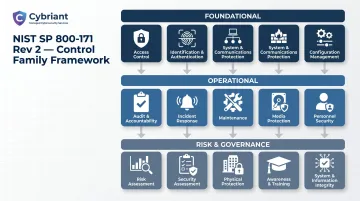
The 17 NIST SP 800-171 Control Families
NIST 800-171 organizes its security requirements into control families - groupings of related controls focused on specific security domains. Revision 2 contains 14 families covering 110 controls, while Revision 3 expands to 17 families with 97 consolidated requirements.
Foundational Security Families
These four families form the technical backbone of any compliant environment:
| Family | What It Governs |
|---|---|
| Access Control (AC) | Who and what can reach your systems - account management, least privilege, session controls, remote access |
| Identification & Authentication (IA) | Verifying identity before access is granted; mandates MFA for network and remote access, cryptographic mechanisms |
| System & Communications Protection (SC) | Data in transit and at rest - encryption, boundary protection, denial-of-service defenses |
| Configuration Management (CM) | How systems are built and changed - baseline configs, least functionality, restrictions on user-installed software |
Operational Security Families
- Audit and Accountability (AU): Generates, retains, and protects event logs - including record review, analysis, and protection against unauthorized modification.
- Incident Response (IR): Builds and tests a full incident handling capability, from detection and monitoring through reporting and recovery.
- Maintenance (MA): Restricts who can perform system maintenance and what tools they can use - a frequently overlooked control area.
- Media Protection (MP): Governs physical and digital media holding CUI, covering access restrictions, sanitization, and transport protections.
- Personnel Security (PS): Screens individuals before they access CUI and defines what happens when they leave or change roles.
Risk and Governance Families
- Risk Assessment (RA): Drives periodic vulnerability scanning, threat monitoring, and documented remediation - the foundation of a risk-aware posture.
- Security Assessment (CA): Tests whether controls actually work, not just whether they're documented. Requires ongoing monitoring and deficiency remediation.
- Physical Protection (PE): Controls who enters facilities where CUI systems live, including visitor logs and physical access authorizations.
- Awareness and Training (AT): Role-based security training for anyone with significant security responsibilities, not just a once-a-year checkbox exercise.
Rev 3 Additions: Preparing for Future Requirements
Revision 3 adds three new control families that defense contractors need to address proactively:
Planning (PL): Formalizes the System Security Plan (SSP) requirement and rules of behavior that were previously implied. Makes explicit the need for documented security planning processes.
System and Services Acquisition (SA): Extends security requirements to acquired systems and third-party services - unsupported components, external information services, and developer security testing all fall under this family.
Supply Chain Risk Management (SR): Directly responds to incidents like the SolarWinds SUNBURST compromise by requiring contractors to identify and assess third-party supplier risks, particularly for critical components and services.
How to Achieve NIST SP 800-171 Compliance
Full compliance typically requires 12–18 months of sustained effort combining technical implementation with rigorous documentation. Starting with clear scoping is critical before implementing any controls - premature deployment wastes resources and creates rework.
Step 1: Define Your CUI Boundary
Identify precisely which systems, networks, personnel, and workflows touch CUI. This compliance boundary determines which assets must meet all 110 controls.
CUI Enclave Strategy: Many contractors create a segmented environment specifically for CUI processing - a defined network zone with enhanced security controls, separate from general business systems. This approach significantly narrows the compliance scope by limiting which systems require full NIST 800-171 implementation.
Common CUI touchpoints contractors overlook:
- Email systems transmitting technical specifications
- File-sharing platforms containing procurement documents
- Collaboration tools used by engineering teams
- Mobile devices accessing CUI remotely
- Cloud services storing contract deliverables
Step 2: Conduct a Gap Assessment
Measure current security practices against all 110 NIST 800-171 Rev 2 controls using NIST SP 800-171A as the assessment methodology.
The output is an SPRS (Supplier Performance Risk System) score. Organizations start from a maximum of 110 points - each unimplemented control deducts a weighted value (1, 3, or 5 points) based on severity. Contractors with negative scores face significant contract risk.
The gap assessment findings feed directly into your SSP - documenting not just where gaps exist, but how you plan to close them.
Step 3: Develop Your System Security Plan (SSP)
The SSP is a mandatory document formally describing how your organization implements each control, who holds responsibility, and which systems fall within scope.
Without an SSP, an assessment cannot be completed - this is non-negotiable per DoD assessment methodology. Incomplete SSP documentation is one of the most common reasons contractors fail CMMC assessments.
Essential SSP components:
- System boundary definition and data flow diagrams
- Control implementation statements for all 110 requirements
- Responsible personnel for each control family
- Configuration standards and baseline documentation
- Integration with other security documentation (policies, procedures, incident response plans)
Step 4: Build a Plan of Action and Milestones (POA&M)
For controls not yet fully implemented, document a POA&M identifying the gap, remediation plan, responsible party, and target completion date.
Critical distinction: A POA&M is not a substitute for implementation. Unimplemented requirements receive a "not implemented" score regardless of POA&M existence. However, a low SPRS score with a documented POA&M signals work-in-progress, while a low score without a POA&M signals non-compliance and lack of remediation planning.
Step 5: Implement Technical Controls and Remediate Gaps
Deploy the actual security technologies and processes across all in-scope systems:
- Role-based access controls with least privilege enforcement and privileged account management
- Multi-factor authentication (MFA) for all remote and network access
- FIPS 140-2 validated encryption for CUI at rest and in transit
- Comprehensive audit logging with 90+ day retention
- Patch management with defined remediation timeframes
- Continuous vulnerability scanning with documented remediation tracking
This phase consumes the most time and resources, particularly around configuration management and audit logging - both require careful baseline documentation and ongoing maintenance.
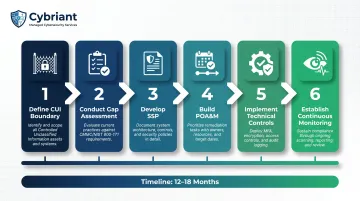
Step 6: Establish Continuous Monitoring
NIST 800-171 compliance is ongoing, not a one-time achievement. Maintaining compliance requires:
- Continuous vulnerability scanning and remediation
- Systematic patch management across all in-scope systems
- 24/7 security monitoring and incident detection
- Periodic security assessments and control validation
- Configuration management to prevent unauthorized changes
Cybriant's 24/7 Managed SIEM and vulnerability management services cover this ongoing requirement - giving defense contractors the monitoring and patching coverage NIST 800-171 demands without building a full internal security operations team.
NIST SP 800-171 Rev 2 vs. Rev 3: What Defense Contractors Need to Know Now
Current Enforcement Reality
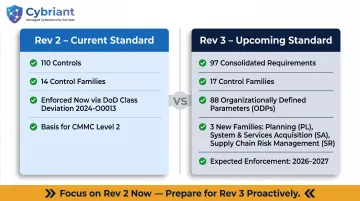
DoD Class Deviation 2024-O0013 explicitly mandates that contractors subject to DFARS 252.204-7012 must comply with NIST SP 800-171 Revision 2, not the version in effect at solicitation issuance. This deviation remains in effect "until rescinded" - meaning Rev 2's 110 controls across 14 families represent the current compliance standard for all DoD contracts and CMMC Level 2 assessments.
Critical: Contractors implementing Rev 3 prematurely may create conflicts with current CMMC requirements. Focus on Rev 2 compliance now while preparing for Rev 3's eventual adoption.
Key Changes in Rev 3
Revision 3 consolidates from 110 to 97 requirements, but total assessment complexity increases. The new structure introduces three significant shifts:
- Organizationally Defined Parameters (ODPs): 88 parameters now require formal documentation of specific policy thresholds - password complexity rules, session timeouts, audit log retention periods, and similar values that were previously implicit
- Removal of NFO Assumed Controls: Policies once considered self-evident are now explicitly required and assessed; organizations can no longer claim credit without documented evidence
- Increased Assessment Rigor: Fewer requirements, but more assessment determination statements - creating more granular evaluation points during CMMC assessments
The Three New Rev 3 Control Families
Planning (PL): Formalizes SSP requirements and rules of behavior documentation that were previously implied in other families.
System and Services Acquisition (SA): Manages security of acquired systems, addresses unsupported components, and governs external service providers - particularly relevant for contractors using cloud services or commercial-off-the-shelf software.
Supply Chain Risk Management (SR): Requires formal assessment and documentation of third-party supplier risks, recognizing that adversaries increasingly target vendor relationships over direct system access.
Practical Timing Guidance
Rev 3 enforcement is expected between late 2026 and early 2027, pending DoD rulemaking - which leaves a meaningful window to prepare without scrambling.
Recommended strategy:
- Achieve full Rev 2 compliance now - this remains the contractual and certification requirement
- Begin familiarizing leadership with Rev 3's ODP requirements and new control families
- Review current policies against Rev 3's ODP requirements to identify documentation gaps before enforcement begins
Cybriant helps defense contractors reach and maintain NIST SP 800-171 Rev 2 compliance today while preparing for Rev 3, combining gap assessments, SSP and POA&M support, and 24/7 Managed SIEM for the continuous monitoring the framework requires. Call 844-411-0404 to start your 800-171 readiness plan.