
Introduction
Cyber threats grow more dangerous by the day - and the wrong managed security provider can leave gaps just as dangerous as having no protection at all. A sophisticated ransomware attack can encrypt your entire infrastructure in hours. A phishing email can compromise executive credentials before lunch. Business Email Compromise (BEC) attacks cost organizations a median of $46,000 per incident, and the 2024 global average breach cost reached USD $4.88 million, with U.S. organizations averaging $9.36 million.
The provider you choose directly shapes breach detection speed, compliance outcomes, data integrity, and total incident cost. Organizations using extensive security AI and automation saved $1.9 million compared to those that did not, and contained breaches significantly faster.
The threat data reinforces the urgency. Vulnerability exploitation as an initial breach vector grew 180% in 2024, and 68% of breaches involved human error: the kind of failures that basic security tooling is not built to catch.
This guide walks through the criteria that actually matter when evaluating an MSSP: from technical capabilities and detection coverage to SLA accountability, compliance fit, and how to pressure-test a provider's response before you sign anything.
Overview
- A Managed Security Service Provider delivers continuous, expert-driven cybersecurity (monitoring, detection, and response) that most businesses cannot replicate in-house
- Key factors include 24/7 human monitoring, documented team credentials, integrated technology stack, compliance support, transparent reporting, and pricing flexibility
- Not all MSSPs are equal: some offer basic alerting while others provide fully managed threat detection, incident response, and proactive threat hunting
- Assess your must-protect assets, compliance obligations, and incident response expectations before evaluating vendors
- Cybriant has delivered enterprise-grade managed security since 2015 and has been named to MSSP Alert's Top 250 MSSPs list for five consecutive years
What is a Managed Security Service Provider (MSSP)?
A Managed Security Service Provider is a third-party organization that delivers continuous cybersecurity monitoring, threat detection, and incident response on behalf of client businesses from a dedicated Security Operations Center (SOC). Unlike internal security teams constrained by business hours and staffing limits, an MSSP provides around-the-clock protection through specialized analysts and purpose-built security tooling.
MSSPs differ from standard Managed Service Providers (MSPs) in both scope and specialization. An MSP manages broad IT infrastructure, covering network maintenance, data backup, and baseline security, from a Network Operations Center (NOC). An MSSP specializes exclusively in cybersecurity from a dedicated SOC with advanced threat response capabilities, forensic analysis, and compliance expertise.
Core components of MSSP service delivery
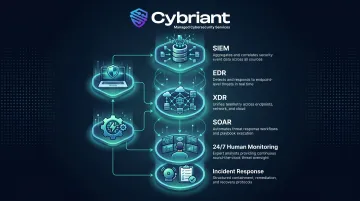
A full-service MSSP integrates people, processes, and technology into continuous security operations. Key components include:
- SIEM (Security Information and Event Management): Centralized log aggregation and correlation that provides actionable intelligence through a single interface
- Endpoint Detection and Response (EDR): Security software deployed on endpoints that collects technical data, analyzes suspicious patterns, and enables active containment
- XDR (Extended Detection and Response): Unifies security-relevant endpoint detections with telemetry from network analysis, email security, identity, and cloud environments for cross-domain analytics
- SOAR (Security Orchestration, Automation and Response): Combines incident response, threat intelligence management, and automation for playbook execution and case management
- 24/7 monitoring and alerting: Human analysts investigating alerts around the clock, not just automated notifications
- Incident response protocols: Documented processes for detection, escalation, containment, and remediation
- Compliance reporting: Audit-ready logs and documented controls mapped to regulatory frameworks
Not every provider delivers all of these components. Some offer monitoring-only services that send alerts without taking action. Others provide fully managed, end-to-end security operations including active containment and remediation. That distinction - passive alerting versus active response - directly affects how quickly threats get contained.
Benefits of partnering with an MSSP
Core operational benefits include:
- Access to senior security analysts and threat intelligence without building an internal SOC
- Faster threat detection and response - median detection by top performers is within 60 minutes
- Reduced risk of regulatory non-compliance and associated penalties
- Scalable coverage as your headcount, locations, or cloud footprint expands
- Lower total cost - in-house SOCs cost $1M to $5M annually, compared to $50K to $500K for outsourced MSSPs
What to Consider When Choosing the Right Managed Security Provider
Choosing an MSSP requires connecting each vendor's capabilities to your organization's specific risk profile, compliance obligations, and operational priorities - not just comparing feature lists or price points. The following six factors help businesses move beyond sales pitches and evaluate providers on what actually matters: measurable protection, real response, and long-term fit.
24/7 Monitoring and Incident Response Capabilities
Round-the-clock human monitoring is non-negotiable. Cyberattacks do not follow business hours - widely exploited zero-days can compromise thousands of organizations over a single weekend. Automated alerts without human triage leave critical response gaps, especially during nights, weekends, and holidays when internal teams are offline.
The distinction matters: are human analysts investigating alerts 24/7, or are off-hours handled by automation alone? Gartner emphasizes that buyers should obtain "24/7, remotely delivered, human-driven security operations capabilities" from MDR services.
Clarify what "response" actually looks like. A strong MSSP can:
- Isolate a compromised device
- Disable a flagged account
- Block a malicious IP
- Guide remediation steps
Not just send a notification. Confirm what actions the provider can take without waiting for client approval during an active incident - and get that escalation path in writing.
Team Expertise and Credentials
The quality of an MSSP's human team directly determines detection accuracy and response effectiveness. Look for documented analyst qualifications, real incident handling experience, and a clear process for ongoing staff development and retention. The cybersecurity workforce faces critical skills gaps, making it essential to verify your provider has retained qualified personnel.
Meaningful proof points to request:
- Certifications held by the team - CISSP, CISM, CRISC, Security+, and CySA+ are recognized industry standards
- Years of experience analysts possess
- Client references from businesses of similar size and industry
- Whether the provider has faced a breach themselves and how they handled it
A SOC 2 Type 2 certification at the provider level is a meaningful baseline for operational trustworthiness. A SOC 2 Type 2 report includes an opinion on the operating effectiveness of controls over a specified period, with detailed descriptions of tests performed by the auditor.
Technology Stack and Tool Integration
The technology an MSSP deploys - SIEM, EDR, XDR, SOAR - determines the depth of visibility and speed of response. When evaluating the tech stack, pin down:
- Which tools they use and how current they are
- Whether those tools integrate with your existing environment
- Who retains the licenses and data if you discontinue the service
- How they handle tool sprawl - lack of orchestration and skilled staff are top barriers to SOC excellence
Outdated or siloed tools create the same gaps they're meant to close. Look for providers investing in AI-assisted threat detection and behavioral analysis, not just signature-based defenses.
Adversaries use living-off-the-land techniques (MITRE ATT&CK T1218) to bypass signature-based defenses, proxying execution through trusted binaries. User and Entity Behavior Analytics (UEBA) and anomaly detection are essential to catch fileless malware and modern attack techniques.
Compliance Support and Regulatory Alignment
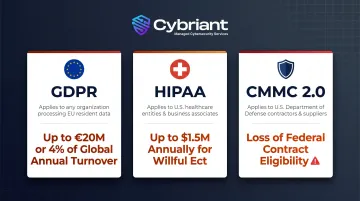
For businesses subject to HIPAA, PCI DSS, SOC 2, GDPR, or industry-specific frameworks, an MSSP must provide audit-ready logs, compliance reporting, and documented controls - not just security monitoring. A provider that cannot map their services to your regulatory requirements is a compliance liability, not an asset.
Regulatory penalties are severe:
| Framework | Penalty Exposure |
|---|---|
| GDPR | Up to €20,000,000 or 4% of global annual turnover, whichever is higher |
| HIPAA | Civil penalties up to $1,500,000 annually for uncorrected willful neglect |
| CMMC 2.0 | Loss of eligibility for Department of Defense contracts |
During evaluation, confirm:
- Which compliance frameworks they actively support
- How they document and report on security controls
- Whether they will adapt reporting as regulatory requirements change
- If they provide continuous monitoring to maintain compliance year-round
Reporting Transparency and Communication Standards
Actionable reporting is a critical but often overlooked differentiator. Strong MSSPs provide monthly summaries of:
- Top risks identified
- Trends over time
- Clear ownership of remediation tasks
Not just raw alert counts or generic dashboards. Reports should translate security findings into business decisions and demonstrate security impact to support audits and strategic planning.
Communication during an active incident is equally important. Verify that escalation protocols include:
- A dedicated phone or out-of-band channel (not just email)
- Named points of contact available around the clock
- Defined response time commitments in the contract
If email is the only escalation method during an email compromise event, that gap costs real response time. Get the communication protocol documented before signing.
Pricing Model and Scalability
MSSP pricing structures vary widely - and surprises show up after contracts are signed. Understand exactly what is included in the base price versus what triggers add-on charges. EDR, SIEM, incident response, vulnerability scanning, and compliance reporting are often billed separately.
Typical annual costs range from $50K to $200K for MDR ($3-$15 per endpoint per month), while broader MSSP services range from $80K to $300K annually ($10-$60 per device per month). Key cost drivers include coverage surfaces beyond endpoints (cloud workloads, identity monitoring), organization size, service level (autonomous vs. guided response), and incident response hours.
Get a line-item breakdown in writing before committing. Evaluate whether the pricing model scales as your organization grows or your threat landscape shifts - a vendor with rigid, all-or-nothing contracts forces you to either overpay for unused capacity or scramble to add coverage mid-incident.
Red Flags to Watch For When Evaluating MSSPs
Some MSSPs rely on a one-size-fits-all approach that cannot address your organization's specific environment or risk profile. If a vendor won't clearly map their services to your actual systems - naming what they monitor, what they manage, and what you remain responsible for - walk away.
Avoid providers that cannot demonstrate:
- Verifiable credentials and external assurance reports such as SOC 2
- Client references from similar-sized organizations in your industry
- Specific performance-related service level agreements (SLAs)
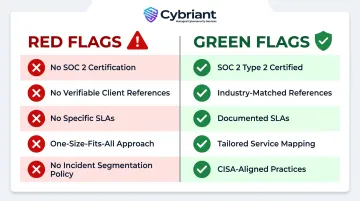
CISA recommends that customers request detailed incident management guidelines, a Software Bill of Materials (SBOM), and statements on how data from different clients will be segmented on the vendor's networks.
Watch for providers without a clear roadmap for handling new attack techniques, regulatory changes, and AI-driven threats. Press them on specifics:
- How they update detection methodology as new threat categories emerge
- What technology or staffing investments are planned in the next 12 months
- How threat intelligence feeds are evaluated, sourced, and refreshed
Operational shortfalls are also a serious concern. Research into why MSSPs lose clients points to understaffed SOCs, low-quality threat intelligence feeds, and outdated tools as the root causes of detection failures. A single misconfiguration or missed breach can result in regulatory penalties - and a client relationship that cannot be recovered.
How Cybriant Can Help
Cybriant is a managed security service provider that has spent over a decade making enterprise-grade cybersecurity accessible to businesses of all sizes. Founded in 2015, the company has been named to MSSP Alert's Top 250 MSSPs list for six consecutive years (2018–2023) and holds SOC 2 Type 2 certification - giving clients verifiable proof of operational security maturity.
Each service is designed around the selection criteria that matter most to security buyers: coverage depth, compliance alignment, and scalability. Here's what Cybriant delivers:
Key service differentiators:
- Human analysts monitor and investigate security logs around the clock - not just automated alerts, but real-time analysis and hands-on remediation
- Continuous vulnerability scanning detects exposures as they emerge, with automated patch deployment to thousands of systems in minutes
- Scalable services bring enterprise-level security within reach for mid-market and small businesses without enterprise budgets
- Modular service packages let clients build programs around specific requirements, with integrated bundles available for better cost efficiency
- Compliance support across HIPAA, PCI DSS, SOC 2, GDPR, NIST, CMMC, and other frameworks - with audit-ready logs and compliance reporting included
- Direct access to specialists in malware analysis, forensic investigation, and threat intelligence for situations that go beyond routine monitoring
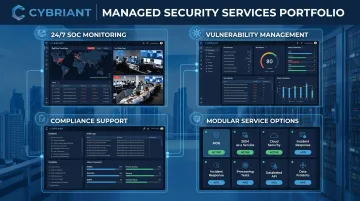
Cybriant's Security Operations Center runs 24/7, staffed by analysts who investigate threats and provide direct, practical guidance - not ticket queues. The technology stack includes Google SecOps, SentinelOne, Tenable, and Automox, providing full visibility across endpoints, networks, and cloud workloads.
Conclusion
The right managed security provider is one whose capabilities align with your specific environment, risk tolerance, compliance obligations, and operational priorities. That fit matters more than feature lists or marketing claims. A strong MSSP earns its value in measurable outcomes - faster detection, effective containment, and fewer costly incidents.
Cybersecurity is not a one-time purchase. The threat landscape shifts constantly, and your MSSP relationship needs to shift with it. When evaluating candidates, focus on verifiable proof points:
- SOC 2 or relevant certifications that confirm operational standards
- Client references from organizations similar in size and industry
- Documented incident response playbooks with clear SLAs
- Transparent reporting that shows detection and response metrics over time
A provider that meets these criteria isn't just a vendor - it's a partner that grows alongside your business and your risk profile.
Cybriant meets each of these criteria: SOC 2 Type 2 certified, with 24/7 human-led monitoring, transparent reporting, and documented response SLAs. Call 844-411-0404 to talk through your security requirements and see whether Cybriant is the right fit for your environment.
Frequently Asked Questions
What is the difference between an MSP and an MSSP?
An MSP manages broad IT infrastructure - network maintenance, data backup, and baseline security - from a Network Operations Center (NOC). An MSSP specializes exclusively in cybersecurity, operating a dedicated Security Operations Center (SOC) with advanced threat monitoring, incident response, forensic analysis, and compliance expertise focused entirely on protecting against cyber threats.
What services should be included in a managed security package?
Core services include 24/7 monitoring, threat detection and response, SIEM, endpoint protection (EDR), vulnerability scanning, patch management, compliance reporting, and incident response. Services vary significantly by provider - some offer monitoring-only while others provide fully managed operations with active containment. Always ask vendors for an explicit scope breakdown in writing before signing a contract.
What certifications should I look for in a managed security provider?
SOC 2 Type 2 is the key baseline - it confirms an independent auditor validated the provider's security controls over time. ISO 27001 and industry-specific compliance expertise (HIPAA, PCI DSS, NIST, CMMC) add further assurance depending on your sector. Also verify that analysts hold credentials such as CISSP, CISM, or CRISC.
Can small businesses realistically benefit from hiring an MSSP?
SMBs are disproportionately targeted: 68% of breaches involve human error, and vulnerability exploitation grew 180% in 2024. Most small businesses lack the resources to staff a dedicated security team. MSSPs close that gap, delivering enterprise-grade expertise at $50K–$200K annually versus $1M–$5M for an in-house SOC.
How do I evaluate an MSSP's incident response capabilities?
Ask about SLAs for critical alert acknowledgment - top performers respond within 60 minutes. Clarify what the MSSP can do autonomously (device isolation, account lockout, IP blocking) versus what requires your approval first. Also confirm they offer defined escalation paths and conduct tabletop exercises to test response protocols with clients.
How to choose the right managed security provider?
Start by mapping your must-protect assets, compliance requirements, and incident response expectations. Then evaluate vendors on 24/7 human-led response, documented credentials, integrated tooling, and transparent SLAs. Prioritize verifiable proof points - SOC 2 Type 2 certification and client references from similar organizations - over marketing claims.