Introduction
Government contractors fail CMMC assessments every year - not because they lack logging tools, but because they misunderstand what NIST SP 800-171 actually requires. Family 3.3 (Audit and Accountability) mandates how organizations create, retain, review, and protect logs of system activity involving Controlled Unclassified Information (CUI). It applies to DoD subcontractors, government contractors, and any nonfederal organization that processes or stores CUI.
Audit logging under NIST 800-171 is an active compliance obligation - nine distinct requirements that function together as an integrated system. Organizations must review logs regularly, protect them from tampering, restrict administrative access, and maintain documented procedures.
This article breaks down all nine requirements, explains how they connect, and identifies the gaps that most commonly trip up organizations during assessments.
Overview
- NIST 800-171 Family 3.3 defines 9 audit requirements spanning log creation, review, protection, timestamping, and access control
- Defense contractors and subcontractors handling CUI must meet these requirements to pursue CMMC Level 2 certification
- Common failure points include insufficient log retention, no alerting when logging fails, and allowing too many users to manage audit configurations
- Meeting these requirements means active log review, clear documentation, and tightly restricted administrative access - not just logging tools
What Is NIST 800-171 Audit Logging Compliance?
NIST SP 800-171 establishes security requirements for protecting Controlled Unclassified Information in nonfederal systems. First published in June 2015, it's currently on Revision 2 (released February 2020, updated January 2021), though Revision 3 was published in May 2024. However, CMMC Level 2 assessments continue to score against Rev. 2 requirements until DoD formally adopts Rev. 3 through updated rulemaking.
Family 3.3 - Audit and Accountability - is one of 14 requirement families in NIST 800-171. It governs how organizations track, record, and account for individual user actions on systems that handle CUI.
While closely related to NIST 800-53 (which applies to federal agencies and covers broader federal information system categories), NIST 800-171 is scoped specifically to nonfederal contractors and focuses exclusively on CUI protection.
Together, these controls establish the minimum security baseline contractors must meet to maintain DoD contract eligibility - and audit logging sits near the center of that requirement set.
Who Needs to Comply and Why It Matters
Any organization in the Defense Industrial Base (DIB) that processes, stores, or transmits CUI on its own networks must comply with NIST 800-171. This includes prime contractors, subcontractors, and vendors at every supply chain tier - not just primes.
Compliance is mandated through DFARS clause 252.204-7012, which requires contractors to implement NIST 800-171 controls and report cyber incidents within 72 hours of discovery.
Why audit logging compliance matters:
- Traceable logs are the only reliable way to detect unauthorized access and reconstruct what happened during an incident
- Logs establish accountability - who accessed what, when, and from where - which is critical for both investigations and assessments
- The DoD oversees approximately 200,000 companies in the Defense Industrial Base, and scrutiny is increasing: as of October 2024, DCMA's DIBCAC had assessed 357 entities
- Failed CMMC assessments, DFARS violations, and loss of contract eligibility all follow from inadequate logging controls
Audit logging sits at the center of these requirements - it's one of the control families assessors examine most closely during CMMC evaluations.
The 9 Audit and Accountability Requirements Explained (3.3.1–3.3.9)
The nine requirements in Family 3.3 split into two Basic Security Requirements (the baseline every organization must meet) and seven Derived Security Requirements (which build on that baseline). All nine are mandatory for NIST 800-171 and CMMC Level 2 compliance.
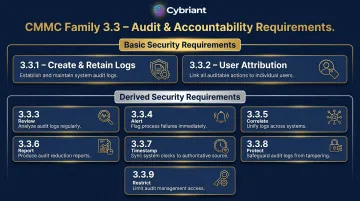
Basic Requirements: Create, Retain, and Attribute Logs (3.3.1 and 3.3.2)
Requirement 3.3.1 mandates that organizations create and retain system audit logs to the extent needed to support monitoring, analysis, investigation, and reporting of unauthorized activity. This means configuring systems to automatically log key events including:
- User logins and logouts
- File accesses and modifications
- Privilege escalations
- System configuration changes
- Failed access attempts
While NIST 800-171 doesn't specify an exact retention period in the standard itself, the DFARS 252.204-7012 clause requires preservation of incident-related monitoring data for at least 90 days after submitting a cyber incident report.
Requirement 3.3.2 ensures that every action in the system can be uniquely traced to the individual user who performed it. Logs must capture:
- Unique user IDs (no shared accounts)
- Session identifiers
- Accurate timestamps
- Action types and outcomes
This requirement is the accountability backbone that makes all other audit requirements meaningful. Without user attribution, logs become forensically useless.
Log Review and Failure Alerting (3.3.3 and 3.3.4)
Requirement 3.3.3 requires organizations to periodically review and update their logged events. This isn't a one-time setup - logging parameters must be reassessed as threats evolve and organizational changes occur. Organizations must establish:
- A defined review process with documented schedules
- Trained personnel responsible for log review
- Procedures for updating event types as systems and threats change
Requirement 3.3.4 mandates that systems generate alerts when the audit logging process itself fails. This includes hardware/software errors, capture mechanism failures, and storage capacity issues.
A gap in logging is itself a security event requiring immediate response. Without failure alerting, an organization may have no indication that its detection capability has gone offline - leaving breaches undetected during the outage.
Analysis, Reporting, and Timestamps (3.3.5, 3.3.6, and 3.3.7)
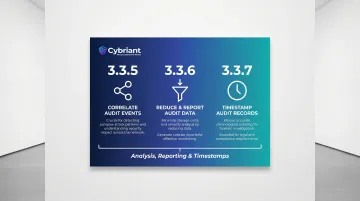
These three requirements work as a group to enable meaningful analysis:
| Requirement | What It Requires | Why It Matters |
|---|---|---|
| 3.3.5 | Correlate audit records across systems to identify activity patterns | A single failed login may be benign; 50 failed logins across five systems in two minutes signals an attack |
| 3.3.6 | Reduce audit records and generate on-demand reports for analysis | Organizations must filter, aggregate, and summarize logs to support investigations and compliance reporting |
| 3.3.7 | Synchronize all internal clocks with an authoritative time source (such as UTC via NTP) | Inconsistent timestamps make cross-system incident reconstruction unreliable - if two servers are out of sync, investigators cannot establish the actual sequence of events |
Log Protection and Access Control (3.3.8 and 3.3.9)
Requirement 3.3.8 mandates protecting audit logs and log management tools from unauthorized access, modification, and deletion. This includes:
- Role-based access controls (RBAC)
- Immutable or write-once storage
- Separation from production environments
- Protection against tampering by privileged users
Requirement 3.3.9 goes further by restricting who can manage the logging configuration itself to a limited subset of privileged users. When any system administrator can disable logging or exclude certain events, the integrity of the entire audit trail is at risk - making this access restriction as important as the logs themselves.
How the Requirements Work Together as a System
The nine requirements form a logical progression, not a disconnected checklist:
Collect (3.3.1) → Attribute (3.3.2) → Review and update (3.3.3) → Alert on failure (3.3.4) → Correlate and report (3.3.5, 3.3.6) → Timestamp accurately (3.3.7) → Protect and restrict (3.3.8, 3.3.9)
A weakness in any stage breaks the chain. You can collect millions of log entries, but if they aren't attributed to individual users, you can't hold anyone accountable. If you don't alert on logging failures, you'll never know when your audit trail has gaps.
Centralized Log Management: The Operational Backbone
All nine requirements point toward a centralized, protected, monitored logging architecture. NIST SP 800-92 highlights Security Information and Event Management (SIEM) software as superior for normalization, analysis, and correlation of log data from multiple sources.
A 24/7 Managed SIEM, like Cybriant's, directly supports multiple Family 3.3 requirements by providing:
- Continuous log collection from endpoints, servers, applications, and network devices (3.3.1)
- Real-time alerting on anomalies and logging failures (3.3.4)
- Cross-source correlation to identify attack patterns (3.3.5)
- Automated report generation and audit reduction (3.3.6)
- Controlled access to log management functions (3.3.9)
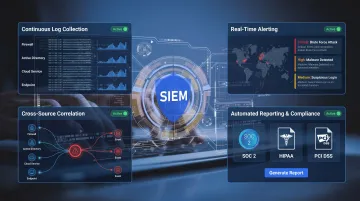
For organizations without dedicated security operations staff, a managed SIEM removes the burden of building and maintaining this infrastructure internally.
Identity Management as a Prerequisite
Centralized log management only delivers accountability if the identity layer beneath it is solid. Requirement 3.3.2 cannot be satisfied without a well-maintained identity system that assigns unique credentials to every user. Shared accounts or generic logins directly violate this requirement. The CMMC Level 2 Assessment Guide explicitly links proper user identification to accountability, noting that organizations must assign unique user IDs to ensure actions can be traced to specific individuals.
Documentation and Evidence Matter as Much as Technology
During a CMMC assessment, organizations must demonstrate the logging system is functioning as designed. This means having:
- Written audit and accountability policies
- Defined review schedules with documented results
- Escalation procedures for alerts
- Evidence of actual log reviews, not just a configured tool
Assessors will examine policies, interview personnel, and test mechanisms. A well-configured SIEM with no supporting documentation or review records will not satisfy an assessor - the tool and the process must both be demonstrable.
Common Mistakes and Misconceptions in NIST 800-171 Audit Logging
Most NIST 800-171 audit logging failures don't come from missing tools - they come from how those tools are configured, maintained, and reviewed. These four mistakes show up repeatedly in contractor assessments.
Misconception: Deploying a SIEM Equals Compliance
The most common mistake is assuming that enabling Windows Event Logging or deploying a SIEM constitutes full compliance. In reality, tools are only one component. Compliance also requires:
- Active review processes with documented schedules
- Trained personnel who understand what they're reviewing
- Written procedures for responding to alerts
- Evidence that logs are actually being analyzed for security events
A 2019 DoD Inspector General audit found that contractors failed to consistently implement mandated controls, including creating and reviewing system activity reports.
Operational Gap: "Set It and Forget It" Logging
Organizations often configure logging at implementation but never revisit it, violating requirement 3.3.3. As systems evolve:
- New event types go uncaptured
- Old logging rules become irrelevant
- New applications aren't added to the log aggregation system
- Blind spots emerge in the audit trail
Regular reviews must reassess which events are being logged and whether coverage remains comprehensive.
Log Protection Failure: Storing Logs in Production
Many organizations store audit logs in the same environment they're logging, with the same access controls. Under requirement 3.3.8, that's a critical exposure - a compromised account can alter or delete the exact logs needed to detect the breach. Logs must be:
- Stored in write-protected, access-controlled environments
- Separated from production systems
- Protected with immutable or write-once storage - and exceptions documented as accepted risks
Clock Synchronization Oversight
Unsynchronized clocks across systems make it impossible to reconstruct the accurate sequence of events during an incident - which is exactly what requirement 3.3.7 addresses. Auditors look for:
- NTP configuration evidence on all in-scope systems
- Consistent UTC timestamping across the environment
- Documentation of the authoritative time source used
NIST SP 800-92 recommends using Network Time Protocol servers to keep log sources' clocks consistent across multiple time zones.
Frequently Asked Questions
What is NIST 800-171 compliance?
NIST 800-171 compliance means meeting the security requirements outlined in NIST SP 800-171 for protecting Controlled Unclassified Information (CUI) in nonfederal systems. It covers 14 requirement families including access control, incident response, and audit and accountability - 110 security requirements in total under Revision 2.
Who is required to comply with NIST 800-171?
Any nonfederal organization that processes, stores, or transmits CUI under a DoD contract must comply. This includes defense contractors, subcontractors, and vendors in the Defense Industrial Base. Compliance is mandated under DFARS clause 252.204-7012 and is required for CMMC Level 2 certification.
What is the difference between NIST 800-53 and 171?
NIST 800-53 is a broad framework for federal agencies covering all types of federal data. NIST 800-171 is a focused subset for nonfederal contractors protecting CUI. It draws from 800-53 controls but applies them specifically to the CUI protection context.
What should audit logs contain?
Under NIST 800-171 requirement 3.3.2, audit logs must include enough detail to uniquely attribute actions to individual users. This typically includes user IDs, timestamps, event types (login, file access, configuration change), source and destination addresses, and the outcome of each action (success or failure).
How often should audit logs be reviewed?
NIST 800-171 requirement 3.3.3 requires periodic review but doesn't specify an exact frequency. Organizations should define a review schedule in their System Security Plan (SSP). Common practice is weekly automated review supplemented by monthly manual analysis, with immediate review triggered by security alerts.
What is log management in cyber security?
Log management is the process of collecting, storing, analyzing, and protecting system-generated event records. For NIST 800-171, it's the operational backbone that enables organizations to satisfy all nine Audit and Accountability requirements and maintain a forensically sound audit trail.