Introduction
Unpatched vulnerabilities have become one of the most predictable - yet preventable - causes of enterprise breaches. 60% of breach victims were compromised due to a known, unpatched vulnerability where the patch was available but not applied, according to the Ponemon Institute. As attack surfaces expand through distributed workforces, cloud adoption, and faster-moving threat actors, ad-hoc patching has shifted from an inconvenience to a critical liability.
The real challenge isn't understanding patch management - it's executing it consistently at scale without overwhelming IT teams or disrupting operations. Verizon's 2025 Data Breach Investigations Report confirms that exploitation of vulnerabilities accounted for 20% of all breaches - a 34% year-over-year increase.
That window for response is shrinking fast. The median time from CVE publication to confirmed exploitation has collapsed to just 5 days for critical vulnerabilities.
This article examines the operational advantages of Patch Management as a Service (PMaaS) and why enterprises treating it as a core security function - not a routine IT task - achieve measurably stronger security postures.
Overview
- PMaaS hands off the full patch lifecycle - identifying, testing, and deploying updates - so enterprise teams aren't managing it manually across every system and endpoint
- Unpatched systems cause 60% of enterprise breaches involving known, patchable vulnerabilities
- Key advantages include faster vulnerability closure, reduced IT workload, and continuous compliance readiness
- Value compounds when PMaaS is paired with clear KPIs and integrated into a broader vulnerability and patch management program
- The result: stronger security posture, predictable operations, and audit-ready documentation
What Is Patch Management as a Service?
PMaaS is a managed cybersecurity model where a specialized provider handles scanning for vulnerabilities, acquiring and testing patches, and deploying them across on-premises, cloud, and hybrid environments. Internal teams don't need to own the process - the provider does.
Unlike vendor-prompted or ad-hoc patching, PMaaS typically covers:
- Operating systems: Windows, Linux, and macOS
- Third-party applications: Java, Adobe Acrobat, browsers, and hundreds of commonly exploited software packages
- Firmware and hypervisors: Including virtualization platforms
- Mobile devices and cloud workloads: Extending coverage to modern distributed environments
PMaaS delivers measurable outcomes: reduced exposure time, fewer incidents, and consistent endpoint hygiene across the enterprise. For organizations managing hundreds or thousands of endpoints, it transforms patching from a periodic firefighting exercise into a continuous security discipline.
That's the model Cybriant's managed patch management service is built on - real-time vulnerability scanning with patch deployment across heterogeneous platforms, including distributed and remote devices, virtualized environments, and third-party applications.
Key Advantages of PMaaS for Enterprise Security
The advantages below are grounded in operational and business outcomes. Each ties directly to metrics enterprises track: breach risk, IT cost, compliance posture, and team capacity.
Continuously Closing the Vulnerability Window Before Attackers Can Exploit It
PMaaS automates vulnerability detection and patch deployment on a continuous cycle. Unlike internal teams operating on monthly or quarterly schedules, a managed service monitors for new CVEs and vendor releases in near real-time.
How PMaaS closes the window:
- Automated scanning identifies missing patches across all endpoints
- Patches are prioritized by CVSS severity, exploit likelihood, and asset criticality
- Deployment happens within defined SLA windows rather than when IT bandwidth allows
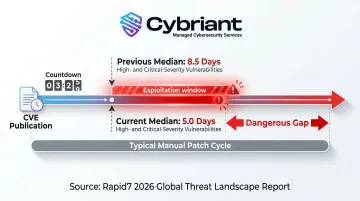
Rapid7's 2026 Global Threat Landscape Report shows the median time from CVE publication to inclusion in the CISA KEV catalog dropped from 8.5 days to 5.0 days for high- and critical-severity vulnerabilities. Manual patching cycles cannot match this pace.
The cost differential is stark. IBM's 2025 Cost of a Data Breach Report places the global average breach cost at $4.4 million, while U.S.-specific breaches averaged $9.36 million in 2024. Unplanned incident response, breach recovery, and operational downtime cost far more than proactive patching.
For enterprises managing hundreds or thousands of endpoints, the automation and speed of PMaaS is the only operationally viable path to closing exposure quickly.
Cybriant's continuous scanning gives security teams a real-time view of patch status across every asset - not a snapshot from the last scheduled scan cycle.
KPIs impacted:
- Mean Time to Patch (MTTP)
- Patch coverage rate (percentage of endpoints patched within SLA)
- Number of critical/high vulnerabilities remaining open past 30/60/90 days
- Breach incident frequency
When this advantage matters most:
Enterprises with large, distributed endpoint fleets; organizations in high-risk industries such as healthcare, finance, and critical infrastructure; and any environment where zero-day or actively exploited vulnerabilities require rapid response.
Releasing Internal IT Teams From Reactive Maintenance to Focus on Strategic Priorities
PMaaS offloads one of the most time-consuming recurring burdens on enterprise IT and security teams - freeing engineers from patch scanning, testing, scheduling, deployment tracking, and rollback management.
What the managed service takes off your team's plate:
The managed service assumes ownership of the full patch lifecycle, freeing internal teams from reactive "patch day" firefighting and enabling them to focus on threat detection, architecture improvements, and strategic projects. Cybriant's service handles automatic system discovery, vulnerability assessment, patch testing in sandbox environments, deployment scheduling, and status reporting.
IDC research shows 70% of IT teams spend more than 6 hours per week on security patching - nearly one full workday per week dedicated to manual, time-consuming patching activities. An Ivanti study found that 71% of IT and security professionals find patching overly complex, cumbersome, and time-consuming.
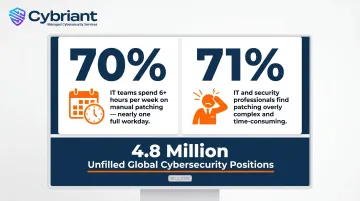
That burden lands hardest when teams are already stretched thin. ISC2's 2024 Cybersecurity Workforce Study reports a global workforce gap of 4.8 million unfilled cybersecurity positions - a 19% year-over-year increase. ISACA found that 66% of cybersecurity professionals say their role is more stressful now than five years ago.
Removing patch management from the queue isn't just an efficiency gain - it's a retention strategy.
That capacity buffer becomes especially valuable during growth phases. As enterprises expand through M&A, remote workforce additions, or new cloud workloads, PMaaS scales with the environment without requiring proportional headcount increases. Cybriant's solution supports distributed and remote patching across devices anywhere - behind the firewall, on the road, at remote sites, or even in sleep mode.
KPIs impacted:
- IT technician hours spent on patch-related tasks per month
- Mean time to respond to non-patch security incidents
- Employee satisfaction and retention rates in IT
- Cost per endpoint managed
When this advantage matters most:
Organizations experiencing rapid growth or digital transformation; enterprises with lean IT teams supporting large endpoint populations; and businesses that have lost staff time to manual patch cycles that delay other security initiatives.
Maintaining Continuous Compliance Readiness Across Frameworks
PMaaS inherently produces the documentation, audit trails, and patch coverage evidence that regulatory frameworks require - making compliance verification an ongoing byproduct of the service, not a periodic scramble.
What continuous compliance looks like in practice:
Automated reporting captures patch status, deployment timestamps, exceptions, rollbacks, and coverage rates per device group - generating audit-ready data for frameworks including HIPAA, PCI DSS, SOC 2, NIST, and ISO 27001. Cybriant's centralized visibility through advanced logging and SIEM capabilities provides the evidence, transparency, and reporting required for audits and compliance.
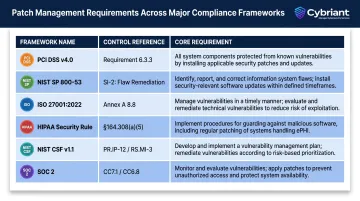
Enterprises in regulated industries face heavy documentation burdens during audits. Six major frameworks explicitly mandate patching controls:
| Framework | Control Reference | Requirement |
|---|---|---|
| PCI DSS v4.0 | Requirement 6.3.3 | Install security patches/updates based on risk ranking |
| NIST SP 800-53 | SI-2 | Identify, report, and correct system flaws; test updates before installation |
| ISO 27001:2022 | Annex A Control 8.8 | Identify, assess, and mitigate technical vulnerabilities |
| HIPAA Security Rule | 45 CFR 164.308 | Risk analysis to identify vulnerabilities; patch management practices required |
| NIST CSF v1.1 | PR.IP-12 | Vulnerability management plan development and implementation |
| SOC 2 | CC7.1 | Configuration and vulnerability management monitoring |
Non-compliance carries material financial risk. The Equifax FTC settlement totaled at least $575 million, with the FTC explicitly citing failure to patch known software vulnerabilities. HHS OCR fined Anchorage Community Mental Health Services $150,000 specifically for unpatched and unsupported software.
Cybriant's automated patch compliance reports enable organizations to verify patching enterprise-wide against the policies and regulations that govern their industry - supporting continuous audit readiness rather than point-in-time compliance.
KPIs impacted:
- Patch compliance rate against policy
- Number of compliance exceptions requiring manual remediation
- Audit preparation hours saved
- Frequency of compliance findings related to vulnerability management
When this advantage matters most:
Enterprises operating under HIPAA, PCI DSS, SOC 2, or ISO 27001 requirements; organizations preparing for or undergoing third-party audits; and businesses seeking cyber insurance coverage, where patching hygiene is increasingly scrutinized by insurers.
What Happens When Patch Management Is Neglected
The compounding consequences of delayed or inconsistent patching in enterprise environments include:
Unpatched vulnerabilities become known attack vectors. Threat actors actively monitor public CVE databases and target organizations that are slow to apply fixes. The window between disclosure and exploitation has collapsed to 5 days for critical vulnerabilities - narrower than most manual patch cycles.
Incident response crowds out proactive work. IT teams spend disproportionate time triaging incidents caused by known, patchable vulnerabilities rather than advancing security maturity. 70% of IT teams already lose a full workday weekly to manual patching tasks.
Compliance posture erodes quietly. Missed patches accumulate as documentation gaps, creating audit exposure and regulatory risk that often only surfaces during a breach investigation. The consequences include penalties, failed audits, and legal liability.
Costs escalate over time. The Equifax breach - caused by an unpatched Apache Struts vulnerability (CVE-2017-5638) - cost the company $1.38 billion. A fix had been available for over four months before attackers exploited it, accessing 147.9 million Americans' personal data undetected for 78 days.
Scaling becomes harder. Without an automated, managed process in place, adding new endpoints, cloud workloads, or remote users multiplies the patching burden with each addition, often leading to abandoned or inconsistently enforced patch policies.
The WannaCry ransomware attack follows the same timeline. Microsoft released a patch for CVE-2017-0145 (EternalBlue) on March 14, 2017 - two months before the May 12 attack infected 300,000+ computers across 150 countries, causing up to $4 billion in damage and crippling the UK's National Health Service. In both cases, the patch existed. The failure was execution.
These aren't edge cases. They're the predictable result of manual, reactive patch management at enterprise scale - and exactly the risk a managed patching program is designed to prevent.
How to Get the Most Value from PMaaS
PMaaS delivers its strongest outcomes when the organization approaches it as an ongoing security discipline rather than a set-it-and-forget-it subscription. The managed provider handles execution, but internal stakeholders must align on policy, priorities, and review cadences.
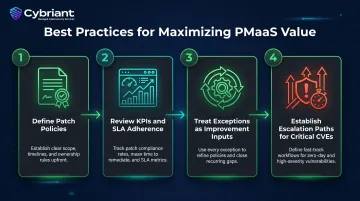
Maximum value comes when:
- Patch policies are clearly defined and consistently enforced across all endpoint groups
- Patch coverage and SLA adherence are reviewed regularly against KPIs
- Exceptions or rollbacks are treated as inputs to improve future deployment strategies - not just isolated incidents
- Critical vulnerability disclosures trigger immediate coordinated response through clear escalation paths between the PMaaS provider and internal security teams
A well-structured PMaaS provider builds these practices into the service itself. Cybriant's managed patch management service combines real-time vulnerability scanning with patch deployment as part of CybriantXDR - ensuring patching stays connected to threat visibility through SIEM, EDR, and MDR capabilities, compliance monitoring, and ongoing risk management.
Risk-based prioritization drives remediation decisions by weighing asset criticality, threat context, and vulnerability severity beyond CVSS scores alone, keeping remediation efforts focused on the risks that matter most.
Organizations should establish testing protocols in controlled environments before production deployment. Cybriant deploys patches in sandbox environments first, reducing deployment risk and improving stability before changes reach the broader network. This approach balances thorough validation with the urgency of addressing active vulnerabilities.
Conclusion
The value of PMaaS lies in three core properties: control over the vulnerability window, clarity through audit-ready documentation, and consistent coverage across all endpoints regardless of environment or scale.
Enterprises that commit to managed patching as a continuous practice - not a periodic event - see real advantages accumulate over time: lower breach risk, reduced IT burden, and a compliance posture that becomes a strategic asset rather than a checkbox.
Those advantages matter more now than ever. With exploitation timelines collapsing to 5 days and the cybersecurity workforce gap widening to 4.8 million unfilled positions, organizations can no longer afford to treat patching as a quarterly task delegated to an already-stretched internal team.
PMaaS is a foundational layer of enterprise security maturity - one that enables security teams to focus on emerging threats while the managed service ensures known vulnerabilities never become the reason for a breach. When 60% of breaches trace back to unpatched known vulnerabilities, that's not a statistic to monitor - it's a gap to close. The organizations that close it through a managed, continuous model are the ones that stop reacting and start leading on security.
Frequently Asked Questions
What are patches in cyber security?
A patch is a software update released by a vendor to fix a security vulnerability, resolve a bug, or improve performance. In cybersecurity, security patches are the most time-critical because they close known vulnerabilities that attackers actively exploit, reducing the window of opportunity for compromise.
What are the three types of patching?
Three distinct patch types serve different purposes:
- Security patches - address exploitable vulnerabilities; highest urgency
- Bug fix patches - resolve functional issues affecting stability or performance
- Feature patches - introduce new capabilities, often bundling prior updates
What are the key steps in patch management?
The core lifecycle covers six stages:
- Asset discovery and inventory
- Vulnerability scanning
- Patch prioritization by severity and risk
- Testing in a controlled environment
- Scheduled deployment
- Post-deployment verification and compliance reporting
Is patch management part of cybersecurity?
Yes, patch management is a foundational cybersecurity control that directly reduces the attack surface by closing known vulnerabilities. It is recognized as a core practice within major security frameworks including NIST SP 800-53 (SI-2) and ISO 27001:2022 (Control A.8.8).
What is the most secure method for patch management?
A managed, automated approach is the most secure method. It continuously scans for vulnerabilities, prioritizes patches by asset criticality and threat context, validates updates in staging, and maintains full audit trails - eliminating the gaps that manual or ad-hoc patching leaves open.
Is patch management part of ISO 27001?
Yes, ISO 27001:2022 includes patch management under Control A.8.8 ("Management of Technical Vulnerabilities"), requiring organizations to identify, assess, and apply patches to reduce exposure. PMaaS provides the documentation and coverage evidence needed to demonstrate compliance during audits.