When a ransomware attack strikes your organization, the clock starts ticking immediately. Within minutes, encryption spreads from the initial infected endpoint to servers, databases, and backups - paralyzing operations and compounding damage with every passing second. For small and mid-market businesses, the stakes are exceptionally high: 59% of organizations were hit by ransomware in the previous year, with SMBs representing nearly half of all targets. The harsh reality is that ransomware can encrypt approximately 54GB of files in as little as 5 minutes, meaning delays measured in hours - or even minutes - can determine whether your organization recovers in days or remains offline for weeks.
This guide walks through what ransomware incident response (IR) services actually deliver, the step-by-step containment and recovery process that minimizes downtime and data loss, and what separates organizations that bounce back quickly from those that don't.
Overview
- Ransomware IR services deliver threat containment, forensic investigation, malware eradication, and data restoration - well beyond standard IT support
- Early containment isolates infected systems within hours, stopping lateral spread before encryption reaches backups
- Restoring from verified backups is faster and safer than paying ransoms, which carry legal risks and rarely guarantee decryption
- Post-incident hardening and continuous monitoring catch ransomware precursor activity before encryption ever begins
What Ransomware Incident Response Services Actually Do
Ransomware incident response services are specialized, expert-led services built for the unique demands of an active attack - not routine IT troubleshooting. Where standard IT support keeps systems running, IR services do something different: contain the threat, investigate how attackers got in, and get you back to operations without leaving backdoors behind.
Core capabilities include immediate threat containment, forensic investigation, malware eradication, secure data restoration, and post-incident analysis - all following a structured methodology that minimizes downtime while preserving evidence for regulatory and legal requirements.
Many business leaders assume only large enterprises need dedicated IR services. The data says otherwise: 47% of organizations with less than $10 million in annual revenue were hit by ransomware. Attackers target smaller organizations precisely because they're less prepared and have weaker defenses.
Without a professional response framework, even a capable internal IT team can make costly mistakes - powering down infected systems prematurely, destroying forensic evidence, or missing attacker backdoors. Each misstep extends recovery time and worsens the outcome.
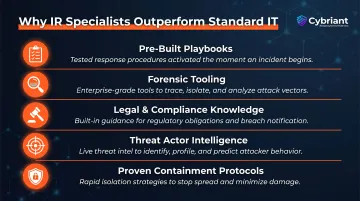
Why IR specialists deliver faster, better outcomes:
- Pre-built response playbooks for immediate action without guesswork
- Forensic tooling and expertise to reconstruct attack chains and identify entry points
- Legal and compliance knowledge for breach notification obligations under HIPAA, state privacy laws, and other regulations
- Threat actor intelligence to understand attacker tactics and prevent reinfection
- Proven containment protocols that balance evidence preservation with operational recovery
Time-to-containment is what separates a contained incident from a catastrophic one. The global median dwell time for ransomware intrusions dropped to just 5 days in 2023 - meaning attackers move fast once inside your network. IR specialists bring the experience and tooling to respond faster, stopping encryption before it reaches your entire infrastructure.
Immediate Containment: The Critical First Hours After a Ransomware Attack
In a ransomware context, containment means one thing: stopping lateral movement before encryption spreads from the initial infected endpoint to servers, backups, and connected systems. Every uncontained minute rapidly multiplies recovery complexity, data loss, and downtime costs. The first actions you take - or fail to take - in the opening hours determine whether you're back online in days or offline for weeks.
Isolate Before You Investigate
The first priority is physical or logical isolation of infected systems from the network. IR teams execute this through:
- Unplugging ethernet cables or removing devices from Wi-Fi
- Taking network switches offline at the segment level to isolate entire groups of systems
- Disabling VPN access points to prevent remote encryption from spreading
- Suspending cloud-based sync services (Google Workspace, Microsoft 365, Dropbox) that can automatically propagate encrypted files to cloud storage
Critical operational security consideration: IR teams use out-of-band communication during isolation - phone calls, separate mobile devices, or pre-established secure channels - to coordinate response without alerting threat actors. Attackers who've deployed ransomware are often still monitoring internal email, chat, and network traffic. Tipping them off prematurely can trigger accelerated encryption or immediate data exfiltration.
The power-down decision: Powering down an infected device stops encryption but destroys volatile memory evidence - active processes, network connections, and encryption keys. IR professionals weigh this tradeoff based on context.
If a device is actively encrypting critical data and can't be isolated from the network, powering down takes priority. If isolation succeeds, keeping the system running preserves forensic evidence that reveals how attackers got in and what they accessed.
Identify Scope and Prioritize Critical Systems
Once isolation begins, IR teams triage systems to determine which systems are infected and actively encrypting, which are clean but at risk, and which are most critical to business continuity.
Prioritization by business function - not technical severity - leads to faster operational recovery. IR specialists prioritize systems based on:
- Finance systems (payroll, accounts payable, billing)
- Customer-facing systems (CRM, e-commerce platforms)
- Operational infrastructure (authentication servers, ERP systems)
- Data repositories with regulatory implications (PHI, PII, payment card data)
Technical severity alone doesn't tell you which systems your business needs most urgently to resume operations.
That prioritization calculus also depends on how far attackers have already moved - which brings dwell time into the picture.
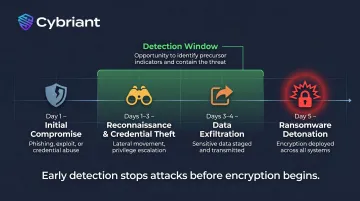
Understanding dwell time: Dwell time is the period between initial compromise and detection. Attackers don't immediately deploy ransomware. They spend days or weeks conducting reconnaissance, stealing credentials, and exfiltrating data before triggering encryption. Monitoring for early indicators before ransomware fully deploys can stop an attack at the precursor stage:
- Unusual network traffic patterns (large data transfers, connections to external IPs)
- Unauthorized remote access tools (RDP sessions, remote admin software)
- Abnormal file access patterns (mass file reads, privilege escalation attempts)
With a median dwell time of just 5 days, organizations that detect these precursors gain precious time to contain threats before ransomware detonates.
Eradication and Forensic Investigation
After containment stabilizes the situation, the forensic investigation phase begins. This isn't optional - skipping forensic analysis means you don't know how attackers got in, whether they're still in your environment, or what data they stole. IR specialists analyze system logs, file access records, and network traffic to reconstruct the complete attack chain.
The forensic investigation answers critical questions:
- Initial entry vector: How did attackers gain access? Phishing email, exposed RDP, compromised credentials, or unpatched vulnerability?
- Lateral movement: What systems did attackers access after initial compromise, and how did they escalate privileges?
- Data exfiltration: Was sensitive data stolen before or during encryption, indicating a multi-extortion scenario?
Entry methods have changed. Exploitation of vulnerabilities now accounts for 38.6% of ransomware attacks, overtaking phishing (17%) and joining compromised credentials (20.5%) as primary entry points. That shift puts patch management and credential hygiene at the front of any defense strategy.
The Persistence Threat
Ransomware operators rarely encrypt files and disappear. They plant persistence mechanisms to maintain access even after the visible ransomware is removed. Missing even one backdoor means attackers can return weeks or months later to deploy ransomware again or sell that access to other threat actors.
Common persistence mechanisms IR teams hunt for:
- Backdoors and remote access tools installed in system directories
- Rogue administrator accounts created for future access
- Modified scheduled tasks that automatically execute malware on system startup
- Registry modifications that trigger malicious code during user logon
- System service modifications that run attacker tools at boot
IR teams conduct deep audits to find and eliminate these footholds before declaring the environment clean. This phase requires forensic expertise and specialized tools that general IT staff typically don't possess.
Multi-Extortion: The Current Ransomware Norm
Modern ransomware attacks aren't just about encryption - they're about multi-extortion. By late 2022, threat actors engaged in data theft in approximately 70% of ransomware cases, up from roughly 40% in mid-2021. Attackers now routinely steal sensitive data before encrypting it and threaten to publish on dark web leak sites, adding reputational and regulatory pressure.
IR services must assess whether data was exfiltrated and guide organizations on breach notification obligations under HIPAA, state privacy laws (California CPRA, Virginia CDPA, etc.), or other applicable regulations.
Forensic analysis identifies the signs: large outbound data transfers, use of file compression tools, connections to attacker-controlled cloud storage. Each finding determines whether notification requirements apply.
The Eradication Process
Eradication means removing every trace of attacker presence from the environment:
- Removing confirmed malware binaries and associated registry entries
- Revoking compromised credentials and resetting all administrative passwords
- Patching the exploited vulnerability or closing the abused access point
- Deleting rogue accounts and unauthorized remote access tools
- Validating that no traces of attacker tools remain across all affected systems
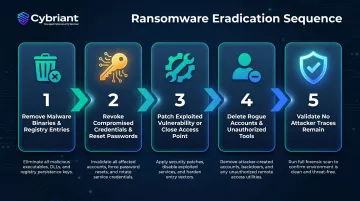
Thorough eradication, validated through forensic analysis, is the prerequisite for recovery. Organizations that skip this step and restore from backups directly risk reinfection within days.
Rapid Recovery: Restoring Operations Without Paying the Ransom
The primary recovery principle: restoring from verified, clean, offline or immutable backups is almost always faster, safer, and less expensive than paying a ransom. The data supports this clearly. Organizations that used backups to recover data experienced a median recovery cost of $375,000 - half the $750,000 median cost incurred by organizations that paid the ransom.
Why paying ransoms is strongly discouraged:
- No guarantee of decryption: Payment doesn't ensure you'll receive a working decryptor or recover all data
- Legal and sanctions risks: The U.S. Department of the Treasury warns that facilitating payments to sanctioned entities violates OFAC regulations under strict liability, with license applications reviewed under a "presumption of denial"
- Doesn't prevent future attacks: The FBI explicitly states it does not support paying ransoms, noting that payment incentivizes further criminal activity and doesn't protect you from being targeted again
Backup Integrity and Restoration Sequencing
Before restoring anything, IR teams verify backup integrity through several critical checks:
- Confirm backups weren't encrypted: Ransomware variants actively seek out and encrypt accessible network backups
- Ensure backups pre-date initial compromise: Restoring a backup from after attackers gained access reintroduces their foothold
- Stage restoration in an isolated environment: Restoring into the production network risks reintroducing malware if backups are compromised
IR teams look for the 3-2-1 backup rule during recovery assessments:
- 3 copies of your data (production data plus two backups)
- 2 different media types (e.g., local disk plus cloud storage)
- 1 copy stored offsite or in immutable cloud storage that can't be encrypted or deleted
Organizations that follow this principle face significantly shorter recovery timelines and far less pressure to consider ransom payments. Organizations without offsite or immutable copies - especially those whose only backups sat on network-attached storage that ransomware encrypted - face a stark choice: pay or accept permanent data loss.
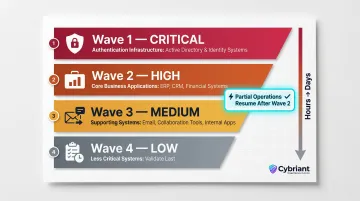
Prioritized restoration sequence enables partial operations within hours:
- Authentication infrastructure (Active Directory, identity management systems) restored first to enable user access
- Core business applications (ERP, CRM, financial systems) restored next to resume critical functions
- Supporting systems (email, collaboration tools, internal applications) restored in subsequent waves
- Less critical systems remain offline until the environment is fully validated
This staged approach allows organizations to resume partial operations - taking customer orders, processing payments, accessing critical data - within hours rather than waiting days for a complete restore.
Decryption Without Paying: When It's Possible
For some ransomware variants, free decryption tools exist. Law enforcement agencies and security researchers have developed decryptors for specific strains and make them available through initiatives like No More Ransom, a partnership between Europol, law enforcement agencies, and cybersecurity companies.
IR specialists identify the specific ransomware strain during forensic analysis and check for available decryptors before any payment is considered. Strain identification - through analysis of ransom notes, file extensions, and encryption markers - happens early in the process. For organizations hit by strains with published decryptors, this step alone can eliminate the ransom decision entirely.
Post-Incident Hardening and Building Long-Term Resilience
Recovery doesn't end when systems are restored. Post-incident activities determine whether your organization is better protected or remains vulnerable to the next attack.
The Post-Incident Review Process
After recovery, IR teams conduct a root cause analysis and produce a written report detailing:
- The attack vector and how attackers gained initial access
- Dwell time and timeline of attacker activity
- Full scope of impact (systems affected, data encrypted or stolen)
- Response timeline and effectiveness of containment measures
- Security gaps that enabled the attack
- Specific recommendations for remediation and hardening
This document drives security investment decisions, supports regulatory compliance reporting where required, and provides documentation for cyber insurance claims.
Security Improvements IR Findings Typically Drive
Immediate tactical hardening:
- Patching the exploited vulnerability or closing the abused access point
- Implementing or strengthening MFA across all remote access and privileged accounts (with stolen credentials acting as the initial action in 24% of breaches, robust MFA is critical)
- Deploying network segmentation to limit future lateral movement and contain breaches to isolated zones
- Updating or creating a formal incident response plan with pre-assigned roles, communication protocols, and backup restoration procedures
Long-term strategic improvements:
- Implementing offline or immutable backups that ransomware can't encrypt
- Deploying endpoint detection and response (EDR) solutions with behavioral analysis
- Establishing 24/7 security monitoring to detect threats as they emerge
- Conducting regular security awareness training to reduce phishing and social engineering success
These hardening measures address known gaps - but sustained protection requires ongoing visibility into what's happening across your environment.
The Role of Continuous Monitoring in Preventing Repeat Attacks
Organizations that implement 24/7 SIEM monitoring can detect ransomware precursor activity before encryption begins. Managed SIEM services aggregate logs from across the entire IT infrastructure - firewalls, endpoints, servers, cloud applications - and use AI-powered detection alongside human analysis to identify:
- Credential stuffing attempts and brute force attacks
- Unauthorized enumeration of network resources
- Anomalous data movement patterns indicating exfiltration
- Privilege escalation attempts
- Deployment of unauthorized remote access tools
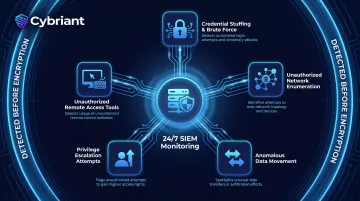
Catching these indicators at the precursor stage - before ransomware deploys - dramatically reduces dwell time and the likelihood of a successful attack. Cybriant's Managed SIEM service provides this continuous oversight, with 24/7 monitoring by security analysts who can immediately contain threats when detected.
What to Look for in a Ransomware Incident Response Service Provider
Not all IR providers deliver the same capabilities or outcomes. When evaluating potential partners, apply these critical criteria:
Essential evaluation factors:
- Guarantees 24/7 availability with defined response time SLAs - attacks don't wait for business hours
- Follows established frameworks (NIST, SANS) rather than improvised approaches
- Integrates with your existing EDR, SIEM, backup platforms, and security infrastructure
- Has documented experience handling HIPAA, PCI-DSS, or SOC 2 incidents and understands breach notification obligations
- Conducts full forensic investigations to identify entry vectors, persistence mechanisms, and data exfiltration
The value of an MSSP combining proactive managed security with reactive incident response: Organizations that already have a managed security partner in place before an attack occurs gain significant advantages:
- Response is faster because your MSSP already knows your environment, tooling, and business priorities
- No time lost learning your infrastructure during an active crisis
- Pre-negotiated service terms reduce the total cost of incident response
- Continuous monitoring enables early threat detection and immediate escalation to IR specialists
Cybriant provides both sides of this equation - proactive managed security and specialized incident response under one roof. With over 10 years of experience, SOC 2 Type 2 certification, and five consecutive years on MSSP Alert's Top 250 MSSPs list, Cybriant's 24/7 Managed SIEM and real-time vulnerability scanning keep threats visible before they escalate - and IR specialists ready when they do.
Frequently Asked Questions
What is the incident response plan for a ransomware attack?
A ransomware IR plan is a documented framework outlining detection, isolation, containment, eradication, recovery, and post-incident review steps. It includes pre-assigned roles, communication protocols, and backup restoration procedures that organizations follow when an attack occurs to minimize damage and accelerate recovery.
What are the 7 steps of incident response?
The standard incident response lifecycle covers Preparation, Identification, Containment, Eradication, Recovery, and Lessons Learned. Seven-step frameworks typically separate Detection from Analysis or add a dedicated Communication/Reporting step for stakeholder notifications and regulatory requirements.
What is containment of ransomware?
Containment means stopping ransomware from spreading to additional systems by isolating infected devices from the network, disabling remote access points, and suspending cloud sync services. The goal is to limit the blast radius and prevent further encryption while investigation and eradication begin.
Is paying ransom illegal in the US?
Paying ransom is not automatically illegal, but it may violate OFAC regulations if the threat actor is a sanctioned entity, exposing your organization to strict liability. Organizations should consult legal counsel and notify the FBI before any payment consideration, and both law enforcement and cybersecurity experts generally advise against paying.
Can ransomware be removed without paying the ransom?
Yes, in many cases ransomware can be removed without payment through malware eradication tools, restoration from clean backups, and - for some strains - publicly available decryption keys from initiatives like No More Ransom. Successful recovery depends on backup integrity and the specific ransomware variant deployed.
How long does ransomware recovery take?
Recovery timelines range from days to weeks depending on infection scope, backup integrity, system complexity, and whether a professional IR team is engaged. Organizations with tested backup plans and an active IR partner often resume partial operations within hours rather than days.
When ransomware strikes, every decision matters. Organizations that engage professional incident response expertise, follow proven containment procedures, and invest in post-incident hardening consistently reduce immediate damage and lower the risk of repeat attacks. Having the right IR partner in place before an attack - not after encryption has started - is what separates hours of disruption from weeks of operational loss. Cybriant's incident response and 24/7 managed detection services put that partner in place ahead of time, with rapid containment and recovery when minutes count. Call 844-411-0404 to put a ransomware response plan in place before you need it.