Introduction
Healthcare organizations face an unforgiving reality: they remain the most targeted industry for cyberattacks and bear the highest breach costs globally. The 2025 IBM Cost of a Data Breach report confirms that healthcare recorded an average breach cost of $7.42 million - the highest among all industries for the 15th consecutive year. The human cost is just as stark: 72% of healthcare organizations that experienced cyberattacks reported disruption to patient care, including increased medical complications and longer patient stays.
Small and mid-sized healthcare providers face a real dilemma: they need executive-level cybersecurity leadership to navigate HIPAA compliance and escalating threats, but a full-time Chief Information Security Officer is rarely affordable or justifiable.
A healthcare virtual CISO (vCISO) closes that gap. It delivers the same strategic oversight, regulatory expertise, and risk management capabilities of an in-house security executive at a fraction of the cost.
This article explains what a healthcare vCISO does, how they support HIPAA compliance and proactive risk management, and what to look for when choosing a provider.
Overview
- Healthcare breach costs average $7.42 million, the highest of any industry for 15 years running
- A healthcare vCISO delivers executive security leadership and HIPAA oversight on a flexible, part-time basis
- Services cover HIPAA's Security Rule, required risk analyses, and third-party vendor risk management
- Scalable engagements cost significantly less than a full-time CISO hire, with no loss of regulatory depth
- Prioritize providers with CISSP, CISM, or HITRUST credentials, SOC 2 Type 2 certification, and verified healthcare experience
Why Healthcare Is One of the Most Targeted Industries for Cybercrime
Healthcare remains a prime target for cybercriminals because protected health information (PHI) is more valuable than financial data. Medical records fuel identity theft, insurance fraud, and prescription drug schemes - making them persistently useful to attackers long after a breach.
The industry compounds that risk with legacy systems and limited security resources, creating exploitable gaps that threat actors know how to find.
Primary Threat Vectors
Healthcare organizations face an evolving set of attack methods that directly threaten operations and patient safety:
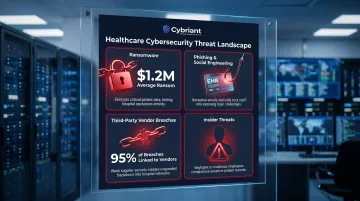
- Ransomware attacks - Healthcare paid an average ransom of $1.2 million in 2025, with attacks shutting down clinical systems and delaying patient care for weeks at a time.
- Phishing and social engineering - Staff with broad data access are targeted with credential-harvesting campaigns designed to gain entry to electronic health record (EHR) systems.
- Third-party vendor breaches - According to the American Hospital Association, 95% of the most significant health sector breaches in 2023 originated from business associates and third parties.
- Insider threats - Employees with legitimate access may intentionally or inadvertently expose PHI through policy violations or negligence.
Compounding Regulatory Pressure
The threat landscape is complicated by strict regulatory requirements. HIPAA violations carry civil penalties up to $1.5 million per violation category annually, and the HHS Office for Civil Rights (OCR) actively enforces compliance. The January 2025 Notice of Proposed Rulemaking (NPRM) introduces explicit requirements for multi-factor authentication (MFA), encryption, and vulnerability management - removing much of the ambiguity around "addressable" specifications and increasing the compliance burden on organizations that lack dedicated security leadership to navigate it.
What Is a Healthcare Virtual CISO?
A healthcare virtual CISO is an external cybersecurity expert who provides the strategic leadership, governance, and compliance management of a full-time Chief Information Security Officer - on a flexible, part-time or contract basis.
Unlike general IT consulting, which is project-based and tactical, a vCISO delivers ongoing executive-level direction and risk program oversight tailored to the organization's operational and regulatory environment.
What Makes Healthcare vCISOs Different
A healthcare vCISO brings specialized knowledge that general vCISOs may lack:
- Understands the three-part HIPAA Security Rule structure and maps technical, administrative, and physical safeguards to organizational controls across HIPAA, HITECH, and HITRUST frameworks
- Knows how to secure medical devices, EHR systems, and clinical workflows without disrupting patient care
- Recognizes healthcare-specific threats - including ransomware targeting clinical systems, vendor risk from business associates, and breach notification compliance
Core Responsibilities
A healthcare vCISO typically handles:
- Strategic security planning and cybersecurity roadmap development aligned with organizational goals
- HIPAA compliance oversight, audit preparation, and documentation management
- Incident response planning and leadership during security events
- Vendor and business associate risk assessment
- Executive and board-level security reporting and communication
vCISO vs. Fractional CISO: What's the Difference?
The terms are often used interchangeably, but the difference comes down to structure. "Fractional CISO" typically implies a fixed part-time schedule - for example, 10 hours per week or two days per month.
A vCISO engagement can vary more widely, from advisory-only consultations to comprehensive program management, depending on scope and budget. Both models deliver executive-level guidance without the overhead of a full-time hire.
Who Benefits Most?
Healthcare vCISO services are ideal for:
- Small to mid-sized hospitals without the budget for a full-time CISO
- Physician groups and specialty clinics handling ePHI
- Healthcare IT vendors and business associates who need HIPAA expertise
- Organizations preparing for audits, mergers, or regulatory reviews
- Practices lacking in-house security leadership or compliance staff
How a Healthcare vCISO Supports HIPAA Compliance
HIPAA's Security Rule requires covered entities and business associates to implement safeguards protecting the confidentiality, integrity, and availability of electronic protected health information (ePHI). A healthcare vCISO ensures organizations meet these requirements and can demonstrate compliance when HHS audits or OCR investigations arise.
Mapping to HIPAA's Three-Part Security Rule
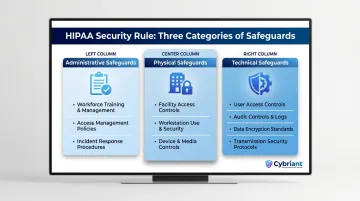
The Security Rule is organized into three categories of safeguards. A healthcare vCISO maps security controls and policies directly to each:
- Administrative Safeguards - Policies and procedures to manage security measures, including workforce training, access management, and incident response procedures
- Physical Safeguards - Measures to protect physical access to facilities, workstations, and electronic media
- Technical Safeguards - Technology controls such as access controls, audit logs, encryption, and transmission security
Conducting the HIPAA-Required Security Risk Analysis (SRA)
Under 45 CFR 164.308(a)(1)(ii)(A), covered entities must conduct an accurate and thorough Security Risk Analysis. The SRA is an ongoing process: identifying threats to ePHI, evaluating existing controls, and producing written documentation that satisfies regulatory expectations.
Enforcement data underscores the importance of a defensible SRA. Recent OCR settlements explicitly citing SRA failures include:
- Assured Imaging (2026): $375,000 settlement after a ransomware attack; OCR found the entity "has never conducted a compliant Security Rule risk analysis."
- Consociate Health (2026): $225,000 settlement following a phishing and ransomware attack; OCR cited failure to conduct an accurate and thorough risk analysis.
- MMG Fusion (2026): $10,000 settlement for a business associate that failed to conduct an accurate risk analysis after a breach affecting 15 million individuals.
A vCISO conducts the SRA, documents findings, prioritizes remediation, and updates the analysis as emerging threats and the organizational environment change.
Implementing Updated HIPAA Security Rule Controls
The January 2025 NPRM - still a proposed rule and not yet finalized as of publication - introduces explicit requirements that were previously "addressable." A healthcare vCISO ensures implementation of:
- Multi-factor authentication (MFA) across systems, with limited exceptions requiring compensating controls
- Encryption for ePHI at rest and in transit
- Automated vulnerability scanning at least every six months or per risk analysis
- Penetration testing at least once every 12 months by a qualified person
- Patch management programs with technical controls for timely installation
Managing Business Associate Agreements and Vendor Risk
Healthcare organizations share PHI with dozens of third-party vendors, and HIPAA holds covered entities accountable for business associate (BA) compliance. The updated NPRM proposes annual written analysis and certification by a subject matter expert verifying BA technical safeguards. A vCISO builds and oversees a vendor risk management process to assess, monitor, and document each vendor's security controls and compliance status.
Preparing for Breach Notification Compliance
HIPAA requires covered entities to notify affected individuals, HHS, and sometimes media within strict timelines - without unreasonable delay and no later than 60 days following discovery of a breach. A vCISO ensures incident response plans include these notification workflows and that documentation is in place before an event occurs.
Healthcare vCISO Services and Proactive Risk Management
A healthcare vCISO shifts organizations from reactive firefighting to proactive risk management, identifying and mitigating threats before they can be exploited. This continuous approach reduces both the likelihood and impact of security incidents.
Building a Continuous Risk Management Program
Rather than responding to incidents after they occur, a vCISO establishes ongoing processes that include:
- Regularly scheduled risk assessments and gap analyses
- Vulnerability scans and threat landscape reviews
- Continuous monitoring of security controls
- Periodic reassessment of third-party vendor risk
Developing and Testing Incident Response Plans
A healthcare vCISO develops a comprehensive incident response plan (IRP) tailored to the organization's clinical and operational environment. This means defining roles across IT, legal, compliance, and clinical leadership, establishing communication protocols for all stakeholders, and conducting tabletop exercises that simulate real attack scenarios. Plans are refined continuously based on lessons learned from both exercises and actual events.
Integrating with Security Operations and Monitoring
A vCISO integrates with the organization's broader security operations, including tools like Security Information and Event Management (SIEM) for continuous monitoring, threat detection, and log analysis. Providers like Cybriant offer 24/7 Managed SIEM with live monitoring and analysis, which is especially important in healthcare environments where threats can escalate rapidly and impact patient care.
Addressing Ransomware Risk in Healthcare
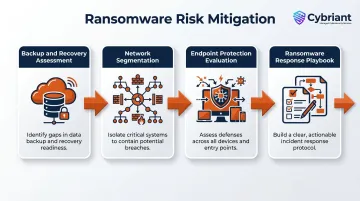
Ransomware poses a serious operational risk to healthcare operations. A vCISO addresses this risk through:
- Assessing backup and recovery capabilities to ensure rapid restoration
- Ensuring network segmentation to contain an outbreak and limit lateral movement
- Evaluating endpoint protection and detection capabilities
- Developing a ransomware-specific response playbook that accounts for clinical continuity during an attack
Communicating Risk to Non-Technical Stakeholders
Boards, hospital administrators, and executives need to understand cybersecurity risk in business terms, not technical jargon. A healthcare vCISO translates risk findings into clear, actionable reporting that informs budget decisions, staffing priorities, and organizational security investments.
Key Benefits of Choosing a Virtual CISO Over a Full-Time Hire
Healthcare organizations, especially smaller providers, face financial and operational constraints that make a full-time CISO impractical. A vCISO delivers executive-level security leadership at a fraction of the cost, with additional advantages in expertise and flexibility.
Cost-Effectiveness
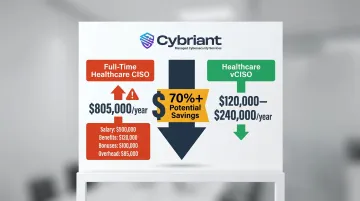
According to Heidrick & Struggles (2025), the average U.S. CISO earns $1,447,000 in total compensation, with healthcare-specific CISOs averaging $805,000. The vCISO model changes that math significantly:
- Full-time healthcare CISO: ~$805,000/year in total compensation
- vCISO retainer: $10,000–$20,000/month ($120,000–$240,000/year)
- Potential savings: 70% or more, even at the high end of vCISO pricing
For smaller organizations, that difference funds technology upgrades, staff training, and security tools.
Access to Specialized Expertise
A vCISO brings cross-industry experience and deep knowledge of healthcare-specific regulations, threats, and best practices that an in-house hire may not possess. This matters especially in smaller markets where the qualified candidate pool is thin. vCISOs stay current on evolving threats, regulatory updates, and emerging security frameworks - that ongoing expertise is built into the engagement model.
Flexibility and Scalability
vCISO engagements can expand during high-demand periods - audit seasons, incident response, merger and acquisition activity - and scale back when needs are lower. This gives healthcare organizations responsive support without long-term fixed overhead. For organizations navigating rapid growth or regulatory change, that adaptability is difficult to replicate with a single full-time hire.
How to Choose the Right Healthcare vCISO Provider
Selecting the right vCISO provider requires evaluating qualifications, service scope, integration capabilities, and the provider's own security posture.
Key Qualifications to Evaluate
Look for providers with:
- Healthcare industry experience - Demonstrated work with hospitals, clinics, physician groups, or healthcare IT vendors
- Relevant certifications - CISSP (Certified Information Systems Security Professional), CISM (Certified Information Security Manager), and CRISC (Certified in Risk and Information Systems Control) demonstrate expertise in security management and risk governance
- HIPAA and HITRUST knowledge - Familiarity with HITRUST r2 (the highest level of certifiable assurance) or HITRUST e1 (foundational assurance)
- Track record - References from healthcare clients and the ability to explain their approach to HIPAA risk analysis and compliance program management
Service Scope and Integration
A strong healthcare vCISO partner integrates with your IT team, coordinates with legal and compliance staff, and provides hands-on implementation support - not just strategy documents. Ask prospective providers:
- How do they handle incident response?
- How often do they communicate with executive leadership?
- What ongoing deliverables are included in the engagement?
- Can they provide examples of security roadmaps and board-level reporting?
Trust and Operational Alignment
Once you've evaluated service scope, turn to the provider's own security posture. A vCISO handling PHI must follow the same data handling standards they're advising you on.
Look for providers holding SOC 2 Type 2 certification, which independently verifies that a service organization maintains effective controls around security, availability, processing integrity, confidentiality, and privacy. Cybriant, for example, is SOC 2 Type 2 certified with over 10 years of managed cybersecurity experience - giving healthcare clients an independently verified baseline rather than a self-asserted claim.
Also confirm that the provider will sign a Business Associate Agreement (BAA) as required under HIPAA.
Frequently Asked Questions
What does a healthcare virtual CISO do differently than a general vCISO?
A healthcare vCISO has specialized knowledge of HIPAA, HITECH, and HITRUST frameworks, along with experience addressing healthcare-specific threats like ransomware targeting clinical systems and medical device vulnerabilities - expertise that a general vCISO may lack.
Can a vCISO help a healthcare organization pass a HIPAA audit?
While no one can guarantee an audit outcome, a vCISO systematically prepares the organization by conducting Security Risk Analyses, implementing required safeguards, documenting policies and procedures, and training staff - all of which are central to what auditors evaluate.
How much does a healthcare virtual CISO service typically cost?
vCISO costs vary based on scope and engagement model. For healthcare organizations requiring HIPAA compliance oversight and audit preparation, monthly retainers typically range from $10,000 to $20,000, which is considerably less than the cost of a full-time CISO hire.
Do small healthcare practices and clinics need a vCISO?
Yes - HIPAA applies to covered entities regardless of size. Small practices handling ePHI must still conduct risk analyses and implement security safeguards. A vCISO gives smaller organizations a cost-effective way to meet those requirements without a full-time hire.
What is the difference between a vCISO and a healthcare IT consultant?
A healthcare IT consultant typically addresses specific projects or implementations, while a vCISO provides ongoing executive-level security leadership, governance, and long-term direction for the organization's full security and compliance program.
How long does it take to onboard a healthcare vCISO?
Most engagements start with an initial security assessment and discovery phase. Active strategic work typically begins within a few weeks of contract execution, though timelines vary by provider and organizational complexity.
Ready to strengthen your healthcare organization's cybersecurity and HIPAA compliance? Contact Cybriant at 844-411-0404 to discuss how our vCISO services can provide the strategic leadership and regulatory expertise your organization needs - without the overhead of a full-time hire.