Introduction
Downtime in manufacturing equals lost revenue - a reality every plant manager understands. Cybersecurity has shifted from an IT concern to a core operational requirement. Manufacturing accounted for 26% of all cyber incidents globally in 2024, making it the most targeted sector by cybercriminals.
The threat is intensifying. As factories grow smarter through IIoT, AI, and cloud integration, every new connection becomes a potential entry point for attackers. Most manufacturing environments were built for reliability and uptime - not cybersecurity.
The convergence of IT and operational technology (OT) has created an expanded attack surface that legacy systems were never designed to defend.
This guide covers why manufacturers are prime targets, the unique challenges of IT/OT convergence, the real cost of incidents, the most common threats, and how to build layered defenses that protect operations without disrupting production.
Overview
- Manufacturing faces the highest cyber incident rate globally, with ransomware and phishing as primary entry points
- IT/OT convergence dramatically expands attack surfaces, especially when legacy equipment lacks built-in security
- Cyberattacks halt production lines, delay shipments, and damage customer relationships before containment is even possible
- Network segmentation, 24/7 monitoring, access controls, and training form the foundation of effective defense
- Managed security partners deliver continuous coverage and OT expertise that internal teams rarely have the capacity to maintain
Why Manufacturing Is a Prime Cyber Target
Attackers focus on manufacturing for specific reasons: production disruptions create immediate financial pressure, making ransom payments more likely. The median ransom payment in manufacturing was $1.2 million - well above the cross-industry average of $325,000 - because downtime costs are so severe. Many facilities lack dedicated cybersecurity teams or mature security programs, leaving security gaps that attackers actively exploit.
Industry 4.0 is widening the attack surface. As factories integrate IIoT sensors, cloud-connected equipment, AI-driven analytics, and remote access tools, each technology layer introduces new exposure. Smart factory initiatives are outpacing the security controls built to protect them. Industrial ransomware attacks surged 87% in 2024, totaling 1,693 incidents.
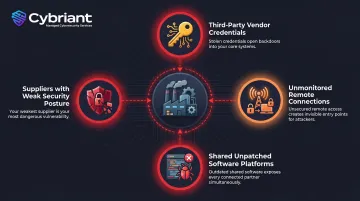
The risk doesn't stop at the facility perimeter. Manufacturers connect with dozens of vendors, suppliers, and logistics partners - and each relationship is a potential exploit path. A breach anywhere in that network can cascade into production disruptions across multiple organizations. Common supply chain exposure points include:
- Third-party vendor credentials with excessive system access
- Unmonitored remote connections from logistics and maintenance partners
- Shared software platforms with unpatched vulnerabilities
- Suppliers with weaker security postures than the primary facility
The Most Common Cyber Threats Targeting Manufacturers
Ransomware
Ransomware targeting manufacturers is specifically designed to lock production systems - ERP platforms, SCADA systems, and control networks - rather than just business data. 65% of manufacturing organizations were hit by ransomware in the prior year. Of incidents Dragos responded to, 75% led to partial OT shutdowns and 25% caused full shutdowns.
The financial impact is severe: 74% of attacks resulted in data encryption, and 93% of ransomware incidents involved attempts to compromise backups - 53% of those attempts succeeded.
Phishing and Business Email Compromise
Phishing accounts for 55% of manufacturing breach entry points, making malicious emails the most common ransomware delivery mechanism. Convincing impersonation attacks targeting finance, procurement, or plant managers can lead to credential theft, wire fraud, or malware installation. Stolen credentials appear in 25% of manufacturing breaches, frequently leading to ransomware deployment.
Supply Chain and Third-Party Attacks
Those stolen credentials often open a second door: third-party access. Attackers compromise vendors or contractors with legitimate connections to plant systems, sidestepping perimeter defenses without raising alerts. Common supply chain entry points include:
- Remote access tools used by equipment vendors or IT contractors
- Unpatched software in supplier-managed systems connected to OT networks
- Compromised credentials shared across partner organizations
- Malicious updates pushed through trusted software channels
The Core Challenge: IT and OT Convergence in Manufacturing Environments
Manufacturing environments run on two distinct technology layers. IT (information technology) systems handle business data and enterprise software. OT (operational technology) systems control physical processes - PLCs, SCADA systems, distributed control systems (DCS), and IIoT devices. Historically, these operated in isolation. Digital transformation has forced them together, opening once-isolated control systems to network-borne attacks.
The OT Security Design Gap
OT systems were engineered for reliability, physical safety, and continuous uptime - not cybersecurity. They run on proprietary protocols, older operating systems, and cannot be easily patched without risking production disruption. 70% of vulnerabilities identified were deep within OT networks, making them difficult to patch without operational impact.
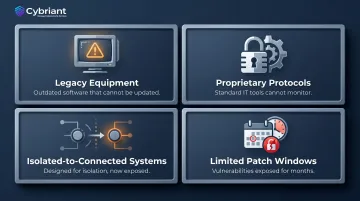
Key OT security challenges:
- Legacy equipment running outdated software that cannot be updated
- Proprietary protocols that standard IT security tools cannot monitor
- Systems designed for isolated networks, now exposed through connectivity
- Patching windows limited to scheduled maintenance, leaving vulnerabilities exposed for months
Flat Networks and the Visibility Gap
Many facilities operate on flat, unsegmented networks where an attacker gaining a foothold in any part can move laterally throughout the entire environment. 45% of service engagements revealed a lack of visibility across OT networks, hindering detection and response. Without an accurate, real-time inventory of every connected device, manufacturers cannot protect what they cannot see.
The Skills Gap
IT security teams are not typically trained in OT protocols and industrial systems. OT engineers are not security specialists. This creates a governance gap where neither team has full ownership of converged environment security. 42.5% of manufacturing ransomware victims cite a lack of expertise as a root cause. Manufacturers routinely adopt new factory-floor technology without any security review.
Third-Party Remote Access Risk Within OT
Vendors, equipment manufacturers, and maintenance contractors frequently require remote access to production systems. Without strict access controls, multi-factor authentication, and session logging, each connection is a potential attacker entry point that is difficult to audit.
The Real Cost of a Cyberattack on Manufacturing Operations
Direct Financial Impact
The average total cost of a data breach in the industrial sector reached $5.56 million in 2024 - an 18% increase from the prior year. This covers both lost production output and recovery expenses: system restoration, ransom payments (or the extended downtime that comes with refusing to pay), and infrastructure rebuilding.
Operational Ripple Effects Across the Supply Chain
When ERP platforms or control systems go offline, the impact extends beyond the plant floor. The downstream effects compound quickly:
- Orders go unfulfilled as production halts
- Shipping schedules collapse, breaking partner commitments
- Customer trust erodes with each delay
Industrial organizations took an average of 199 days to identify and 73 days to contain a breach, meaning these disruptions can stretch across months, not days.
Intellectual Property and Competitive Damage
Manufacturing environments hold proprietary designs, formulas, production methods, and supplier contracts. When this information is exfiltrated, recovery is rarely complete. 24% of manufacturing attacks involved data theft or IP targeting - and stolen designs routinely resurface in counterfeit products or competitor offerings within months.
Regulatory, Insurance, and Contractual Consequences
Manufacturers now face a growing web of regulatory requirements. A breach doesn't just disrupt operations - it activates financial and legal exposure across multiple fronts:
- Regulatory penalties from frameworks like NIST CSF or sector-specific standards
- CMMC compliance failures for defense contractors, potentially costing government contracts
- Insurance claim complications when controls were inadequate at the time of breach
- Contractual defaults with customers who mandate documented security practices
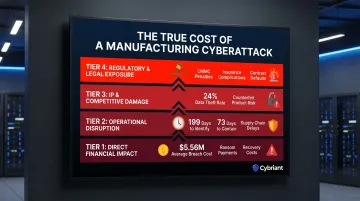
Each of these consequences compounds the direct cost of the attack itself, making proactive security investment far less expensive than recovery.
Cybersecurity Best Practices for Industrial Operations
Network Segmentation as a Foundational Control
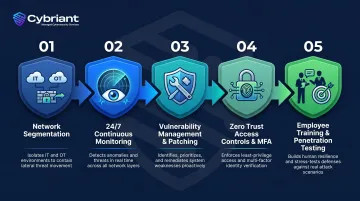
Separating IT from OT networks - and creating segmented zones within OT environments - is the single most impactful step manufacturers can take. For example, isolating critical control systems from general plant floor networks limits lateral movement and contains a breach before it reaches production-critical systems.
Segmentation strategies:
- Physical or logical VLANs to separate network zones
- DMZs between IT and OT with unidirectional gateways
- Zone-and-conduit architecture aligned with ISA/IEC 62443
- Firewalls controlling traffic between segments
Continuous 24/7 Monitoring Across IT and OT Environments
Threats that go undetected for days or weeks can cause catastrophic damage to production operations. A managed SIEM solution monitoring both IT and OT traffic around the clock gives security teams the visibility to catch anomalies before they escalate. Cybriant's 24/7 Managed SIEM pairs live traffic analysis with dedicated security professionals who triage alerts and coordinate remediation - purpose-built for environments where downtime isn't an option.
Consistent monitoring also creates the baseline needed to identify vulnerabilities before attackers do.
Vulnerability Management and Structured Patch Cycles
Manufacturers must balance patching urgency with production continuity. This means:
- Scheduling vulnerability scans during planned maintenance windows
- Prioritizing high-risk OT systems
- Testing patches before deployment in production environments
- Using real-time scanning to identify exposures before attackers exploit them
Zero Trust Access Controls and MFA for All Remote Connections
All remote access - whether by internal staff, vendors, or contractors - should require multi-factor authentication, be logged, and follow least-privilege principles. No user or device should be trusted by default, even if connecting from inside the network perimeter.
Key access control measures:
- MFA for all remote connections
- Jump servers as central authorization points between security zones
- Session logging and monitoring
- Time-limited access credentials
- Regular access reviews and revocation of unnecessary permissions
Employee Training, Phishing Awareness, and Penetration Testing
Plant floor employees and IT staff alike are frequent targets of phishing and social engineering attacks. Closing that gap requires a combination of ongoing training and active testing:
- Security awareness training tailored to manufacturing roles and scenarios
- Phishing simulations to reinforce recognition of common attack patterns
- Regular penetration testing to surface gaps in controls before attackers do
- Post-incident reviews to update training based on real-world findings
How a Managed Security Partner Strengthens Manufacturing Defenses
The In-House Resource Gap
Most manufacturing organizations - especially mid-sized facilities - do not have the security headcount or specialized expertise to monitor both IT and OT environments continuously. Managing vulnerabilities across hundreds of devices and maintaining incident response capability requires resources most manufacturers cannot justify building internally. This is why many turn to managed security service providers (MSSPs) who bring enterprise-grade capabilities without requiring a full internal security build-out.
What to Look for in an MSSP for Manufacturing
Not all MSSPs are equipped to handle the complexity of manufacturing environments. Prioritize providers that offer:
- 24/7 monitoring with live analyst coverage, not just automated alerts
- Proven experience across both IT and OT environments
- Real-time vulnerability management with active patch support
- Compliance assistance for frameworks like NIST CSF or CMMC
- A documented track record with industrial or operational clients
Cybriant checks each of these boxes - with 24/7 Managed SIEM, real-time vulnerability scanning, and over 10 years supporting businesses across industries, including complex operational environments.
Managed Security as an Operational Investment
Manufacturers who work with Cybriant typically see two immediate changes: faster detection of anomalous activity across both IT and OT, and a clear audit trail their insurers and customers can actually use. That's not a general MSSP benefit - it's what 24/7 monitoring with live analyst coverage delivers specifically. That resilience carries real business weight, protecting revenue, preserving contracts, and defending the operational reputation manufacturers spend years building. Talk to our team at 844-411-0404.
Frequently Asked Questions
What is cybersecurity in manufacturing?
Cybersecurity for manufacturing is the protection of production systems, operational technology, business data, and supply chain networks from cyber threats. Its goal is to maintain uptime, operational continuity, and data integrity while preventing unauthorized access, data loss, and production disruptions.
How do manufacturers get started with OT security?
Start with an asset inventory - you can't protect what you don't know exists. From there, conduct a risk assessment against a framework like NIST CSF or IEC 62443 to identify gaps. Many manufacturers work with an MSSP to run this process and implement controls without building an in-house security team from scratch.
What are some examples of managed services?
Managed services commonly used in manufacturing cybersecurity include:
- 24/7 managed SIEM and threat monitoring
- Managed detection and response (MDR)
- Vulnerability scanning and patch management
- Incident response services
- Compliance management for NIST CSF and CMMC
What are the most common cyberattacks targeting manufacturers?
Ransomware, phishing/business email compromise, and supply chain attacks are the top threats. Ransomware is particularly damaging because it targets both IT and OT systems to maximize production disruption and financial pressure on victims.
How does IT/OT convergence create cybersecurity risk in manufacturing?
OT systems were designed for uptime and safety, not security. Connecting them to IT networks exposes them to the broader threat landscape. Legacy OT devices that cannot be easily patched become vulnerable entry points that attackers can use to reach production-critical systems.
What cybersecurity framework should manufacturers follow?
The NIST Cybersecurity Framework (CSF) is the most widely adopted starting point, covering risk identification through response and recovery. For OT-specific environments, IEC 62443 provides more targeted guidance for industrial automation and control systems.