Introduction
Security decision-makers face an overwhelming challenge: an alphabet soup of cybersecurity acronyms, each promising protection - yet choosing the wrong solution can leave critical gaps in your defenses. According to IBM's Cost of a Data Breach Report 2024, the global average cost of a data breach reached $4.88 million, a 10% increase from 2023.
That financial exposure is compounded by a severe talent shortage. The ISC2 2024 Cybersecurity Workforce Study reveals a staggering global workforce gap of 4.8 million unfilled cybersecurity roles - a 19% year-over-year increase. With fewer skilled professionals available, picking the wrong security tool isn't just costly - it can leave real gaps that no one on your team has the bandwidth to catch.
The MDR vs SIEM question matters because these two solutions often appear side-by-side in vendor pitches but serve fundamentally different functions. This post covers:
- Clear definitions of MDR and SIEM
- A side-by-side feature comparison
- Key functional differences between the two
- A practical guide to choosing the right fit for your organization
Overview
- SIEM collects and correlates log data across your environment, providing visibility that still requires skilled in-house staff to interpret and act on
- MDR combines technology with human expertise to monitor, hunt threats, and respond to incidents 24/7 on your behalf
- Running SIEM in-house carries significant overhead - licensing, tuning, and analyst salaries - while MDR bundles those capabilities into a managed service
- Organizations with mature in-house security teams benefit most from SIEM's centralized visibility and compliance reporting
- Teams without dedicated security staff - or those needing end-to-end threat management - are better served by MDR
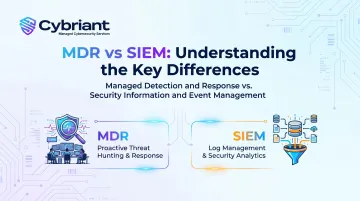
MDR vs SIEM: Quick Comparison
| Attribute | SIEM | MDR |
|---|---|---|
| Primary Purpose | Centralized log aggregation, correlation, and alerting for visibility and compliance | Active threat detection, investigation, and response delivered as a managed service |
| Operational Model | Technology platform (tool) requiring internal team management | Fully managed service with external security team included |
| Threat Response | Generates alerts only - your team must investigate and respond | Active remediation - analysts investigate, contain, and eliminate threats |
| Expertise Required | Requires skilled in-house analysts to tune, manage, and respond | External security experts included - no internal SOC needed |
| Compliance Support | Excellent for log retention, audit trails, and regulatory reporting (HIPAA, PCI-DSS, SOC 2) | Complements compliance efforts but typically doesn't replace logging requirements |
| Best Fit | Large enterprises with staffed SOCs; heavily regulated industries; organizations needing centralized data layer | SMBs and mid-market without security staff; organizations needing immediate protection; businesses wanting SOC capabilities without building one |
Note: Managed SIEM represents a middle ground where an MSSP operates the SIEM platform on your behalf, handling tuning, monitoring, and alert triage. Many organizations layer Managed SIEM with MDR for comprehensive protection.
What is SIEM?
Security Information and Event Management (SIEM) is a software platform that aggregates log and event data from across your entire IT environment - endpoints, servers, applications, network devices - into a centralized location for analysis, alerting, and reporting.
How SIEM Works
In practical terms, SIEM follows this workflow:
- Data ingestion - Collects logs from all connected systems
- Normalization - Standardizes data from different sources into a common format
- Correlation - Applies rules to identify patterns indicating potential threats
- Alert generation - Triggers notifications when suspicious activity is detected
- Analyst review - Your team interprets alerts and determines appropriate action
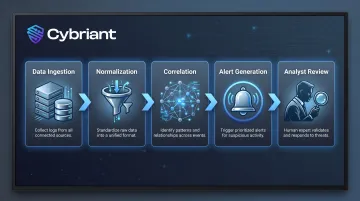
SIEM is fundamentally a tool, not a service. The organization's own team must interpret and act on the alerts it produces.
SIEM's Core Strengths
SIEM delivers three primary capabilities:
- Broad visibility - Aggregates data from your entire IT ecosystem into one centralized view of security events
- Compliance reporting - Built-in log retention and audit trails support HIPAA, PCI-DSS, SOC 2, and other regulatory requirements
- Forensic investigation - Long-term log retention enables detailed incident analysis and root cause determination
SIEM's Limitations
Despite its strengths, SIEM presents significant challenges:
- Alert fatigue - According to Verizon's 2024 DBIR, in 74% of breaches, alerts were generated but ignored because analysts were overwhelmed by volume
- Continuous tuning required - The Ponemon Institute found that 78% of users say configuring a SIEM effectively requires significant effort
- Skilled staff dependency - Running a SIEM with true 24/7 coverage requires a minimum of 5 full-time equivalents across shifts
- Lengthy deployment - Traditional SIEM deployments average six months to become operational
Use Cases of SIEM
SIEM delivers the most value for:
- Large enterprises with dedicated SOC staff who can act on SIEM alerts and run proactive threat hunting
- Highly regulated sectors like finance, healthcare, and government with strict compliance logging requirements
- Businesses that need a unified view across existing security tools for centralized data aggregation
Not every organization has the staff to run SIEM in-house. Managed SIEM closes that gap by outsourcing platform management, tuning, and alert triage to a provider like Cybriant, whose 24/7 Managed SIEM service typically becomes operational within days rather than months.
What is MDR?
Managed Detection and Response (MDR) is a fully outsourced cybersecurity service that combines advanced detection technology (often including EDR and network monitoring) with a dedicated team of security analysts who continuously monitor, investigate, and respond to threats.
What Makes MDR Different
MDR teams don't just flag potential threats - they actively investigate, contain, and remediate incidents, often before your internal team even needs to get involved. The 24/7 human-in-the-loop element is the defining characteristic. While automated tools generate alerts, experienced analysts validate them, hunt for hidden threats, and take decisive action.
MDR's Core Capabilities
MDR services deliver four essential functions:
- Continuous threat monitoring - 24/7 surveillance across endpoints and critical systems to detect threats as they emerge
- Proactive threat hunting - Analysts actively search for behavioral anomalies, attacker tactics, and indicators of compromise that automated rules might miss
- Incident investigation and response - When threats are confirmed, the MDR team contains and eliminates them, guiding remediation
- Security posture reporting - Regular updates on threat landscape, incidents addressed, and recommendations for strengthening defenses
MDR's Trade-Offs
MDR isn't the right fit for every organization. Before committing, weigh these trade-offs:
- Subscription-based cost - Predictable monthly or annual fees rather than capital investment
- Less customization - May feel less tailored than an in-house SIEM deployment you control directly
- External provider trust - Requires confidence in the provider's processes, expertise, and tooling
Use Cases of MDR
MDR delivers the most value for:
- SMBs and mid-market companies - Organizations without dedicated security staff who need professional-grade protection
- Post-breach organizations - Businesses that have experienced a security incident and need immediate, ongoing protection
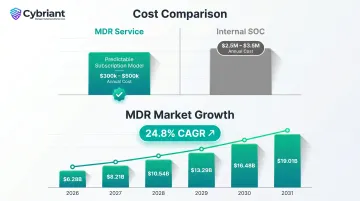
- Cost-conscious enterprises - Companies wanting SOC-level capabilities without the $2.5-3.5 million annual cost of building one internally
Demand reflects these pressures. MarketsandMarkets projects the MDR market will grow from $6.28 billion in 2026 to $19.01 billion by 2031 - a 24.8% compound annual growth rate - driven largely by organizations that can't staff or fund an internal SOC.
MDR vs SIEM: Key Differences Explained
Purpose and Scope
SIEM is fundamentally a visibility and alerting tool covering your broad IT environment. It tells you what happened by correlating events and generating alerts based on predefined rules. MDR is an outcome-focused service focused on active threat detection and response. It tells you what to do about it and then does it for you.
That distinction in purpose flows directly into how each solution handles the people behind the technology.
Human Expertise
SIEM is technology-dependent and requires in-house analysts to interpret data and respond to threats. You're responsible for hiring, training, and retaining qualified personnel.
MDR embeds human expertise into the service itself - threat hunters and incident responders are included. This addresses a critical challenge: the ISC2 2024 study reports 4.8 million unfilled cybersecurity roles globally. Organizations without access to this scarce talent can still achieve professional-grade security through MDR.
Staffing gaps also shape how each solution handles threats that don't follow a known playbook.
Proactive vs. Reactive
Traditional SIEM is largely reactive. It fires alerts based on pre-defined rules and correlation logic. If an attack doesn't match a known pattern, it may go undetected.
MDR is proactive. Analysts actively hunt for threats that haven't triggered any rules yet - looking for behavioral anomalies and indicators of compromise that automated logic misses, such as:
- Credential misuse and account takeover patterns
- Lateral movement between systems
- Dormant malware waiting to activate
- Attacker TTPs (tactics, techniques, procedures) not yet in rule libraries
Where MDR focuses on catching what rules miss, SIEM was purpose-built for a different requirement: documentation.
Compliance and Reporting
SIEM excels at compliance. It was built for log retention, audit trails, and regulatory reporting required by HIPAA, PCI-DSS, SOC 2, CMMC, and other frameworks. SIEM provides the documented evidence auditors demand.
MDR generally does not replace compliance logging - it complements it. Organizations in regulated industries often need both: SIEM for compliance documentation and MDR for active threat management.
Understanding that both tools often coexist makes cost structure the final practical question to answer.
Cost Structure and Deployment Time
SIEM (especially on-premises) requires significant upfront investment:
- Software licensing
- Hardware infrastructure
- 4-8 full-time staff during deployment
- 6-12 months to deploy properly
MDR is subscription-based and typically operational within days or weeks. This significantly reduces time-to-protection and converts unpredictable security costs into manageable monthly expenses. Cloud-based and Managed SIEM options have narrowed this gap somewhat, offering faster deployment than traditional on-premises SIEM.
MDR vs SIEM: Which Is Right for Your Business?
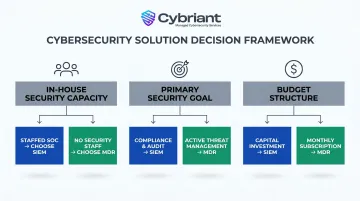
Choose the right solution based on three key factors:
1. In-House Security Capacity
- Already have a staffed SOC? SIEM amplifies your team's capabilities with centralized visibility and log correlation.
- No dedicated security staff? MDR fills that gap entirely, bringing the expertise and 24/7 coverage you don't have in-house.
2. Primary Security Goal
- Need compliance and audit trails? SIEM is purpose-built for log retention, regulatory reporting, and forensic documentation.
- Need active threat management? MDR focuses on detecting, investigating, and remediating real attacks as they happen.
3. Budget Structure
- Traditional SIEM carries upfront hardware, software, and staffing costs - a significant capital investment.
- MDR and Managed SIEM run on predictable monthly fees with no capital outlay, which simplifies budget planning considerably.
Situational Recommendations
Choose SIEM or Managed SIEM if you:
- Operate in a heavily regulated industry requiring detailed audit logs
- Need long-term log retention for forensic investigations
- Have an existing security team that needs better data and centralized visibility
Choose MDR if you:
- Lack in-house security staff or struggle to hire qualified analysts
- Need 24/7 coverage and active threat hunting
- Have experienced a security incident and need immediate expert-driven protection
- Want proactive defense without the cost of standing up a full internal SOC
Why Not Both?
MDR and Managed SIEM are complementary, not competing. Many organizations use Managed SIEM for compliance and visibility while layering MDR on top for active threat hunting and response. The combined approach covers detection, response, and compliance without requiring a fully staffed internal SOC.
Cybriant's CybriantXDR service takes exactly this approach - integrating Managed SIEM, MDR, and vulnerability management into one service that spans endpoints, network, and cloud workloads.
Conclusion
SIEM and MDR serve different functions. The right choice depends on your team's capabilities, compliance requirements, and how hands-on you need your security coverage to be. SIEM is a powerful tool that amplifies skilled teams. MDR is a complete service that acts as your security team.
If you're unsure which model fits your environment, Cybriant can help. As a SOC 2 Type 2 certified MSSP with over 10 years of experience in Managed SIEM and security monitoring, Cybriant works with businesses of all sizes to build coverage that matches their risk profile. Call 844-411-0404 to talk through your specific needs.
Frequently Asked Questions
What is the difference between SIEM and MDR?
SIEM is a technology platform that collects and analyzes security event data to generate alerts. MDR is a fully managed service that combines technology with human expertise to actively detect, investigate, and respond to threats on your behalf.
What is EDR vs MDR vs SIEM?
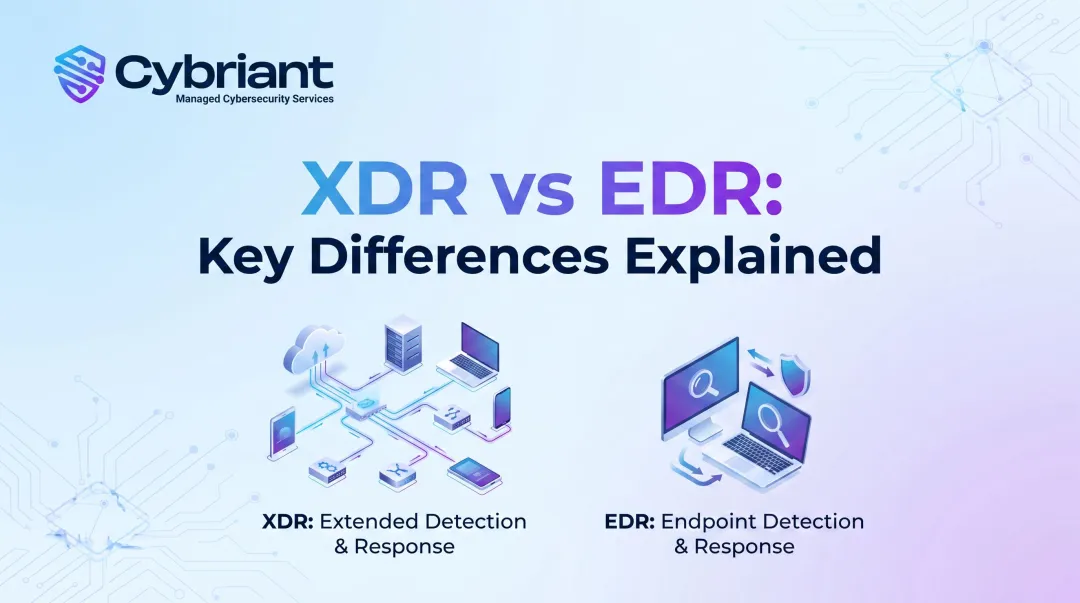
EDR (Endpoint Detection and Response) focuses on monitoring and responding to threats at the device level. SIEM aggregates log data across the entire IT environment for visibility and compliance. MDR is a managed service that typically layers on top of EDR and/or SIEM, adding 24/7 human-led monitoring and incident response.
What is the difference between managed SIEM and MDR?
Managed SIEM means an MSSP operates and monitors the SIEM platform on your behalf, handling tuning, alert triage, and compliance reporting. MDR adds active threat hunting, incident investigation, and hands-on remediation as part of the service.
What is the difference between managed EDR and managed SIEM?
Managed EDR focuses specifically on protecting endpoints (laptops, servers, mobile devices) with continuous monitoring and response. Managed SIEM covers the broader IT environment by aggregating and analyzing log data from all sources for compliance, visibility, and threat detection.
What are the three advantages of incorporating SIEM technology?
SIEM delivers three core advantages:
- Centralized visibility across all systems and data sources
- Compliance support with built-in log retention and audit reporting for regulations like HIPAA and PCI-DSS
- Faster threat detection through event correlation and automated alerting across the entire IT environment