Introduction
Attack surfaces are expanding at an unprecedented rate. Cloud infrastructure, API integrations, and third-party connections are proliferating faster than most internal security teams can track, let alone test. According to Salt Security's latest research, 66% of organizations report API growth exceeding 50% in just one year, creating an environment where penetration testing is no longer optional - it's foundational.
The more pressing decision is whether to build that capability internally or outsource it. When you examine actual operational outcomes - cost, risk reduction, compliance readiness, and vulnerability coverage - the case for outsourcing becomes hard to argue against.
This article breaks down the measurable, practical reasons businesses choose to outsource penetration testing, with specifics on what external testing delivers that in-house teams typically cannot replicate.
Overview
- External testers bring cross-industry experience and certifications most in-house teams can't match
- Outside assessors catch what internal familiarity causes teams to miss or rationalize away
- Outsourcing eliminates full-time hiring costs, expensive tooling licenses, and ongoing training overhead
- PCI DSS, HIPAA, and similar frameworks require third-party validation - outsourcing fulfills this directly
- Ongoing testing partnerships deliver far more value than annual point-in-time assessments
What Is Outsourced Penetration Testing?
Outsourced penetration testing means hiring an external security provider to simulate real-world cyberattacks against your systems, applications, or networks. The goal is straightforward: identify and report exploitable vulnerabilities before malicious actors do.
Testing typically covers web applications, internal networks, APIs, cloud infrastructure, and mobile apps. Scope is defined upfront based on what the organization needs to protect or validate. Cybriant's penetration testing services, for example, include external and internal network testing, web application assessments, social engineering evaluations, and cloud infrastructure testing.
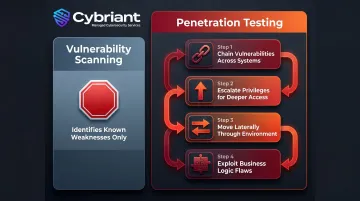
Penetration testing is fundamentally different from vulnerability scanning. Scanners identify known weaknesses - but they stop there. Penetration testing simulates how an attacker would:
- Chain vulnerabilities together across systems
- Escalate privileges to gain deeper access
- Move laterally through your environment
- Exploit business logic flaws that automated tools miss entirely
Key Advantages of Outsourcing Penetration Testing
Most organizations don't outsource penetration testing because it's trendy - they do it because building equivalent capability in-house is genuinely difficult, structurally biased, and costly. The three advantages below explain why external testing consistently outperforms internal alternatives.
Advantage 1: Access to Specialized Expertise That Is Difficult to Build In-House
External penetration testing providers maintain teams with diverse, cross-industry experience and certifications like OSCP, CREST, CEH, and GPEN - skills that take years to develop and are expensive to recruit and retain.
The global cybersecurity workforce gap stands at 4,763,963 people, according to the 2024 ISC2 study. ISACA's 2025 State of Cybersecurity Report found that 38% of organizations take three to six months to fill entry-level security roles, with the same timeline for senior positions. Half of organizations admit they struggle to retain cybersecurity talent once hired.
Outsourced teams bring exposure to attack techniques across dozens of environments - niche areas like cloud-native exploitation, API authorization flaws, and business logic testing that a single in-house hire rarely covers across all domains. Cybriant's penetration testing team covers external and internal networks, web applications, and cloud platforms including AWS, Azure, and Google Cloud, combining manual methodologies with automation to surface nuanced vulnerabilities automated tools overlook.
Organizations testing with experienced external professionals identify a broader and more realistic set of exploitable vulnerabilities, which translates directly to fewer undetected attack paths. This gap is most significant for organizations with multi-environment attack surfaces, niche systems, or active infrastructure changes such as cloud migrations or acquisitions.
Key metrics that improve with external expertise:
- Number of critical and high vulnerabilities identified per engagement
- Diversity of vulnerability types uncovered
- Time-to-discovery for business logic and chained-attack vulnerabilities
Advantage 2: Independent, Unbiased Assessment That Internal Teams Cannot Provide
Teams that built or maintain the systems they're testing carry unconscious assumptions about how those systems work. This familiarity creates blind spots. External testers have no such familiarity and approach the environment the way a real attacker would.
Internal testers have organizational incentives to soften findings, relationships with the team that wrote the code, and prior knowledge of what was "supposed to" work. External pen testers have none of these constraints, which makes their findings more likely to surface high-severity issues internal teams rationalize away.
NIST SP 800-115 explicitly states: "In some cases, engaging third parties offers an independent view and approach that internal assessors may not be able to provide". The European Central Bank's TIBER-EU framework echoes this, noting that "an external tester provides a fresh and independent perspective, which may not always be feasible with internal teams".
Regulators and auditors value third-party findings precisely because the tester has no stake in the outcome - making external reports stronger evidence of due diligence than internal assessments. Cybriant's network penetration testing delivers reports that satisfy compliance requirements for PCI DSS, HIPAA, and SOC 2, with the third-party impartiality auditors expect.
This independence matters most before major product launches, in post-acquisition assessments, during compliance audits, and anywhere internal security and development teams share reporting lines - situations where objectivity is structurally harder to achieve.
Key metrics that improve with independent testing:
- Severity distribution of findings (external testers typically surface more high/critical vulnerabilities)
- Audit pass rates
- Time-to-remediation for previously undetected vulnerabilities
Advantage 3: Cost Efficiency and Scalability Without the Overhead of an In-House Team
Building and maintaining a full-time in-house penetration testing capability requires competitive salaries for certified testers, expensive tooling licenses, ongoing training, and management overhead - costs that are difficult to justify for most SMBs and many mid-size enterprises.
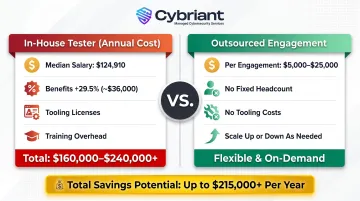
According to the U.S. Bureau of Labor Statistics, the median annual wage for Information Security Analysts was $124,910 in May 2024, with the top 10% earning more than $186,420. Employer benefits add another 29.5% of total compensation, bringing the fully-loaded annual cost to $160,000–$240,000 per tester - before tooling, training, or management overhead.
Outsourced engagements typically range from $5,000 to $25,000 depending on scope and complexity - a fraction of the annual cost of a single full-time hire. Organizations pay for testing when they need it, access certified security expertise on a project or retainer basis, and avoid carrying fixed headcount. Cybriant's flexible pricing options make this accessible without long-term hiring commitments.
Scalability is a practical benefit that's easy to underestimate. Organizations can request broader testing before a major launch, scale back during steady-state periods, and add specialized testing only when their attack surface requires it - without renegotiating headcount.
This advantage is most relevant for small and mid-size businesses that cannot justify full-time security hires, and for enterprises that need periodic deep testing across a broad or complex environment rather than continuous in-house coverage.
Key metrics that improve with outsourced testing:
- Annual security testing spend vs. vulnerabilities identified
- Testing frequency achievable within budget
- Time to initiate a new test engagement
What Happens When Businesses Skip Outsourcing Penetration Testing
Organizations that rely solely on internal vulnerability scans or outdated annual tests often develop a false sense of security. Vulnerabilities remain hidden, remediation is delayed, and the gaps become apparent only when an incident exposes what was missed.
Common downstream consequences:
- Business logic flaws and chained vulnerabilities that scanners miss stay in production environments, creating exploitable entry points
- Frameworks requiring third-party validation - PCI DSS, HIPAA, SOC 2 - go unmet, leading to audit failures or certification delays
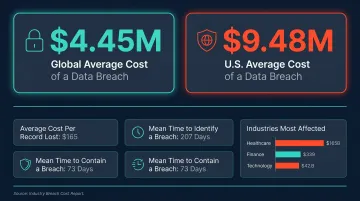
- The global average cost of a data breach is $4.44 million; U.S. organizations average $10.22 million - far higher than the cost of proactive testing
The 2025 Verizon Data Breach Investigations Report found that third-party involvement in breaches doubled to 30%, and vulnerability exploitation was present in 20% of all breaches. Both are recurring patterns that proactive testing directly addresses.
A breach enabled by an untested vulnerability damages customer trust, invites regulatory scrutiny, and sets back growth in ways that take years to recover from. HHS Office for Civil Rights settled a ransomware investigation for $375,000 after the organization failed to conduct an accurate risk analysis - a concrete example of what underinvesting in security testing costs.
How to Get the Most Value from Outsourced Penetration Testing
Outsourcing penetration testing only delivers full value when treated as a continuous security practice rather than a one-time compliance activity. Findings need to be acted upon, remediation verified, and testing repeated as systems evolve.
Cybriant builds this into its managed security model - combining automated scanning with manual expert analysis, structured remediation support, and reporting designed for both technical teams and executive stakeholders.
Operational conditions that maximize ROI:
- Define scope before the engagement begins, with objectives tied to your actual risk profile
- Choose the right methodology: black box for external attacker simulation, gray box for insider threat scenarios, or white box for deep code-level analysis
- Review findings with both technical and executive stakeholders so remediation gets prioritized - not shelved
- Track remediation progress across departments and verify fixes before closing findings
Selecting the right provider:
Look for certifications, sample reports, transparency in methodology, compliance mapping capabilities, and post-engagement retesting availability. These are the markers that distinguish a high-value partner from a commodity scan dressed up as a pen test. Cybriant's certified security experts conduct assessments following structured methodologies - including open source intelligence gathering, host discovery, enumeration, exploitation, and post-exploitation analysis.
Integration with compliance frameworks:
Three major frameworks set specific testing requirements:
- PCI DSS v4.0: Requires testing "at least once every 12 months and after any significant infrastructure or application change", performed by a qualified, organizationally independent resource
- HIPAA (proposed rules): Mandates "penetration testing at least once every 12 months by a qualified person"
- SOC 2: Auditors expect scoped, third-party penetration tests to satisfy Trust Services Criteria
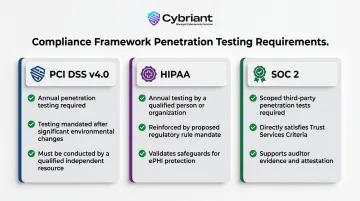
Cybriant's penetration testing reports are structured for regulatory and auditor review, detailing identified vulnerabilities, exploitation methods, potential impacts, and actionable remediation recommendations.
Conclusion
Outsourcing penetration testing gives organizations access to specialized expertise that's genuinely hard to build in-house, an objective view of risk that internal teams can't fully provide, and security coverage that scales without proportional cost increases.
These advantages compound when outsourcing becomes an ongoing practice rather than a one-time exercise. Over time:
- Each engagement deepens knowledge of the organization's attack surface
- Remediation quality improves with each retest cycle
- Compliance posture strengthens as findings are consistently addressed
Businesses that wait for a breach to validate their security posture have already paid the highest price. Outsourcing penetration testing is how organizations stay ahead of that cost, not react to it. Getting started is straightforward: define your in-scope assets and compliance drivers, request a scoping call, and Cybriant returns a fixed-scope proposal with timeline, methodology, and a retest window before any testing begins. Contact Cybriant at 844-411-0404 to scope your engagement and get started.
Frequently Asked Questions
What is the difference between outsourcing and in-house penetration testing?
In-house testing relies on internal staff with fixed skills and organizational familiarity, while outsourcing brings external experts with diverse cross-industry experience, independent perspective, and specialized certifications. Most organizations find outsourcing more cost-effective unless testing volume warrants a dedicated in-house team.
Do penetration testers work remotely?
Most outsourced penetration testing is conducted remotely, particularly for web applications, APIs, and cloud environments. Testers access systems through secure, pre-authorized connections under defined rules of engagement. On-site testing is reserved for physical security assessments or specific network infrastructure scenarios.
What are the three types of penetration testing?
The three main approaches are:
- Black box: No prior system knowledge, simulating an external attacker
- Gray box: Partial knowledge provided, simulating an insider or credentialed threat
- White box: Full access including code and architecture, offering the deepest analysis
The right choice depends on your organization's security maturity and testing objectives.
Is pentesting being replaced by AI?
AI is augmenting penetration testing - automating asset discovery, evidence capture, and retesting - but not replacing it. CREST notes that "AI is not replacing penetration testers: it's reshaping how they work". Business logic flaws, chained vulnerabilities, and weaknesses tied to specific operational context still require human expertise to catch and validate.
What security functions usually are not outsourced?
Organizations typically retain oversight of classified or regulated data systems, incident response decision-making, and security governance in-house. Penetration testing is routinely outsourced because external perspective and specialized skills outweigh the advantage of internal familiarity.