This article answers the critical questions healthcare security leaders are asking: What does effective healthcare penetration testing actually entail? How does it connect to HIPAA requirements? What systems and attack surfaces should be in scope? How does the testing process protect clinical operations? And how do you select a provider who understands the unique complexity of healthcare environments?
Overview
- Healthcare data breaches cost $7.42 million on average, the highest of any industry
- HIPAA's Security Rule already implies pen testing obligations under its Risk Analysis (§164.308(a)(1)) and Evaluation (§164.308(a)(8)) standards
- A 2025 HHS proposed rule would mandate annual pen testing and network scans every six months starting in 2026
- Healthcare pen tests must cover EHR/EMR systems, FHIR/HL7 APIs, patient portals, and medical devices
- Without a signed Business Associate Agreement, your pen testing vendor becomes a direct HIPAA compliance liability
Why Healthcare Is the #1 Target for Cyberattacks
No industry pays more for a data breach than healthcare. According to IBM's 2025 Cost of a Data Breach Report, healthcare breaches averaged $7.42 million - the highest of any industry.
That's not a recent trend. Healthcare has been the costliest industry for breaches every year since 2011, even as the figure has declined from 2023's record $10.93 million.
The volume matches the severity. Between 2009 and 2025, 7,357 healthcare data breaches affecting 500 or more individuals were reported to the HHS Office for Civil Rights, exposing the protected health information of over 935 million individuals. Breach volume peaked at 746 incidents in 2023, followed by 742 in 2024.
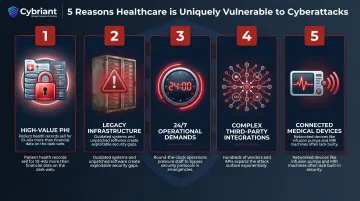
What makes healthcare uniquely vulnerable:
- Vast stores of protected health information – Patient records contain comprehensive personal, financial, and medical data worth up to 50 times more on the dark web than credit card numbers
- Legacy infrastructure – Many hospitals run critical systems on outdated software with known vulnerabilities
- 24/7 operational demands – Healthcare can't shut down for maintenance windows, limiting security upgrade opportunities
- Complex third-party integrations – EHR vendors, labs, billing systems, imaging centers, and telehealth platforms create an expanded attack surface
- Connected medical devices – Infusion pumps, monitoring systems, and diagnostic equipment often run on unpatched software
The financial toll is only part of the picture. Research published in the American Economic Journal found that ransomware attacks decrease hospital volume by 17–24% during the initial attack week. Among patients already admitted when an attack begins, in-hospital mortality increases by 34–38%. When attackers compromise healthcare systems, patients die.
What Is Healthcare Penetration Testing?
Penetration testing is an authorized, simulated cyberattack conducted by security experts to identify and exploit vulnerabilities before real attackers can. Unlike vulnerability scanners that simply identify known weaknesses, penetration testers chain multiple vulnerabilities together to demonstrate what an actual attacker would do - and how far into your environment they could penetrate.
Three Main Testing Types
Healthcare organizations typically encounter three testing types, each targeting a different threat scenario.
External penetration testing simulates an outside attacker with no prior access to your network. Testers probe internet-facing systems - patient portals, public websites, remote access services - looking for ways to breach the perimeter.
Internal penetration testing assumes a threat already inside the network, whether through a compromised employee account, malicious insider, or successful phishing attack. This tests your ability to contain lateral movement and prevent privilege escalation.
Authenticated/credentialed testing evaluates role-based access controls by acting as different user types: patients, clinicians, nurses, billing staff, and administrators. This reveals whether users can access data or functions beyond their authorized scope.
Healthcare-Focused Testing Is Different
Generic penetration testing that only examines ports, servers, and network infrastructure misses the majority of real healthcare risk. Healthcare-focused engagements must account for:
- EHR and EMR systems with complex authorization models
- FHIR and HL7 API integrations that exchange clinical data
- Patient portals and mobile health applications
- Telehealth platforms with video conferencing components
- Connected medical devices and Internet of Medical Things (IoMT) networks
- Clinical workflow logic embedded in applications
Vulnerability Chaining in Healthcare
A 2023 vulnerability in Mirth Connect (CVE-2023-43208) - a popular healthcare integration engine - allowed unauthenticated remote code execution. Individually, this was just one vulnerable service. But attackers chained it with weak network segmentation and inadequate monitoring to exfiltrate patient data and deploy ransomware across entire healthcare networks. Automated scanners flagged the vulnerable service - but only penetration testers could map the full exploit path that made it dangerous.
Penetration testing complements - not replaces - ongoing vulnerability management, security awareness training, and continuous monitoring. Its role in a layered security program is specific: validating whether your existing controls hold up under real attack conditions.
HIPAA Compliance and Penetration Testing: What the Rules Actually Say
The HIPAA Security Rule does not explicitly require "penetration testing" by name - but multiple provisions directly imply it. 45 CFR 164.308(a)(1)(ii)(A) requires covered entities to "conduct an accurate and thorough assessment of the potential risks and vulnerabilities to the confidentiality, integrity, and availability of electronic protected health information." Accurately assessing exploitable vulnerabilities requires actually attempting to exploit them - that's precisely what penetration testing does.
Similarly, 45 CFR 164.308(a)(8) requires periodic technical and nontechnical evaluation of security safeguards. Penetration testing provides real-world proof that your safeguards work - or identifies where they fail.
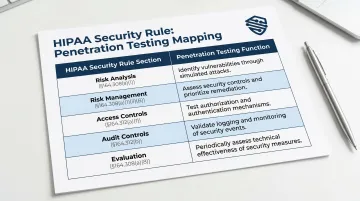
How Penetration Testing Supports HIPAA Security Rule Sections
| HIPAA Security Rule Section | How Pen Testing Addresses It |
|---|---|
| Risk Analysis (§164.308(a)(1)(ii)(A)) | Identifies exploitable vulnerabilities that automated scans miss |
| Risk Management (§164.308(a)(1)(ii)(B)) | Prioritizes remediation based on actual exploit paths |
| Access Controls (§164.312(a)(1)) | Tests whether role-based access restrictions actually prevent unauthorized access |
| Audit Controls (§164.312(b)) | Validates that logging mechanisms capture attacker behavior |
| Evaluation (§164.308(a)(8)) | Provides periodic technical validation of security control effectiveness |
The Proposed 2026 HIPAA Security Rule Update
On December 27, 2024, HHS OCR issued a Notice of Proposed Rulemaking (NPRM) that would explicitly require:
- Vulnerability scanning at least every six months
- Penetration testing at least once every 12 months
- Testing conducted by a "qualified person"
As of publication, this rule remains proposed and is not yet finalized. Healthcare organizations should monitor developments closely, but those who implement these cadences now will be ahead of the compliance curve once the rule is finalized - and finalization appears likely given the regulatory direction.
The Business Associate Agreement Requirement
Meeting the proposed testing cadence is only part of the picture. Before any engagement begins, you also need the right agreements in place. If your penetration testing provider will access or be exposed to ePHI during the engagement, HIPAA requires a signed Business Associate Agreement (BAA). The testing team will likely encounter patient data in EHR systems, databases, or application logs - and without a BAA, your organization is in violation before testing even starts.
Penetration Testing as a Compliance Asset
A well-structured pen test report that maps findings to specific HIPAA Security Rule sections becomes evidence of due diligence for OCR audits, HITRUST assessments, and cyber insurance applications. OCR auditors and insurers look for documented proof that controls were tested, not just configured. A findings report tied to specific regulatory sections gives them exactly that.
What a Healthcare Pen Test Actually Covers
Testing "network and infrastructure only" is insufficient for modern healthcare environments. Today's attack surface extends far beyond firewalls and servers.
A comprehensive healthcare penetration test must include:
- Patient portals and mobile health applications
- Web applications used by clinical staff
- APIs (FHIR, HL7, billing, scheduling, lab integrations)
- EHR and EMR systems
- Cloud storage and infrastructure configurations
- Identity providers and single sign-on systems
- Remote access services (VPN, RDP, virtual desktop infrastructure)
- Connected medical device networks
Authenticated Testing Is Non-Negotiable
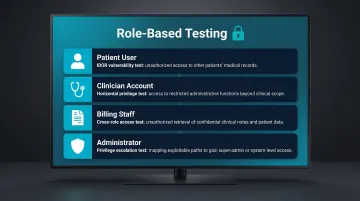
Most sensitive PHI-related functionality sits behind login flows. Testing only unauthenticated endpoints misses the bulk of real risk. Testers must simulate multiple user roles to test role-based access controls and privilege escalation paths:
- Patient users – Can they view other patients' records through URL manipulation?
- Clinician accounts – Can they access billing or administrative functions?
- Billing staff – Can they view clinical notes they shouldn't access?
- Administrators – Are there privilege escalation paths from lower-level accounts?
Scope Areas That Are Commonly Missed
Business Logic Vulnerabilities
Automated tools cannot detect whether a patient user can view another patient's records by changing a URL parameter (Insecure Direct Object Reference). A documented OpenEMR vulnerability allowed authenticated users to delete, modify, or read records belonging to arbitrary patients - a business logic flaw no scanner would catch.
FHIR and HL7 API Security
Healthcare interoperability depends on APIs, which are increasingly exploited. A documented OpenEMR authorization bypass in the FHIR CareTeam endpoint allowed patient-scoped tokens to access data for all patients. Testing must validate authorization logic, not just authentication.
Medical Device and IoMT Security
Connected infusion pumps, imaging systems, and remote monitoring devices often run on legacy software with no patch management. Claroty's 2025 analysis of over 2.25 million IoMT devices found alarming exposure across healthcare organizations:
- 99% had confirmed known exploited vulnerabilities in their environment
- 89% were running medical systems with publicly available exploits and insecure internet connections
FDA guidance now requires healthcare organizations to include connected devices in their security assessment scope.
The Healthcare Penetration Testing Process, Step by Step
Planning and Scoping
Effective pen testing begins with defining clear scope - listing all applications, APIs, user roles, and systems to be tested. Equally important are Rules of Engagement (ROE) that protect 24/7 clinical operations from disruption.
Critical scoping decisions:
- Define which systems are in scope versus explicitly excluded
- Establish permitted testing methods for life-critical systems
- Set blackout windows when testing must pause
- Identify emergency contacts if testing causes unexpected disruption
- Specify what data can be extracted as proof-of-exploitation
With scope locked down, testing moves into active reconnaissance.
Discovery and Reconnaissance
Testers map your organization's digital footprint the same way an attacker would. This includes:
- Enumerating exposed services and API endpoints
- Identifying software versions and patch levels
- Looking for misconfigurations in cloud infrastructure
- Gathering information from public sources (employee names, email formats, technology stack)
Once the attack surface is mapped, testers shift from passive observation to active exploitation.
Attack and Exploitation
The active testing phase uses real-world attack techniques to demonstrate actual risk, not just theoretical vulnerability. This includes:
- Credential attacks (password spraying, credential stuffing)
- Privilege escalation from low-level to administrative access
- API abuse (authorization bypass, injection attacks, IDOR)
- SQL injection and cross-site scripting
- Social engineering simulations (when in scope)
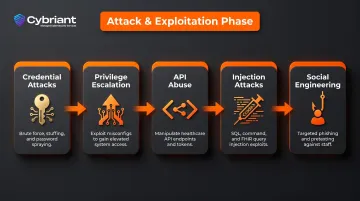
Testers document exactly how far into the environment they penetrate and what sensitive data they can access. That documentation feeds directly into the final deliverable.
Reporting and Remediation
A high-quality healthcare pen test report must contain:
- Risk-scored findings – Critical/High/Medium/Low ratings with CVSS scores
- Proof-of-exploitation evidence – Screenshots, logs, and technical details demonstrating the vulnerability was actually exploited
- Business impact statements – Plain-language explanations of what an attacker could do with this access
- Specific remediation guidance – Not just "patch this," but architectural recommendations
- HIPAA Security Rule mapping – Cross-references to specific HIPAA sections each finding addresses
When reviewing a vendor's deliverable, confirm it includes both HIPAA control mapping and a scheduled retest date - without those two elements, you have findings but no compliance documentation and no way to verify fixes held.
How Often Should Healthcare Organizations Test - And What to Look for in a Provider?
Baseline frequency: Annual penetration testing is the minimum standard. The proposed HIPAA Security Rule NPRM would establish this as an explicit requirement: annual penetration testing plus semi-annual vulnerability scanning.
Additional testing should be triggered by:
- Major infrastructure changes (cloud migrations, network redesigns)
- New patient-facing system launches
- Significant identity or access control changes
- Post-incident recovery (to validate remediation)
- Mergers or acquisitions that affect ePHI flows
What Separates a Qualified Healthcare Pen Testing Provider
Healthcare-specific expertise:
- Verifiable experience testing EHR platforms, FHIR APIs, and medical device networks
- Understanding of healthcare workflow constraints and clinical safety requirements
- Ability to sign a Business Associate Agreement
- HIPAA-mapped reporting that plugs directly into compliance workflows
- Clear retesting policy to validate remediation
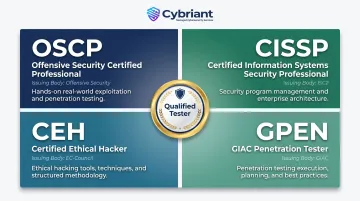
Credentials signal hands-on capability. Look for testers who hold one or more of the following:
Recognized credentials:
- OSCP (Offensive Security Certified Professional) for hands-on exploitation skills
- CISSP (Certified Information Systems Security Professional) for security program management
- CEH (Certified Ethical Hacker) for comprehensive ethical hacking methodologies
- GPEN (GIAC Penetration Tester) for penetration testing planning and execution
Cybriant was named to MSSP Alert's Top 250 MSSPs list for five consecutive years through 2022 and holds SOC 2 Type 2 certification. With over a decade of proven security expertise serving organizations of all sizes, Cybriant's penetration testing services cover the core healthcare attack surface - EHR platforms, FHIR APIs, medical device networks, and third-party integrations - helping clients meet current HIPAA requirements and prepare for proposed regulatory updates.
Pairing Pen Testing with Continuous Managed Security
Annual testing gives you a clear risk picture - but only at the moment the test runs. Between tests, new vulnerabilities emerge, configurations drift, and threat actors refine their techniques. Pairing annual pen testing with ongoing Managed SIEM and real-time vulnerability scanning closes that gap, catching exposures before the next scheduled test rather than months after they're introduced. Cybriant's 24/7 managed security program provides this continuous coverage, complementing periodic penetration testing with around-the-clock threat detection and response.
Frequently Asked Questions
What is pentesting for HIPAA compliance?
HIPAA penetration testing is a simulated cyberattack scoped to systems, applications, and APIs that store or transmit ePHI. It tests whether HIPAA Security Rule safeguards - access controls, audit controls, and risk management measures - actually work under real attack conditions, not just on paper.
Is pentesting required for HIPAA?
HIPAA doesn't explicitly require penetration testing, but the Evaluation standard (§164.308(a)(8)) and Risk Analysis requirements strongly imply it by mandating periodic technical evaluation of security safeguards. The proposed 2026 HIPAA Security Rule update would make annual pen testing an explicit requirement if finalized.
What are the most common cyber attacks in healthcare?
The most prevalent attacks targeting healthcare organizations include ransomware, phishing, unpatched software exploits, insecure API vulnerabilities, and credential theft. Verizon's 2025 Data Breach Investigations Report found that System Intrusion (including ransomware) has overtaken all other breach types as the leading cause in healthcare.
How much should a penetration test cost?
Healthcare pen test costs typically range from $8,000–$40,000+, depending on scope, number of systems, and reporting requirements. BAA obligations, medical device testing, and compliance-mapped reporting can push pricing toward the higher end.
What is the NIST standard for pentesting?
NIST Special Publication 800-115 ("Technical Guide to Information Security Testing and Assessment") is the primary NIST framework for penetration testing methodology. Additionally, NIST SP 800-66r2 specifically provides HIPAA implementation guidance, recommending penetration testing as a method for technical security evaluation of systems that store, process, or transmit ePHI.