Introduction
Security decision-makers at SMBs and mid-market companies face a bewildering alphabet soup of acronyms - SIEM, MSSP, MDR - without clear guidance on whether these are competing products, complementary services, or entirely different security categories. The stakes are real: according to a 2023 SANS Institute survey, 73% of security teams cite false positives as their top detection challenge, and 60% point to skills gaps as a more pressing concern than raw headcount. Choosing the wrong model means threats go undetected - or your team spends more time managing tools than stopping attacks.
This guide breaks down each acronym clearly, compares them side by side, and helps you identify which solution fits your organization's size, budget, risk profile, and compliance requirements - or whether a combination is the right answer.
Overview: MDR vs MSSP vs SIEM at a Glance
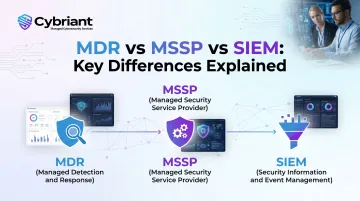
- SIEM is a technology platform that collects and correlates log data but requires skilled in-house staff to tune, investigate, and respond
- MSSP monitors your environment and sends alerts, but investigation and response remain your team's responsibility
- MDR combines technology and human analysts to detect, investigate, and contain threats - no client approval needed for every response step
- The right fit depends on your internal team size, budget, and how much response ownership you want to retain
Understanding SIEM, MSSP, and MDR
What Is SIEM (Security Information and Event Management)?
SIEM is a software platform that aggregates log and event data from across your infrastructure - endpoints, firewalls, servers, applications - and uses rules and analytics to surface anomalies and generate alerts for human analysts to investigate. NIST defines SIEM as an application that provides centralized logging capabilities, while Gartner describes it as a configurable system of record that collects, aggregates, and analyzes security event data.
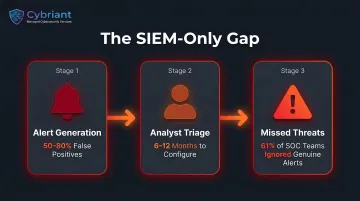
The critical limitation: SIEM is a product, not a service. It provides visibility but requires a skilled internal team to configure, tune, and act on its output. Without dedicated security staff, SIEM generates high volumes of false positives - over 50% of alerts in most environments, with some organizations reporting rates as high as 80%.
In practice, this creates compounding gaps:
- Sophisticated threats that don't match predefined rules are missed entirely
- Average deployments take 6–12 months to configure, delayed by parser development and unstructured data onboarding
- 61% of SOC teams have ignored alerts that later proved to be genuine security incidents
What Is an MSSP (Managed Security Service Provider)?
An MSSP is a third-party company that monitors and manages your security infrastructure on a subscription basis. Gartner defines MSSPs as specialized entities providing outsourced monitoring from 24/7 Security Operations Centers (SOCs). Their scope typically covers alert triage, firewall management, vulnerability scanning, and compliance reporting across multiple clients.
The defining characteristic: MSSPs operate on an alert-and-notify model. When suspicious activity is detected, they escalate to the client - incident investigation and response typically remains your responsibility. When an MSSP sends hundreds of alerts per day, your internal team must manually triage them, creating hidden labor costs equivalent to 2-3 full-time employees.
That said, the MSSP category spans a wide range of service depths. Cybriant, a SOC 2 Type 2 certified provider named to the MSSP Alert Top 250 list for five consecutive years, offers 24/7 Managed SIEM with live analyst monitoring - filtering false positives and providing remediation guidance rather than simply forwarding alerts.
What Is MDR (Managed Detection and Response)?
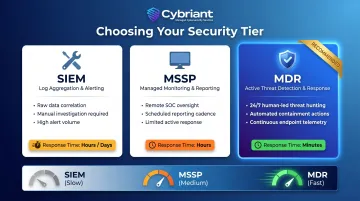
MDR builds on traditional managed security by adding proactive threat hunting, investigation, and active incident response. Gartner defines MDR as remotely delivered SOC functions that enable rapid detection, analysis, and containment. MDR providers pair human analysts with purpose-built tooling - EDR, network detection, threat intelligence - to investigate and act on threats, not just report them. For a focused two-way breakdown, see MDR vs SIEM.
The defining difference: MDR providers take containment actions - isolating endpoints, blocking traffic, disabling compromised accounts - without requiring client approval for every step. This dramatically reduces mean time to response (MTTR) compared to SIEM-only or MSSP-only environments. Gartner projected that half of all organizations would use MDR services by 2025, driven by MDR's 90% reduction in the likelihood of major breaches and 90% reduction in total escalated alerts per month, according to a commissioned Forrester Total Economic Impact study.
MDR vs MSSP vs SIEM: Key Differences at a Glance
| Capability | SIEM | Traditional MSSP | MDR |
|---|---|---|---|
| Primary Function | Log aggregation, correlation, compliance reporting (tool) | Device management and alert notification (service) | Proactive threat hunting, detection, and active containment (outcome-focused service) |
| Who Operates It | Your internal security team | Third-party SOC monitors and escalates | Third-party analysts investigate and respond autonomously |
| Response Capability | None - alerts require internal investigation | Low - escalates to client for action | High - provider isolates hosts, blocks traffic, disables accounts |
| Threat Hunting | Only if your team has time and expertise | Limited or none | Continuous proactive hunting included |
| False Positive Management | Your team must tune and filter | Provider may filter, but alerts still high | Provider filters and investigates before escalation |
| Internal Staff Required | 8-10 FTEs for 24/7 SOC coverage | 2-3 FTEs to act on escalations | Minimal - coordination only |
| Detection Method | Rule-based, relies on client tuning | Signature-based and device-log monitoring | Behavioral, AI-driven, multi-signal (endpoint, cloud, identity) |
Response Depth Comparison
With SIEM, when an alert fires, your analysts must determine if it's legitimate, investigate the scope, and execute containment actions themselves. With 73% of organizations naming false positives as their top challenge, this becomes an exhausting cycle.
MSSPs move the monitoring burden off your plate, but not the response burden. They'll tell you something suspicious happened - then you're responsible for deciding what to do next and executing the response.
MDR providers close that gap entirely. They confirm the threat, understand its scope, and take containment actions like isolating infected endpoints or blocking malicious domains - keeping you informed without waiting for approval at every step.
Internal Resource Requirements
Internal staffing requirements vary significantly across these three models:
- SIEM: Requires 8-10 full-time employees for 24/7 SOC coverage, plus continuous training and retention in a market where 67% of organizations report a cybersecurity staffing shortage
- MSSP: Needs minimal internal security expertise, but still requires 2-3 staff who can act on escalated alerts - you outsource the monitoring, not the response
- MDR: Designed to function as a stand-in for an in-house SOC, requiring only minimal internal coordination while providing immediate access to experienced analysts
Cost Structure Comparison
| Deployment Model | Annual Cost Range | Primary Cost Drivers |
|---|---|---|
| In-House SOC | $1.8M – $3.2M + $200K-$500K setup | 8-10 FTE salaries, benefits, training, tools, attrition |
| Traditional MSSP | $150K – $300K | Subscription fees + internal staff for response |
| MDR | $48K – $210K (for 500 endpoints) | Predictable subscription, scales with coverage scope |
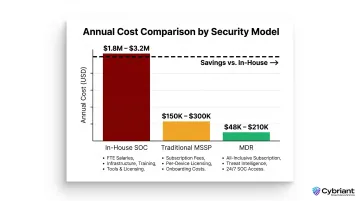
These cost differences reflect what each model actually delivers. SIEM carries high upfront investment in licensing, deployment, tuning, and staff. MSSP offers predictable subscription costs but may charge extra for incident response. MDR bundles monitoring and response into a single fee - offsetting the cost of internal security hires and making the total spend more predictable.
Compliance Support
SIEM excels at generating detailed audit trails for HIPAA (45 CFR 164.312(b) - logging requirements), PCI DSS (Requirement 10 - log and monitor all access), and SOX (audit of internal controls). It provides the system of record regulators require.
MSSPs often provide basic compliance reporting tied to their monitoring activities, but often lack the forensic documentation required for breach notification or detailed incident reporting.
MDR services typically include forensic documentation, incident reporting, and breach notification support. They satisfy logging requirements via integrated SIEM and meet the 24/7 incident response mandates of PCI DSS Requirement 12.10 - which requires immediate response and personnel available around the clock. HIPAA 45 CFR 164.308(a)(6) similarly requires documented policies for addressing security incidents, an area where MDR providers deliver structured, audit-ready outcomes.
Strengths and Limitations of Each Approach
Strengths and Limitations of SIEM
Strengths:
- Unmatched data visibility and historical log retention for forensic investigations
- Highly customizable detection rules tailored to your unique environment
- Strong compliance reporting for regulated industries requiring audit trails
- Maximum control over your security data and response decisions
Limitations:
- Deployment and tuning take 6-12 months before the system runs effectively
- Alert fatigue from high false-positive volumes (50-80% of alerts)
- Ineffective without dedicated internal security staff (8-10 FTEs for 24/7 coverage)
- Originally built for on-premises environments, with limited native cloud coverage
- 42% of SOCs dump all incoming data into SIEM without a retrieval or management plan
Strengths and Limitations of MSSP
Strengths:
- Cost-effective outsourcing of routine security tasks without hiring full-time staff
- Predictable subscription pricing that's easier to budget than salaries and tools
- Access to experienced security professionals without recruiting or retaining them
- Suitable for SMBs needing baseline coverage without building an in-house team
Limitations:
- Alert-and-notify model shifts incident response to the client, adding hidden labor costs
- Most MSSPs react to alerts rather than proactively hunt for hidden threats
- Detection relies on signature-based and rule-based methods that miss advanced threats
- Service level agreements may not guarantee response times during active incidents
- Requires 2-3 internal FTEs to triage escalated alerts and coordinate response
Strengths and Limitations of MDR
Strengths:
- Active threat detection, investigation, and containment by expert analysts 24/7
- Proactive threat hunting catches what automated rules miss, which matters when 88% of SMB breaches involve ransomware
- Faster mean time to detect (MTTD) and mean time to respond (MTTR), reducing major breach likelihood by 90%
- Designed for organizations without an in-house SOC, providing immediate protection
- Especially effective in regulated industries facing sophisticated attacks (healthcare breaches average $10.93M; financial breaches average $6.08M)
Limitations:
- Requires some coordination between the MDR provider and internal IT teams to define scope and access permissions
- Requires long-term commitment to deliver full value - not a one-month trial solution
- Quality varies significantly between providers; vet on response capabilities, telemetry coverage, and use of frameworks like MITRE ATT&CK
- May cost more than basic MSSP services, though still far less than building an in-house SOC
Which Solution Is Right for Your Business?
Decision Framework
Three factors determine which solution fits your organization:
| Factor | What to Evaluate | Implication |
|---|---|---|
| Internal team size | Do you have 8-10 dedicated security analysts? | Mature SOCs can leverage SIEM's control; lean teams need MSSP or MDR |
| Risk and threat profile | Do you handle sensitive data or face targeted attacks? | Healthcare, finance, and IP-heavy orgs need MDR's active response - the 2025 Verizon DBIR recorded 2,842 confirmed breaches in small businesses, with 88% involving ransomware |
| Compliance requirements | Are you subject to HIPAA, PCI DSS, SOX, or CMMC? | CMMC 2.0 Level 2 requires audit log retention (AU.L2-3.3.1); PCI DSS v4.0 demands 24/7 incident response staff - SIEM alone can't meet these without dedicated personnel |
Best Fit Summary
Mapping those factors to each solution:
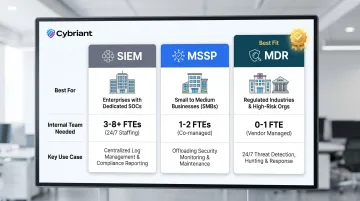
- SIEM fits large enterprises with dedicated security staff who want full control over detection rules and compliance reporting
- MSSP fits SMBs needing outsourced coverage without complexity, particularly those with basic monitoring needs and limited security budgets
- MDR fits organizations that need active threat response without building an in-house SOC - especially those in healthcare, finance, or other regulated sectors
Cybriant's SOC 2 Type 2 certified managed security services are built for businesses that need more than alerting - combining MSSP coverage, 24/7 Managed SIEM, and active MDR response to reduce risk without requiring in-house security expertise.
Can SIEM, MSSP, and MDR Work Together?
These three are not mutually exclusive. Many organizations run a hybrid model where an MSSP manages their SIEM deployment, or an MDR provider integrates with an existing SIEM to enrich its alerts with expert analysis. The key is defining clear boundaries of responsibility - knowing which alerts the provider acts on independently versus which require client escalation.
Practical Hybrid Scenarios
Three common configurations show how these tools complement each other in practice:
Growing organizations often start with an MSSP for baseline coverage - outsourcing firewall management, vulnerability scanning, and log monitoring - then layer in MDR as their threat profile matures and data sensitivity increases.
Compliance-heavy enterprises may use SIEM to satisfy log retention requirements for PCI DSS or HIPAA, while an MDR provider handles 24/7 triage, threat hunting, and containment. This eliminates the need to staff a full internal SOC.
Organizations without in-house SIEM expertise can outsource management entirely to an MSSP. Cybriant's 24/7 Managed SIEM service, for example, covers deployment, tuning, and live monitoring - cutting false positive rates and ensuring threats are contained, not just logged.
The strongest posture rarely comes from a single acronym. Cybriant brings SIEM, MSSP-style management, and MDR-grade detection and response together in one 24/7 program, so you get log retention, managed infrastructure, and live analyst response without stitching three vendors together. Call 844-411-0404 to find the right mix for your environment.
Frequently Asked Questions
What is the difference between MDR and MSSP and SIEM?
SIEM is a technology platform for collecting and analyzing security data - it's a tool, not a service. MSSP is a managed service that monitors your security environment and sends alerts when threats are detected. MDR is a fully managed service that actively detects, investigates, and responds to threats on your behalf, including containment actions like isolating infected endpoints.
What is MSSP in cyber security?
An MSSP is a third-party provider that monitors and manages an organization's security infrastructure from a Security Operations Center, offering services like firewall management, alert triage, vulnerability scanning, and compliance reporting on a subscription basis - making it an option for organizations that need security coverage without building internal teams.
What is replacing SIEM?
SIEM is not being fully replaced but is evolving. Next-generation SIEM tools incorporate AI and behavioral analytics to reduce false positives and detect insider threats. Many organizations are supplementing or replacing standalone SIEM with managed services like MDR that bundle detection, human analysis, and active response into a single solution.
Can an MSSP manage my SIEM?
Yes - many MSSPs offer managed SIEM as part of their service portfolio, handling deployment, tuning, and monitoring so organizations gain SIEM's compliance and visibility benefits without needing dedicated in-house staff to run it. This model works well for organizations that need audit trails for compliance but lack internal expertise.
Is MDR better than MSSP for small businesses?
MDR generally provides stronger threat response for SMBs because it includes active investigation and containment - not just alerting. With 88% of SMB breaches involving ransomware, isolating infected systems in minutes rather than hours can prevent widespread damage. The right choice ultimately depends on budget, risk profile, and whether the business handles regulated data.
Do I need MDR if I already have a SIEM?
Having a SIEM doesn't remove the need for MDR. SIEM provides visibility and log data, but without skilled analysts to act on it, threats get missed - 61% of SOC teams have ignored alerts that later proved genuine. MDR adds the human expertise and active response layer that makes SIEM data actionable, ensuring alerts are triaged, investigated, and contained around the clock.