Introduction
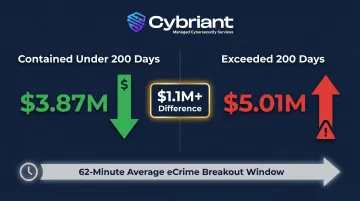
When a security incident hits, the clock starts ticking on financial loss, reputational harm, and regulatory exposure. Organizations that contain breaches within 200 days spend an average of $3.87 million, while those that exceed that threshold face costs topping $5.01 million - a difference of over $1.1 million tied directly to response speed. That gap isn't abstract. It represents the difference between a contained incident and a company-defining crisis.
Outsourced incident response is often framed as a cost-cutting option. Its real value is what it does to recovery timelines, response quality, and operational continuity when a threat is actively unfolding. Threat actors now break out to secondary systems in an average of 62 minutes (as fast as 2 minutes 7 seconds in documented cases). Organizations relying on business-hours monitoring or improvised response playbooks are falling further behind that pace every year.
This article breaks down the operational advantages of outsourcing incident response - what changes, what accelerates, and what gets protected when a dedicated external team is already in place before the breach happens.
Overview
- Outsourced incident response uses a third-party provider (MSSP or MDR firm) to detect, contain, and recover from security threats on your behalf
- Core advantages are speed of detection and containment, specialized expertise difficult to hire in-house, and 24/7 coverage without staffing overhead
- Organizations without outsourced IR face slower response times, higher breach costs, and reactive security that can't keep pace with evolving threats
- Maximum value comes when outsourced IR is paired with defined SLAs, regular performance reviews, and clear communication protocols
- For SMBs and mid-market enterprises especially, outsourcing bridges the gap between growing threat exposure and realistic in-house security capacity
What Is Outsourced Incident Response?
Outsourced incident response is a service arrangement where a third-party security provider - such as a Managed Security Service Provider (MSSP) or Managed Detection and Response (MDR) firm - handles the detection, investigation, containment, and recovery activities that follow a cybersecurity incident.
It applies across a range of organizational contexts:
- Organizations lacking a dedicated in-house Security Operations Center (SOC)
- Businesses with small IT teams that lack incident response specialists
- Enterprises augmenting existing security operations with 24/7 expert coverage
- Mid-market companies facing resource constraints but escalating threat exposure
Outsourced IR is not simply a cost-reduction strategy. Its real value shows up in time-to-containment, damage limitation, and compliance continuity.
When incidents hit, an improvised internal response rarely contains the damage. A coordinated, expert-led team closes that gap - turning what could be a company-defining crisis into a controlled, recoverable event.
Key Advantages of Outsourced Incident Response
The advantages below translate directly into operational outcomes: faster containment, lower breach costs, and security coverage that doesn't depend on headcount.
These advantages are most pronounced for organizations facing real-world constraints: limited in-house expertise, budget pressure, compliance obligations, or growth that has outpaced their current security infrastructure.
Advantage 1: Faster Incident Detection and Containment
Outsourced IR providers operate with pre-built detection playbooks, automated triage workflows, and analyst teams already trained in active threat scenarios. This compresses the time between alert and action compared to teams building these capabilities from scratch.
How this works in practice:
The provider continuously monitors environments using SIEM correlation, threat intelligence feeds, and behavioral analytics. The system flags anomalies and escalates validated threats - reducing the noise that slows internal teams. Providers like Cybriant deliver 24/7 Managed SIEM with live monitoring and analysis, making enterprise-grade continuous coverage accessible even for businesses without the headcount to staff an internal SOC overnight.
Why speed matters:
Mean time to detect (MTTD) and mean time to respond (MTTR) are the two metrics most directly tied to breach cost. Breaches contained in under 200 days cost an average of $3.87 million, compared to $5.01 million for those exceeding 200 days - a difference of over $1.1 million. Faster containment limits lateral movement, data exfiltration volume, and system downtime - each of which has a direct dollar figure during post-incident calculation.
KPIs impacted:
- Mean time to detect (MTTD)
- Mean time to respond (MTTR)
- Dwell time (how long an attacker remains undetected)
- Number of systems affected
- Total incident remediation cost
When this advantage matters most:
Speed advantage is highest during ransomware attacks, data exfiltration events, and credential compromise scenarios. With average eCrime breakout times hitting 62 minutes, every hour of undetected access multiplies the damage exponentially.
Advantage 2: Access to Deep Expertise Without the Hiring Burden
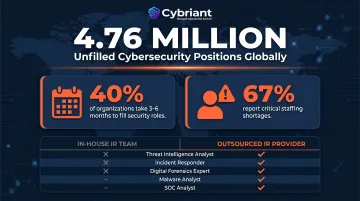
The global cybersecurity workforce gap reached 4.76 million unfilled positions in 2024 - and building a capable internal IR team means competing for talent that's already scarce. Outsourced IR providers solve this by employing dedicated analysts, threat hunters, forensic investigators, and incident commanders whose full-time focus is threat detection and response.
How this creates the advantage:
The provider's team brings cross-industry experience, familiarity with the latest attacker tactics, techniques, and procedures (TTPs), and institutional knowledge from handling hundreds of incidents across different environments. This is context an internal team rarely accumulates at the same pace.
The staffing reality:
Nearly 40% of organizations report it takes 3 to 6 months to fill security roles, and 67% report staffing shortages. An in-house team lacking specialist skills may misclassify incidents, under-contain threats, or miss root cause entirely - leading to repeat incidents and higher long-term costs.
KPIs impacted:
- Analyst utilization rate
- False positive rate
- Percentage of incidents fully resolved vs. re-opened
- Time to root cause identification
When this advantage matters most:
This advantage is critical for organizations facing complex, multi-stage attacks such as advanced persistent threats (APTs), supply chain compromises, or insider threats - where generic response playbooks are insufficient and specialized forensic or malware analysis is needed.
Advantage 3: Continuous 24/7 Coverage Without Staffing Overhead
Attackers don't keep office hours - and the data confirms it. Intrusions are deliberately timed for nights, weekends, and holidays when internal teams are off-shift. Outsourced IR providers maintain around-the-clock coverage so detection capacity never drops.
How this works operationally:
Providers maintain follow-the-sun coverage models or co-located SOC teams on rotating shifts, meaning alerts are acted on immediately regardless of when they occur. No shift gap means no window of uncovered exposure.
Why after-hours coverage is non-negotiable:
The numbers make the case clearly:
- 76% of ransomware executions happen after hours - weekends, before 8:00 a.m., or after 6:00 p.m. on weekdays
- 44% of companies cut security staffing on holidays and weekends by up to 70%; 20% cut it by 90%
- 60% of organizations said weekend/holiday attacks extended the time to assess scope; 50% needed longer to mount an effective response
Organizations relying on business-hours monitoring are effectively unprotected for roughly 65% of the week - a gap that is both a security liability and a growing concern for cyber insurance eligibility.
The cost of in-house 24/7 coverage:
Maintaining a single 24/7 monitoring seat requires approximately 4.8 Full-Time Equivalents (FTEs). With median salaries for Information Security Analysts at $124,910 plus approximately 30% in benefits, minimum staffing costs for a 24/7 SOC easily exceed $1.2 million annually.
By contrast, outsourced MDR services typically cost between $8 and $35 per endpoint per month, with annual costs ranging from $50,000 for smaller businesses to $300,000+ for enterprises - a fraction of the cost of building and staffing an internal SOC.

KPIs impacted:
- After-hours incident detection rate
- Time-to-escalation outside business hours
- SOC staffing cost per hour of coverage
- Cyber insurance compliance status
When this advantage matters most:
This advantage is highest for organizations in regulated industries (healthcare, financial services), businesses with distributed or global operations, and any organization carrying cyber insurance that requires documented continuous monitoring.
What Happens When Outsourced Incident Response Is Missing or Ignored
Without structured IR capabilities - whether in-house or outsourced - organizations default to reactive, improvised responses that are slower, less coordinated, and far more expensive.
Common operational consequences include:
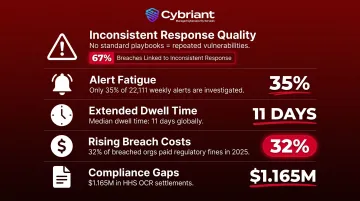
Inconsistent response quality: Each incident is handled differently depending on who is available, leading to missed containment steps and recurring vulnerabilities. Without standard playbooks, teams reinvent the response process during each crisis.
Alert fatigue and misclassification: Organizations receive an average of 22,111 security alerts weekly, but only 35% are investigated. 66% of SOC teams report an inability to keep pace with alert volume, and genuine threats slip through.
Extended dwell time: Without continuous monitoring, attackers remain undetected for extended periods. Median dwell time globally is 11 days, with ransomware attacks averaging 6 days and non-actor disclosed incidents averaging 24 days. Each day increases data loss and remediation scope.
Rising incident costs: Poor containment compounds into regulatory fines, legal liability, reputation damage, and repeat breach risk. In 2025, 32% of breached organizations paid a regulatory fine - and 48% of those fines exceeded $100,000.
Difficulty meeting compliance requirements: HIPAA, PCI-DSS, and NIST require documented IR procedures and demonstrable response timelines. Gaps create audit exposure - illustrated by HHS OCR's April 2026 settlements totaling $1,165,000 across four ransomware breaches.
How to Get the Most Value from Outsourced Incident Response
Outsourced IR delivers its highest return when the engagement is structured correctly from the start. Treat it as an active partnership - not a passive contract - and the operational benefits compound quickly.
Three practices consistently separate high-performing outsourced IR arrangements from underperforming ones:
- Set SLAs with measurable thresholds: Establish specific time-to-acknowledge and time-to-contain commitments, and review them quarterly against real incident data. NIST SP 800-61 recommends documenting who has authority to take actions like disconnecting a server - vague SLAs produce vague outcomes.
- Share environment context before an incident: Provide your provider with asset inventory, network architecture, and business risk priorities upfront. NIST notes that outsourcers need regularly updated documentation on critical resources to avoid mishandling incidents and reduce false escalations.
- Run joint tabletop exercises at least annually: Test alignment on escalation paths, communication protocols, and decision authority with your provider before a real incident forces those conversations. SANS Institute recommends tabletops annually or every 15 months to surface gaps and keep cross-team roles current.
Conclusion
The value of outsourced incident response lies not in replacing internal security awareness, but in closing the speed, expertise, and coverage gaps that determine how much damage a threat causes before it is stopped.
These advantages compound when the engagement is treated as an ongoing operational partnership rather than a one-time procurement. Organizations that build their outsourced IR relationships around defined SLAs, regular performance reviews, and joint readiness exercises see measurably better outcomes than those treating it as a compliance checkbox.
For SMBs and growing enterprises, outsourcing incident response is the most practical path to enterprise-grade resilience. The right provider - one with documented SLAs, proven response playbooks, and around-the-clock coverage - determines how quickly your organization recovers when an incident hits.
Organizations looking for a trusted MSSP partner can explore how Cybriant's managed security services - backed by SOC 2 Type 2 certification and recognition on MSSP Alert's Top 250 list - deliver the 24/7 IR readiness mid-market and enterprise teams need.
Frequently Asked Questions
What is an outsourced SOC?
An outsourced SOC is a third-party managed service where security analysts monitor, detect, and respond to threats on behalf of an organization. It delivers 24/7 coverage and expert incident response without requiring the client to build or staff an internal security operations center.
What is the difference between in-house SOC and outsourced SOC?
An in-house SOC offers full control but comes with high staffing costs and talent challenges. An outsourced SOC delivers a pre-built expert team through a subscription model, offering faster deployment and lower overhead in exchange for some operational control.
What is a hybrid SOC?
A hybrid SOC splits responsibilities between an internal team and an external provider. This allows organizations to retain oversight of strategic decisions while offloading 24/7 monitoring, alert triage, or incident response to the outsourced partner.
Do SOC analysts work 24/7?
Analysts at established outsourced SOC providers work 24/7 using rotating shifts or follow-the-sun staffing models. Most in-house teams are limited to business hours or on-call rotations, leaving significant exposure during off-hours.
What is the difference between CSIRT and SOC?
A SOC is an ongoing, continuous security monitoring function focused on threat detection and triage. A CSIRT (Computer Security Incident Response Team) is activated specifically during and after a confirmed incident to manage containment, investigation, and recovery. Many outsourced providers integrate both functions.
Which is better, outsourcing or insourcing incident response?
The right choice depends on your organization's size, budget, risk profile, and existing team capabilities. For most SMBs and organizations without a mature in-house security team, outsourcing offers faster deployment, lower overhead, and broader expertise.