Introduction
Manufacturing has overtaken financial services and healthcare to become the most-attacked industry globally - and the reason is direct: production downtime creates immediate, quantifiable leverage that most industries lack. When attackers encrypt a hospital's records, recovery is painful but gradual. When they shut down an assembly line, every hour costs hundreds of thousands of dollars in lost production, missed contracts, and cascading supply chain penalties.
Three compounding factors make manufacturers especially exposed:
- Aging OT systems: PLCs, SCADA controllers, and HMIs were built for reliability, not security
- Collapsed air gaps: Industry 4.0 connectivity has linked shop floors directly to corporate networks - and to the internet
- Thin security coverage: Lean teams spread across IT and OT environments can't catch every threat before it reaches production
A single breach at any of these pressure points can halt operations within hours.
This guide covers the five most critical cybersecurity protection strategies manufacturers must implement in 2026, and what to look for when choosing a partner to help execute them.
Overview
- Manufacturing accounted for 27.7% of all cyberattacks in 2025, with ransomware engineered to halt production lines - not just steal data
- IT/OT convergence has erased the air gap, exposing production systems to the same threats as business networks
- Five core strategies covered: IT/OT segmentation, Zero Trust access, ransomware response planning, continuous monitoring, and supply chain controls
- CMMC 2.0, NIS2, and NIST CSF 2.0 now mandate these controls, making them a compliance requirement as much as a security one
- Manufacturers lacking in-house security teams can partner with MSSPs that deliver enterprise-grade capabilities at mid-market scale
Why Manufacturing Is the #1 Cyberattack Target in 2026
Manufacturing's structural vulnerabilities make it irresistible to attackers. Legacy OT systems - PLCs, SCADA, and HMIs - were built for reliability, not security. Industry 4.0 connectivity has eroded the IT/OT boundary, exposing shop floor equipment to threats that originate in corporate networks.
Third-party vendor access compounds the problem. OEM technicians often connect through broad, always-on VPN tunnels with minimal oversight - access that's rarely scoped, monitored, or revoked when no longer needed.
Manufacturing represented 27.7% of all cyberattacks in 2025, the highest share of any industry for the fifth consecutive year. The sector also accounted for approximately 69% of all ransomware victims across industrial organizations, with 1,171 entities compromised.
The Economics of Production Downtime
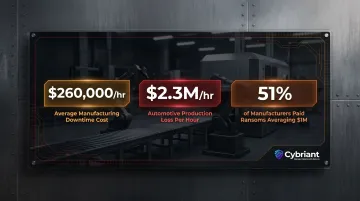
Ransomware in manufacturing has evolved beyond data theft. Attackers now target production uptime directly, knowing that every hour of downtime translates to quantifiable losses. The average cost of unplanned downtime is $260,000 per hour across all manufacturing sectors, reaching $2.3 million per hour in automotive production. For SMEs, downtime costs can reach $150,000 per hour.
That financial exposure drives fast ransom decisions. In 2025, 51% of manufacturing organizations paid ransoms to recover data. Average payments hit $1 million.
Regulatory Pressure Is Increasing
The regulatory environment around manufacturing cybersecurity is tightening:
- CMMC 2.0 for defense contractors took effect November 10, 2025, requiring implementation of 110 NIST SP 800-171 controls
- NIS2 in the EU applies to medium-sized and larger enterprises across chemicals, food, electronics, machinery, and automotive manufacturing
- IEC 62443 establishes security requirements for partitioning industrial control systems into zones and conduits
- NIST CSF 2.0 released February 2024, now explicitly applies to IT, IoT, and OT environments
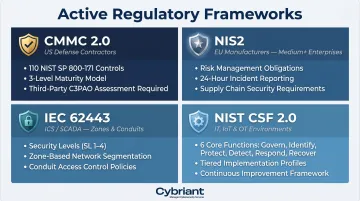
These frameworks are converging around the same core principles: segmentation, least-privilege access, continuous monitoring, and supply chain controls. For manufacturers, meeting these requirements isn't a future goal - it's an active obligation, and the strategies covered below map directly to what these frameworks require.
Best Cybersecurity Protection Strategies for Manufacturing Businesses in 2026
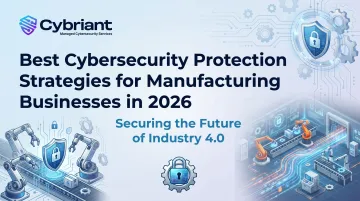
These five strategies address the most commonly exploited attack vectors in manufacturing and form a layered defense that protects both business systems and production operations.
Strategy 1: IT/OT Network Segmentation
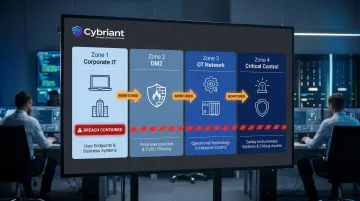
Network segmentation creates controlled boundaries between corporate IT networks and operational technology environments - preventing a compromised laptop in Sales or a phishing victim in Finance from becoming the launchpad for a production shutdown.
Effective segmentation does not mean complete isolation. It means brokered, monitored communication across defined zones: Corporate IT, DMZ, OT, and Critical Control. The critical implementation detail that distinguishes real protection from paper segmentation is this: all inter-zone traffic must be monitored with tools that understand industrial protocols, and segmentation must be tested with operations teams to confirm that necessary business connectivity (like MES-ERP integration) is preserved.
Recent incidents demonstrate why this matters:
- Jaguar Land Rover (September 2025): An IT system intrusion forced a proactive shutdown of global IT systems, severely disrupting manufacturing operations for nearly five weeks
- Asahi Group Holdings (September 2025): Qilin ransomware breached Japanese operations, paralyzing systems managing product orders and shipments, forcing a halt to logistics and production
- Nucor Corporation (May 2025): Unauthorized third-party access to IT systems forced the steelmaker to proactively halt certain production operations to contain the incident
| What It Protects | Key Actions | Manufacturing Relevance |
|---|---|---|
| Production systems, PLCs, SCADA, HMIs from lateral movement originating in IT networks | Define network zones (Corporate, DMZ, OT, Critical); implement default-deny firewall rules; monitor all inter-zone traffic with OT-aware tools | Limits blast radius of a breach; prevents a phishing attack in Finance from reaching CNC machines or safety systems |
Strategy 2: Zero Trust Access Management
Zero Trust replaces the outdated "castle-and-moat" perimeter model with a "never trust, always verify" architecture. Every user, device, and vendor must authenticate and be authorized for each specific resource before access is granted - including third-party OEM technicians who previously had broad VPN access.
This closes the most commonly exploited entry point in manufacturing: overprivileged remote access. Third-party involvement in breaches doubled year-over-year - from 15% to 30%. In cyber-physical environments, 82% of organizations reported at least one attack in the past 12 months originating from supplier access. Remote access exploitation accounts for 20% of all OT incidents, spanning VPN vulnerabilities, remote access applications, and RDP from corporate networks.
Practical Zero Trust implementation for manufacturers:
- Replace broad VPN access with session-based ZTNA for vendor access first (fastest risk reduction)
- Enforce MFA at every login, especially for OT-touching accounts
- Implement just-in-time access provisioning so vendor sessions automatically expire after the maintenance window
- Record all remote sessions for audit and forensic purposes
| What It Protects | Key Actions | Manufacturing Relevance |
|---|---|---|
| OT systems, SCADA, PLCs from unauthorized or compromised vendor and remote access | Replace always-on VPNs with ZTNA; enforce MFA for all remote and OT access; scope vendor access to specific devices only; record all sessions | Prevents compromised third-party credentials from becoming a production network breach; supports NIS2, IEC 62443, and NIST CSF compliance |
Strategy 3: Ransomware Defense and Incident Response Planning
Modern ransomware attacks in manufacturing are coordinated double-extortion campaigns that simultaneously encrypt business systems and compromise OT controls. Isolating a production system requires operational coordination that cannot be improvised under pressure - the response plan must be built before the incident, not during it.
In 2025, only 40% of ransomware attacks resulted in data encryption (down from 74% in 2024), but extortion-only attacks surged to 10% - attackers are shifting tactics, and manufacturers must be ready for multiple scenarios.
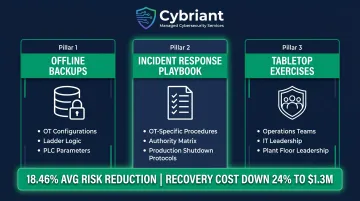
Key preparedness components:
- Offline, tested backups of OT system configurations and process parameters (ladder logic, PLC parameters) - not just data files
- Written incident response playbook with OT-specific procedures and clear authority for who can authorize production shutdowns
- Regular tabletop exercises that include operations and plant floor leadership alongside IT and security teams
Proper incident response planning yields an 18.46% average risk reduction. The mean cost of recovery (excluding ransom) dropped 24% to $1.3 million in 2025 for organizations with strong preparedness programs.
| What It Protects | Key Actions | Manufacturing Relevance |
|---|---|---|
| Business continuity and production recovery speed following ransomware or destructive malware events | Maintain offline backups of OT configs (ladder logic, PLC parameters); create and test an OT-specific incident response playbook; conduct tabletop exercises with operations teams | Minimizes downtime, reduces ransom payment pressure, and demonstrates operational resilience to insurers and regulators |
Strategy 4: Continuous Threat Monitoring and Managed SIEM
Traditional IT security monitoring fails in manufacturing for three reasons: legacy OT devices don't generate standard logs, industrial protocols are invisible to conventional SIEM tools, and most small to mid-sized manufacturers lack the in-house SOC staff to monitor alerts 24/7.
Adversaries often maintain persistent footholds for weeks before executing attacks. Nearly 50% of OT incidents are detected within 24 hours and 60% are contained within 48 hours of detection - but industrial organizations average 199 days to identify and 73 days to contain a data breach. Detection speed, not just prevention, is critical to limiting damage.
Effective continuous monitoring for manufacturers includes:
- A Managed SIEM that ingests events from both IT and OT environments
- Correlation of anomalies (unusual after-hours network connections, unexpected lateral movement toward OT systems)
- Human analysts who can distinguish real threats from noise and provide actionable response guidance
Cybriant's 24/7 Managed SIEM with live monitoring and analysis delivers this capability to manufacturers without requiring an internal security operations team. Dedicated security professionals review alerts in real time, cut through false positives, and provide detailed remediation guidance for critical threats.
| What It Protects | Key Actions | Manufacturing Relevance |
|---|---|---|
| Both IT and OT environments from undetected persistent threats, lateral movement, and pre-ransomware reconnaissance | Deploy a SIEM that understands OT protocols; establish IT+OT event correlation baselines; ensure 24/7 human-led monitoring with rapid escalation procedures | Closes the detection gap created by legacy OT systems and under-resourced security teams; supports compliance reporting |
Strategy 5: Supply Chain and Third-Party Vendor Access Controls
In manufacturing, small equipment vendors and HVAC contractors with broad, always-on remote access have repeatedly served as the initial entry point in major breaches - attackers exploit trusted credentials to reach deep into OT systems without triggering alarms. Supply chain attacks nearly doubled from 154 incidents in 2024 to 297 in 2025, as threat actors increasingly compromise smaller vendors to gain indirect access to larger industrial targets.
Practical vendor access controls:
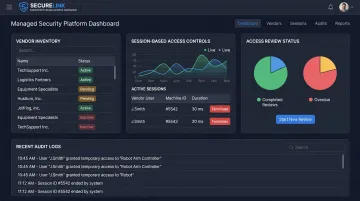
- Maintain a live inventory of all third-party vendors with network access and what systems they can reach
- Enforce time-limited, session-specific access rather than persistent VPN tunnels
- Require evidence of security posture from critical vendors
- Conduct quarterly access reviews to revoke permissions for vendors no longer engaged
Cybriant's third-party risk management solution helps organizations identify and close the access gaps that vendor relationships create - gaps that frequently go unaddressed until after an incident. The service includes vendor access auditing, security posture assessments, and session-based access controls.
| What It Protects | Key Actions | Manufacturing Relevance |
|---|---|---|
| OT systems and production networks from compromise via trusted third-party access channels | Audit all vendor access paths; replace persistent VPN with session-based ZTNA; enforce MFA for all vendor logins; review and revoke unused vendor access quarterly | Addresses one of the most common ransomware entry vectors in manufacturing; supports supply chain security requirements under NIS2 and CMMC 2.0 |
How to Evaluate the Right Cybersecurity Approach for Your Manufacturing Business
Don't Treat OT Systems Like IT Systems
The most common mistake manufacturers make is applying standard IT security tools - antivirus scans, network scanners, frequent patch cycles - to industrial control environments. This approach can crash legacy PLCs or disrupt real-time production processes.
The right approach starts with understanding operational constraints first, then layering in security controls that enhance rather than disrupt them. OT security must prioritize production availability and worker safety above all else - IT security prioritizes data confidentiality. That distinction alone determines which tools belong where.
Key Criteria for Evaluating a Cybersecurity Partner
When evaluating a managed security provider for manufacturing, look for:
- OT/ICS-specific experience (not just general IT security)
- 24/7 monitoring capability with human analysts who understand industrial environments
- Scalable deployment models sized for mid-market operations - not just large enterprise rollouts
- A track record of helping clients achieve compliance with relevant frameworks (CMMC, NIST CSF, IEC 62443)
When evaluating vendors, push for measurable outcomes: reduced downtime risk, faster incident containment, verifiable compliance posture, and clear SLAs for OT environments specifically.
The Role of Cyber Insurance
Those outcomes also matter beyond operations - insurers in 2026 require evidence of specific OT controls before issuing or renewing policies. Major carriers like Chubb explicitly require details on OT segmentation (VLAN, Data Diode, Air-gap, DMZ), remote access security (Multi-Factor Authentication, Zero Trust Network Access), OT monitoring, and immutable or offline/air-gapped backups.
These strategies are not just best practices - they're insurance prerequisites. According to industry claims data, manufacturing carries the highest proportion of ransomware claims of any sector - meaning insurers scrutinize your OT controls more closely than in almost any other industry.
Conclusion
Manufacturing's unique combination of legacy OT systems, IT/OT convergence, and production-critical uptime requirements makes it the highest-value target for attackers. But these same characteristics make a layered, strategy-driven approach to cybersecurity both achievable and essential.
The five strategies outlined - segmentation, Zero Trust, ransomware defense, continuous monitoring, and supply chain controls - work together to address the most exploited attack vectors in the sector. Implemented correctly, they limit blast radius, close persistent entry points, accelerate detection, and reduce recovery time.
That said, manufacturers do not need to tackle this alone or at enterprise IT budgets. The right managed security partner delivers continuous monitoring, vulnerability management, and compliance support as an extension of your existing team - so operations leadership can stay focused on production, not threat response.
Cybriant has spent over 10 years helping businesses of all sizes build security programs that match enterprise-level rigor without enterprise-level overhead. Our 24/7 Managed SIEM, OT security capabilities, and compliance management services are built for mid-market manufacturers who need a full security operation without the cost of running one in-house.
Contact Cybriant at 844-411-0404 to assess your current security posture and build a protection strategy tailored to your manufacturing environment.
Frequently Asked Questions
What are the trends for cybersecurity in 2026?
Key trends include AI-enabled attacks, persistent adversary access (over one-time disruption), accelerating IT/OT convergence, and Zero Trust replacing perimeter-based defenses as the dominant security model. By 2028, 50% of organizations are projected to adopt Zero Trust posture for data governance as AI-generated data proliferates.
Is cybersecurity still worth it in 2026?
Yes - cybersecurity investment is more critical than ever. The cost of a single ransomware-induced production shutdown (averaging $260,000 per hour) typically far exceeds the annual cost of a comprehensive security program. Regulatory and insurance requirements are also making baseline controls mandatory rather than optional.
Why is manufacturing the top target for cyberattacks?
Legacy OT systems were never built with security in mind, shop floors are increasingly connected to corporate networks, and production downtime creates immediate financial pressure - pushing manufacturers to pay ransoms fast. Manufacturing represented 27.7% of all cyberattacks in 2025.
What is the difference between IT security and OT security in manufacturing?
IT security prioritizes data confidentiality, while OT security must prioritize production availability and worker safety above all else. Applying IT tools directly to OT environments risks operational disruption or equipment damage.
How can small and mid-sized manufacturers protect against ransomware without large security teams?
Start with network segmentation, MFA enforcement, offline OT backups, and a tested incident response plan. Partnering with an MSSP for 24/7 monitoring fills the gaps without requiring a large in-house security team.
What compliance frameworks apply to manufacturing cybersecurity in 2026?
Key frameworks include CMMC 2.0 for US defense contractors, NIS2 for manufacturers operating in or supplying to the EU, IEC 62443 for ICS/SCADA environments, and NIST CSF 2.0 which now explicitly addresses OT environments. All four frameworks are converging around Zero Trust principles.