Introduction
NIST SP 800-171 Rev 3 was finalized in May 2024. For defense contractors and businesses handling Controlled Unclassified Information (CUI), that raises two immediate questions: what actually changed, and do they need to act now?
The answer isn't straightforward. The requirement count dropped from 110 to 97, which looks like a reduction on paper. But determination statements increased 32%, expanding the verification burden in ways that aren't obvious from the headline number alone.
This article covers the key structural and substantive updates in Rev 3, how it compares to Rev 2, its relationship to CMMC, and what organizations should do to prepare for eventual transition.
Important for CMMC contractors: CMMC 2.0 - including all Phase 1 through Phase 4 assessments - is currently based on NIST SP 800-171 Revision 2, not Revision 3. The DoD has not yet updated the CMMC framework to require Rev 3 controls. If you're preparing for a C3PAO assessment, Rev 2 is still your compliance baseline. Rev 3 is relevant to understand for future planning, but it does not change what your assessor will measure you against today.
Overview: NIST SP 800-171 Rev 3 at a Glance
- Requirements dropped from 110 to 97, but determination statements jumped 32% to 422 - compliance verification has gotten more demanding, not less
- Three new control families added: Planning (PL), System and Services Acquisition (SA), and Supply Chain Risk Management (SR)
- 88 Organization-Defined Parameters (ODPs) replace vague language, requiring documented policy values
- CMMC Level 2 still maps to Rev 2; Rev 3 carries no mandate yet, but preparation should start now
- Non-Federal Organization (NFO) controls eliminated - previously assumed requirements are now explicitly stated
What Is NIST SP 800-171 Rev 3 and Why Was It Updated?
NIST SP 800-171 is the federal cybersecurity standard for protecting Controlled Unclassified Information in nonfederal systems. Originally published in 2015 and updated in 2016, it derives directly from FIPS Publication 200 and the moderate security control baseline in NIST SP 800-53.
Rev 3 was finalized on May 14, 2024, representing the most significant update to date.
Purpose of the Update
The revision modernizes controls against evolving threats - particularly supply chain attacks like SolarWinds - and eliminates ambiguity caused by vague language such as "periodically" or "limit."
Rev 3 aligns more directly with NIST SP 800-53 Rev 5, replacing loosely defined terms with specific, measurable requirements throughout.
Scope and Application
Understanding who Rev 3 affects - and when - matters before planning any compliance roadmap:
- Who it covers: Any nonfederal organization that processes, stores, or transmits CUI
- CMMC connection: Rev 3 serves as the foundation for CMMC Level 2 certification, but enforcement hasn't taken effect yet
- Current requirement: The CMMC Final Rule explicitly states that CMMC Level 2 still requires implementation of Rev 2
Key Changes in NIST SP 800-171 Rev 3: What's New
The Control Count Nuance
Rev 3 appears to reduce requirements from 110 to 97 - but this reduction is misleading. NIST merged overlapping controls rather than eliminating protections, a phenomenon some practitioners call the "law of conservation of NIST controls."
Example: Insider threat training (03.02.03) was withdrawn and absorbed into 03.02.01 (Literacy Training and Awareness), which now explicitly requires training on recognizing insider threats, social engineering, and social mining.
Of the 33 "withdrawn" requirements, nearly all were folded into other requirements. The actual protection burden did not decrease.
Organization-Defined Parameters (ODPs)
Rev 3 replaces vague language with 88 specific ODPs that organizations must define and document.
Rev 2 Example (Vague):
- "Limit consecutive invalid logon attempts"
Rev 3 Example (Parameterized):
- Organizations must specify "at most [ODP: number] consecutive invalid logon attempts within [ODP: time period]"
In April 2025, the DoD published mandatory values for all 88 ODPs for defense contractors. For example:
- Invalid logon attempts: at most five (5) consecutive attempts
- Configuration settings: apply common security configurations from the NIST National Checklist Program (NCP)
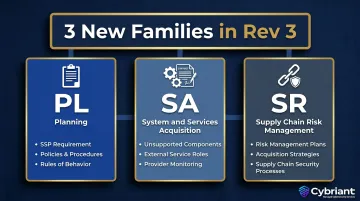
Three New Control Families
Planning (PL):
- Requires documented policies, procedures, system security plans, and rules of behavior
- Explicitly mandates a System Security Plan (SSP) under requirement 03.15.02
System and Services Acquisition (SA):
- Addresses unsupported system components and external system services
- Defines user roles and establishes shared responsibilities with external service providers
- Requires ongoing monitoring of provider compliance
Supply Chain Risk Management (SR):
- Introduces formal supply chain risk management plans
- Requires documented acquisition strategies
- Establishes supply chain security processes to address modern attack vectors
This addition responds to urgent industry needs: 64% of organizations suffered a supply chain attack in a two-year period, yet only 45% have documented response steps.
Elimination of Non-Federal Organization (NFO) Controls
In Rev 2, more than 60 controls were assumed to be in place without explicit statement - leading to common compliance failures where organizations didn't know they were required. Rev 3 removes the NFO category entirely, either explicitly including those controls or reclassifying them under new tailoring categories (Not Applicable or Other Related Controls) - giving auditors and organizations a shared, unambiguous baseline.
Other Related Controls (ORC) Tailoring Category
The NFO elimination connects directly to another tailoring mechanism: the Other Related Controls (ORC) designation. When a control's outcome is fully addressed by a separate, related control, it is designated ORC. Rev 3 contains 11 ORCs.
Practical implication: While this reduces duplication, it can create ambiguity during assessments about which control satisfies which requirement. Organizations should document their ORC rationale explicitly - assessors will expect a clear mapping showing which control covers which requirement, not an assumption that the overlap is self-evident.
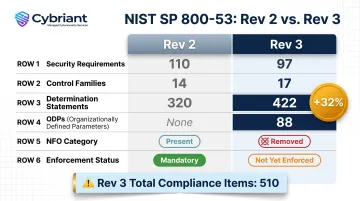
NIST SP 800-171 Rev 2 vs. Rev 3 at a Glance
| Dimension | Rev 2 | Rev 3 |
|---|---|---|
| Total Security Requirements | 110 | 97 |
| Control Families | 14 | 17 (added PL, SA, SR) |
| Determination Statements (SP 800-171A) | 320 | 422 (+32%) |
| Organization-Defined Parameters (ODPs) | None | 88 |
| Basic vs. Derived Requirement Distinction | Present | Eliminated |
| NFO Tailoring Category | Present | Removed |
| New Tailoring Categories | None | ORC and N/A |
| Current Enforcement Status | Mandatory under DFARS and CMMC | Published but not yet enforced |
Why the Requirement Count Drop Is Misleading
The 32% increase in determination statements means every organization using Rev 3 will face a larger verification burden during assessments. Each requirement must satisfy all its determination statements to be considered "fully implemented."
Shift in Requirement Structure
That increased verification load stems partly from how requirements are now written. Rev 3 adopts SP 800-53 Rev 5 control language with parameterized syntax, making requirements more precise and measurable - though the tradeoff is added complexity for implementers.
The elimination of the basic vs. derived distinction means all 97 requirements are now treated uniformly, removing a conceptual simplification that Rev 2 provided.
The 510-Item Compliance Picture
Organizations pursuing full Rev 3 compliance must account for:
- 422 determination statements (from SP 800-171A Rev 3)
- 88 ODPs requiring documented values
- Total: 510 distinct items that must be addressed and verified
NIST 800-171 Rev 3 and CMMC: How They Work Together
The Relationship
NIST SP 800-171 sets the security requirements; CMMC is the certification program that verifies contractors have implemented those requirements.
As of now, CMMC Level 2 is still based on NIST SP 800-171 Rev 2. The CMMC Final Rule explicitly states Rev 3 is not currently applicable. Organizations being assessed for CMMC should continue working against Rev 2.
CMMC Transition Timeline
The DoD is expected to eventually incorporate Rev 3 into DFARS 252.204-7012 and CMMC through future rulemaking. DoD guidance confirms the agency will "incorporate Revision 3 with future rulemaking," with estimates pointing to a rulemaking window of late 2026 to 2027. Significant regulatory changes typically provide a 2-3 year transition onramp, so contractors have time to prepare.
Practical Guidance
Given that timeline, here's what defense contractors should focus on now:
- Rev 3 builds directly on Rev 2, so work done toward current compliance carries forward - nothing is wasted
- Contractors should avoid implementing Rev 3 in place of Rev 2 for CMMC purposes
- Watch for official rulemaking announcements from the DoD regarding the transition schedule
How to Prepare Your Organization for NIST SP 800-171 Rev 3 Compliance
Conduct a Gap Analysis Against Rev 3 Now
Even though Rev 3 is not yet required under CMMC, mapping your current controls against Rev 3 requirements now avoids a last-minute scramble when the transition becomes mandatory.
Focus areas:
- The three new control families (Planning, System and Services Acquisition, Supply Chain Risk Management)
- Areas where Rev 2-compliant organizations may have meaningful gaps
- Controls that were previously assumed under NFO but are now explicit
Define and Document Your Organization-Defined Parameters
Rev 3's 88 ODPs require organizations to establish and record specific values - exact timeframes, frequencies, thresholds - for parameterized controls.
Start developing these documented policy values now, aligned with the DoD's published ODP values where mandatory for defense contractors.
Strengthen Supply Chain Risk Management Practices
The new SR family requires:
- Formal supply chain risk management plan
- Documented acquisition strategies
- Ongoing processes for identifying and addressing supply chain weaknesses
Given that only 45% of organizations have documented supply chain response steps, most organizations aren't ready to meet this requirement.
Invest in Continuous Monitoring Capabilities
Rev 3 shifts from periodic security reviews to proactive, real-time posture management. Requirement 03.12.03 explicitly mandates that organizations "develop and implement a system-level continuous monitoring strategy that includes ongoing monitoring and security assessments."
Implement or expand continuous monitoring tools, including:
- Real-time vulnerability scanning
- Security event monitoring and correlation
- Automated configuration management and compliance tracking

Cybriant's 24/7 Managed SIEM with live monitoring and analysis, combined with real-time vulnerability scanning and patch management, directly supports the ongoing monitoring and threat detection that Requirement 03.12.03 requires.
Review and Update Your System Security Plan and POA&M
Rev 3 explicitly requires a comprehensive System Security Plan as part of the Planning family (03.15.02). Your SSP should:
- Reflects all 17 control families
- Documents all ODP values
- Identifies any exceptions or tailoring decisions
Once your SSP is updated, use the Plan of Action & Milestones (POA&M) to track any control gaps identified during the Rev 3 gap analysis - with documented timelines and resource allocations for each remediation item.
Preparing for Rev 3 doesn't have to strain your internal team. Cybriant's 24/7 Managed SIEM, real-time vulnerability scanning, and patch management deliver the continuous monitoring Rev 3 emphasizes, and our compliance support helps map your controls before the transition becomes mandatory. Call 844-411-0404 to start your Rev 3 readiness plan.
Frequently Asked Questions
What is NIST SP 800-171 Rev 3 in a nutshell?
NIST SP 800-171 Rev 3 is the May 2024 update to the federal standard for protecting Controlled Unclassified Information (CUI) in nonfederal systems. It features 97 security requirements across 17 control families and serves as the foundation for future CMMC compliance.
How many controls are in NIST SP 800-171 Rev 3?
Rev 3 contains 97 security requirements - down from 110 in Rev 2. However, the companion assessment guide (SP 800-171A Rev 3) includes 422 determination statements, a 32% increase - so the overall compliance verification burden has grown despite fewer top-level requirements.
How many requirement families are in NIST SP 800-171 Rev 3?
Rev 3 has 17 security requirement families, compared to 14 in Rev 2. The three new additions are Planning (PL), System and Services Acquisition (SA), and Supply Chain Risk Management (SR).
What is the difference between NIST SP 800-171 Rev 3 and Rev 2?
Key differences include fewer top-level requirements (97 vs. 110) but more determination statements (422 vs. 320), three new control families, 88 new ODPs replacing vague language, elimination of NFO assumed controls, and a new ORC tailoring category that reduces duplication.
Is CMMC replacing NIST SP 800-171?
No - CMMC and NIST SP 800-171 are complementary, not competing. NIST 800-171 defines the security requirements, while CMMC is the certification program that verifies those requirements have been implemented. They work together; CMMC does not replace NIST 800-171.
How do I get a NIST SP 800-171 assessment?
Organizations can conduct a self-assessment using NIST SP 800-171A Rev 3 at any time. However, CMMC Level 2 contractors may require a third-party assessment by a C3PAO. Start with a gap analysis to understand your current posture before initiating a formal assessment.