Introduction
Penetration testing pricing is one of the most confusing aspects of cybersecurity procurement - and the stakes of getting it wrong are real. Costs range from a few thousand dollars to well over $100,000, leaving most organizations unsure of what to budget. Research shows that most professional penetration tests fall between $5,000 and $35,000, with complex enterprise engagements scaling much higher.
The mistakes fall into familiar patterns:
- Underbudgeting and receiving a shallow scan that misses critical vulnerabilities
- Overspending on scope that doesn't match the organization's actual risk profile
- Getting blindsided by retesting or remediation fees not included in the original quote
Many organizations discover too late that their $3,000 "penetration test" was an automated vulnerability scan, providing a false sense of security while leaving exploitable weaknesses undetected.
This article breaks down typical price ranges by test type, the key factors that drive costs up or down, common pricing models, and how to estimate the right budget for your organization's actual risk profile.
Overview
- Penetration testing typically costs $5,000–$50,000 for most engagements; specialized tests can reach $100,000+
- Pricing shifts based on test type, scope, methodology (black/gray/white box), and tester experience
- Compliance mandates (PCI DSS, HIPAA, SOC 2) add 15–30% to cost due to stricter documentation requirements
- Automated scans under $4,000 routinely miss critical flaws; manual testing delivers the depth most businesses actually need
- PTaaS (Penetration Testing as a Service) can reduce per-test costs by about 30% through subscription-based models
How Much Does Penetration Testing Cost?
Penetration testing costs range from $5,000 for a basic external scan to $150,000+ for a full red team exercise - and the gap between those numbers comes down to scope, not vendor markup. Most organizations overspend or underspend because they budget for the wrong test type, not because they picked the wrong price tier.
Two pitfalls consistently trip up buyers:
- Underbudgeting - results in automated scans rather than manual exploitation, missing the vulnerabilities that matter most
- Wrong test type - paying for an external network test when the real risk is inside the perimeter, or vice versa
Typical Cost Ranges
| Engagement Tier | Price Range | Best For |
|---|---|---|
| Basic | $5,000–$15,000 | SMBs and first-time buyers with a single external network or simple web app in scope |
| Mid-Range | $15,000–$50,000 | Growing businesses with multiple assets, compliance requirements, or complex web/cloud/API environments |
| Enterprise/Advanced | $50,000–$150,000+ | Large internal networks, full red team exercises, multi-cloud environments, or specialized product security assessments. Best for large enterprises and organizations with mature security programs. |
Cost Breakdown by Test Type
Each asset type carries different manual effort, tool requirements, and time commitments - which is why a cloud environment test costs more than a simple external network scan even at similar scope sizes:
| Test Type | Typical Range | Key Cost Drivers |
|---|---|---|
| Network Penetration Test (External) | $5,000–$20,000 | Number of exposed IPs, perimeter complexity |
| Network Penetration Test (Internal) | $6,000–$35,000+ | Internal assets, subnets, Active Directory scope, lateral movement paths |
| Web Application Pen Test | $5,000–$30,000 | Dynamic pages, user roles, authentication flows, payment processing |
| API Pen Test | $5,000–$20,000 | Number of endpoints, authentication models (REST/GraphQL), data sensitivity |
| Mobile App Pen Test | $12,500–$40,000 | Per platform (iOS/Android), backend API inclusion, local storage security |
| Cloud Pen Test | $10,000–$50,000 | Cloud accounts/services, IAM complexity, serverless/container scope |
| Red Team Exercise | $50,000–$150,000+ | Engagement duration (4-12 weeks), social engineering, physical testing, evasion tactics |
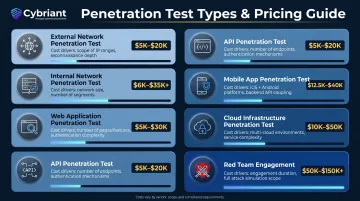
These are planning ranges, not fixed quotes. Actual quotes shift based on asset count, testing duration, and compliance deadlines - all factors worth clarifying before any vendor conversation.
Key Factors That Affect Penetration Testing Costs
Penetration testing pricing is shaped by a combination of technical, operational, and compliance-related considerations. Understanding these factors helps businesses avoid surprise invoices and scope misalignment.
Scope and Complexity of the Environment
The number of assets in scope is the single largest cost driver. More assets mean more tester time. Assets include:
- IP addresses and network segments
- Applications and APIs
- User roles requiring testing
- Cloud accounts and services
- Third-party integrations and external dependencies
A company testing one external-facing website faces an entirely different scoping exercise than one testing an internal Active Directory environment across multiple locations. Each additional asset increases discovery time, exploitation attempts, and reporting requirements.
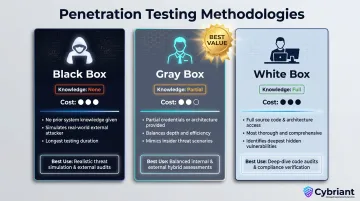
Testing Methodology: Black Box, Gray Box, or White Box
The methodology significantly impacts both cost and findings quality:
Black Box Testing
- No prior knowledge of the environment
- Testers simulate external attacker perspective
- Higher cost due to extensive reconnaissance
- Often recommended only for mature organizations testing external defenses
Gray Box Testing
- Partial knowledge provided (user credentials, network diagrams)
- Moderate cost with optimal value
- Balances realistic attack simulation with efficient testing
- Most common approach for standard engagements
White Box Testing
- Full access to source code, architecture, credentials
- Comprehensive coverage but time-intensive
- Identifies subtle configuration issues and logic flaws
- Best for application security and pre-release testing
Black box testing is not always better - it can miss internal vulnerabilities that pose the greatest risk. Gray box typically delivers the best cost-to-value ratio for most organizations.
Tester Experience and Certifications
Skilled penetration testers typically charge $150 to $300+ per hour. Testers with certifications such as OSCP, CISSP, OSCE, OSWE, or CREST accreditation command higher fees, often adding a 15-25% premium to engagement costs.
Why the premium matters: Experienced testers identify complex vulnerabilities that automated tools and junior testers miss, including:
- Business logic flaws in application workflows
- Attack chaining across multiple systems
- Subtle misconfigurations that create privilege escalation paths
- Insider threat scenarios and lateral movement opportunities
The higher day rate often pays for itself - a single critical vulnerability caught before an attacker finds it can cost far less to fix than the breach response, legal exposure, and reputational damage that follow.
Compliance Requirements
Certain frameworks don't just recommend penetration testing - they require it. Compliance-mandated tests incur a 15-30% cost uplift due to formal documentation, specific scoping requirements, and stricter methodologies. Key compliance frameworks include:
PCI DSS (v4.0)
- Requires annual external and internal penetration testing
- Must include segmentation testing to verify isolation
- Mandates manual methodology and industry-accepted practices
- Requires retesting after significant infrastructure changes
HIPAA
- Proposed updates would require penetration testing at least annually
- Focuses on electronic protected health information (ePHI) security
- Emphasizes risk assessment and vulnerability identification
SOC 2
- Does not explicitly mandate penetration testing
- Auditors routinely expect it as evidence for Trust Services Criteria CC4.1
- Used to demonstrate ongoing evaluation of internal controls
Budget for the additional documentation, formal reporting, and methodology requirements that each framework demands - these aren't optional extras, they're part of what auditors evaluate.
Remediation, Retesting, and Hidden Costs
The vendor's quote is usually only part of the total cost. Additional expenses include:
Retesting After Remediation
- Some providers include one round of fix validation (within 90 days)
- Others bill retesting on a time-and-materials basis
- Can add 10-20% to the original quote if not included
Scope Changes Mid-Engagement
- Additional assets discovered during testing
- Expanded user role testing requirements
- New applications or APIs requiring assessment
Internal Staff Time
- Coordination and access provisioning
- Remediation implementation
- Documentation and reporting review
Set aside a contingency of 10-20% of total testing spend to absorb these costs. Before signing any contract, confirm whether retesting is included and whether the vendor offers remediation guidance - both details significantly affect total spend.
Penetration Testing Pricing Models Explained
How a vendor charges matters as much as what they test. The three most common pricing models - fixed-price, hourly, and PTaaS - each carry different trade-offs for budget control, flexibility, and ongoing value.
Fixed-Price / Flat-Rate
Fixed-price engagements give organizations a clear, upfront cost for defined scope and deliverables. This model works best for:
- Well-defined tests like web application assessments
- Compliance-driven penetration tests with established requirements
- Organizations that need predictable budgeting
Risk to consider: If the environment is more complex than initially scoped, costs may increase. Ensure the scope document clearly defines all assets and boundaries before signing.
Hourly / Time and Materials
Hourly or T&M models bill for actual time spent. Typical rates range from $150–$300 per hour for standard work, with specialized engagements like reverse engineering or red teaming priced higher. This model trades budget certainty for scope flexibility - useful when you don't know exactly what you're getting into upfront.
Good fit for:
- Open-ended security assessments
- Advisory engagements requiring flexible scope
- Projects where full complexity is unknown upfront
- Organizations with evolving testing requirements
Penetration Testing as a Service (PTaaS)
PTaaS is a subscription-based model that provides ongoing or frequent testing, often including:
- Platform-based workflow tools
- Issue tracking and remediation management
- Continuous retesting as fixes are implemented
- Real-time findings visibility
Research shows PTaaS can reduce per-test costs by approximately 31–32% compared to traditional consulting engagements. This efficiency comes from platform automation, reduced project management overhead, and bundled retesting.
PTaaS is a strong fit for organizations that need regular testing throughout the year - SaaS companies with frequent release cycles, or businesses under continuous compliance requirements like SOC 2 or PCI DSS. For those already running vulnerability management programs, the model pairs naturally with continuous scanning to reduce gaps between scheduled assessments.
Low-Cost vs. High-Cost Pen Testing: What's the Difference?
A significant price gap between two quotes does not always mean one is overpriced - it usually reflects what's included in the actual testing process.
What Budget-Range Tests Often Look Like
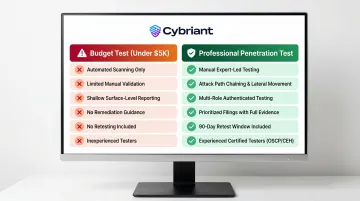
Tests priced under $5,000 typically include:
- Heavy reliance on automated vulnerability scanners
- Limited manual validation of findings
- Shallow reporting without reproduction steps
- No remediation guidance or prioritization
- No retesting included
- Inexperienced testers who miss complex vulnerabilities
That last point carries real risk. Industry experts warn that penetration tests priced below $3,000-$4,000 are almost certainly automated vulnerability scans relabeled as penetration tests. These services may satisfy a checkbox requirement but leave significant security gaps.
What Higher-Cost Tests Deliver
Professional penetration testing engagements include:
- Manual expert-driven testing of business logic and workflows
- Attack path chaining across multiple systems
- Authenticated testing of multiple user roles and permission levels
- Detailed findings with evidence, impact analysis, and reproduction steps
- Prioritized remediation guidance aligned with business risk
- Retesting window included (typically 90 days)
- Experienced testers who identify subtle configuration issues
This gap has a technical basis: NIST SP 800-115 notes that vulnerability scanners cannot detect vulnerabilities revealed only through combinations of attack patterns. Manual testing is required to validate actual risk and exploitability.
Cybriant's penetration testing pairs automated scanning with manual expert analysis - covering external and internal networks, web applications, and social engineering scenarios - and delivers findings with clear remediation steps tied to business risk.
How to Estimate the Right Pen Testing Budget for Your Business
Estimating the right budget starts with fit - matching the test type and scope to your actual risk profile, not just selecting the cheapest option available.
Key Questions to Ask Before Scoping
- Identify your highest-risk assets first - customer data, financial systems, and internet-facing applications typically warrant deeper testing
- Confirm whether compliance is driving the engagement - PCI DSS, HIPAA, SOC 2, and CMMC each carry specific testing mandates
- Factor in how often systems change - frequent deployments often benefit from PTaaS or quarterly testing cycles
- Review prior test results if available - previous findings help scope follow-up engagements more precisely
- Decide whether remediation support is needed - internal technical capacity determines whether vendor-assisted remediation adds real value
Budget Benchmarks by Organization Size
| Company Size | Typical Security Spend Per Employee/Year | Annual Pen Test Budget Guidance |
|---|---|---|
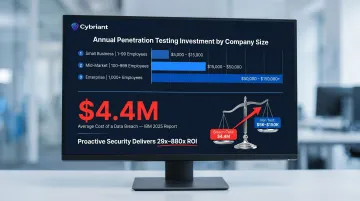
| Small (20-100 employees) | $750–$1,500 | $5,000–$15,000 for focused annual testing |
| Mid-Market (100-500 employees) | $1,200–$2,500 | $15,000–$50,000 for annual or bi-annual testing |
| Enterprise (500+ employees) | $2,000–$5,000+ | $50,000–$150,000+ for continuous programs or red team exercises |
To frame the ROI: The 2025 IBM Cost of a Data Breach Report found the global average cost of a data breach is $4.4 million. A $15,000 to $30,000 penetration test that identifies and closes a critical exploitable vulnerability compares favorably against that $4.4M average breach cost.
Working with an Experienced Provider
Getting the scope right is where many organizations struggle - and where an experienced provider makes a real difference. Cybriant works with businesses to define appropriate test scope, avoid over-spending on unnecessary coverage, and connect penetration testing findings to a broader cyber risk management program.
Beyond the test itself, Cybriant's Virtual CISO service provides the strategic oversight needed to act on results - tying findings to risk assessments, gap analysis, and ongoing vulnerability management rather than treating each test as a one-off exercise.
To replace a generic range with an accurate number, start with a scoping conversation: Cybriant maps your in-scope assets, compliance drivers, and highest-risk systems, then proposes a fixed-scope engagement with prioritized remediation guidance and a retest window included. Call 844-411-0404 to scope your penetration test and get a tailored quote.
Frequently Asked Questions
How much does penetration testing services cost?
Penetration testing typically costs $5,000–$50,000 for most business engagements, with enterprise or red team exercises reaching $100,000+. The exact cost depends on scope (number of assets), methodology (black/gray/white box), and compliance requirements.
How much does an external pen test cost?
External network penetration tests typically range from $5,000 to $20,000. Cost is influenced by the number of public-facing IP addresses, services exposed, and whether social engineering or application-layer testing is included.
How much does PTaaS cost?
PTaaS (Penetration Testing as a Service) is subscription-based and typically costs 20–30% less than traditional one-off engagements. Pricing varies by provider and testing frequency, making it a practical option for organizations that need ongoing testing throughout the year.
How much does a pentester charge per hour?
Skilled penetration testers typically charge $150–$300 per hour for standard work, with specialized tasks like reverse engineering and red team operations priced higher. Most fixed-price engagements embed these rates into the total project cost.
How much does cyber security cost for a small business?
For small businesses, a basic annual penetration test often falls in the $5,000–$15,000 range - a manageable entry point that covers most standard network and application assessments.
Is pen testing worth it?
Yes. With the average data breach costing $4.4 million, the ROI is clear. A $15,000 test that identifies and closes a critical vulnerability can prevent losses many times its cost.