What are cybersecurity compliance services?
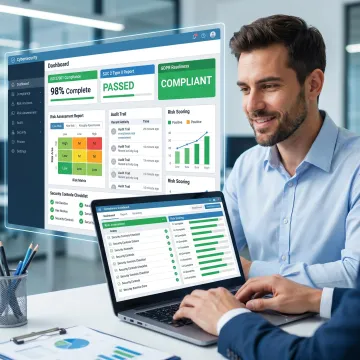
Cybersecurity compliance services help businesses align their security practices with required frameworks, regulations, and customer expectations. These services often include gap assessments, policy and control reviews, penetration testing, vulnerability management, documentation support, and ongoing monitoring. The goal is to reduce risk while improving readiness for audits, certifications, contract requirements, and internal governance standards.
Which compliance frameworks can these services support?
Cybriant’s services are well suited for organizations working toward frameworks such as CMMC and NIST, as well as broader security and risk management requirements. Support can include identifying control gaps, prioritizing remediation, validating safeguards through testing, and building a roadmap for ongoing oversight. This helps businesses create a more structured and defensible compliance program over time.
How does penetration testing help with compliance?
Penetration testing helps validate whether security controls work as intended by simulating realistic attack methods against systems, applications, or networks. The findings can reveal exploitable weaknesses, misconfigurations, and process gaps that may affect compliance readiness. For organizations pursuing standards like CMMC or NIST, testing provides actionable evidence to strengthen defenses and support remediation planning.
Do I need ongoing vulnerability management or just a one-time assessment?
Ongoing vulnerability management is usually more effective than a one-time assessment because new weaknesses appear as systems change, software updates are released, and threats evolve. Continuous scanning, prioritization, and patch management help maintain a healthier environment and support compliance over time. A one-time assessment can be useful, but sustained monitoring provides stronger long-term risk reduction and documentation.
What does a virtual CISO do for compliance programs?
A virtual CISO provides strategic leadership without requiring a full-time in-house executive. This role helps define security priorities, align controls to frameworks, guide risk management decisions, and oversee program maturity. For compliance efforts, a vCISO can coordinate assessments, remediation planning, policy development, and executive reporting so the organization has clearer direction and accountability.
Can you help after a security incident affects compliance?
Yes. Incident response and containment services help organizations investigate what happened, limit damage, and restore operations quickly. From a compliance perspective, this support can also help document the event, identify control failures, and guide corrective actions. Fast, structured response is especially important when incidents affect sensitive data, contractual obligations, or regulated business operations.
Are these services a fit for small and mid-sized businesses in Texas?
Yes. Cybriant positions its services to make enterprise-grade cybersecurity accessible to businesses of all sizes, including small and medium-sized organizations. That is especially valuable in Texas, where growing companies often face customer security questionnaires, contractual requirements, and industry expectations before they have a large internal security team. Scalable support helps close that gap efficiently.
Is monitoring available outside normal business hours?
Yes. Cybriant offers 24/7 operations, including managed monitoring and response capabilities designed to detect and address threats at any hour. This is important for organizations with distributed teams, cloud environments, customer-facing systems, or multi-shift operations. Around-the-clock visibility can improve both security outcomes and compliance readiness by reducing response delays and strengthening oversight.