Introduction
Security leaders face mounting pressure to justify cybersecurity spending to boards and executives, yet most ROI conversations around Managed XDR stall because the value feels intangible or hard to quantify. Unlike revenue-generating investments, security solutions prevent losses rather than create gains - making traditional ROI calculations counterintuitive. How do you assign a dollar value to attacks that didn't happen?
Managed XDR ROI is measurable when you know which costs, risks, and efficiencies to factor in. The 2024 IBM Cost of a Data Breach Report put the global average breach cost at $4.88 million - and breaches contained in under 200 days cost $1.24 million less than those that dragged past that mark. That gap is quantifiable value, and it's just one piece of the ROI picture.
This guide walks through a practical framework for calculating that value - covering avoided breach costs, operational efficiency gains, and tool consolidation savings.
Overview
- Managed XDR ROI goes well beyond licensing costs - it spans breach prevention, SOC efficiency gains, tool consolidation, and reduced compliance exposure
- Track MTTD, MTTR, analyst hours reclaimed, and total cost of ownership versus in-house alternatives as your key metrics
- Use the formula (Total Benefits – Total Costs) / Total Costs × 100 to calculate ROI across both hard costs and risk-adjusted estimates
- SMBs and mid-market companies achieve the strongest ROI by gaining enterprise-grade capabilities without the cost of building an internal SOC
What Is Managed XDR ROI - and Why Is It Hard to Measure?
Defining Managed XDR
Managed XDR (MXDR) is a fully outsourced security service that combines Extended Detection and Response technology with 24/7 human-led threat detection, investigation, and response. Unlike traditional endpoint-focused MDR, MXDR delivers unified visibility across endpoints, networks, cloud environments, email, and identity systems - all managed by an external provider.
The Traditional ROI Challenge
Cybersecurity ROI has always been hard to pin down because security solutions prevent losses rather than generate revenue. Security leaders struggle to assign dollar values to "attacks that didn't happen," making traditional return-on-investment calculations nearly impossible to justify in a boardroom.
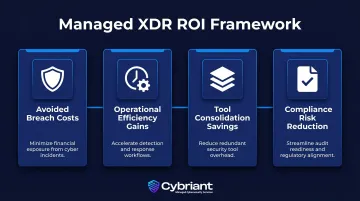
Modern ROI frameworks solve this by treating Managed XDR as both a risk transfer mechanism and a cost optimization tool. Instead of focusing solely on prevention claims, these frameworks measure value through:
- Avoided breach costs based on industry benchmarks
- Operational efficiency gains from automated triage and 24/7 coverage
- Stack consolidation savings by replacing redundant tools
- Compliance risk reduction through continuous monitoring
Each of these levers produces numbers a CFO can actually evaluate - which is where the real ROI conversation begins.
The Real Costs That a Managed XDR Solution Helps You Avoid
Breach Costs
The financial impact of data breaches continues to escalate. IBM's 2024 research found the global average breach cost reached $4.88 million, representing a 10% year-over-year increase. The 2025 report showed a decrease to $4.4 million, but this reduction was explicitly attributed to faster identification and containment - exactly what MXDR delivers.
Detection speed directly reduces breach costs. Breaches contained in under 200 days cost an average of $4.22 million, while those exceeding 200 days cost $5.46 million - a $1.24 million difference tied directly to faster MTTD and MTTR.
Downtime and Business Disruption
Ransomware and advanced threats can halt operations for days or weeks. Recent data shows ransomware attacks cause an average of 24 days of downtime, with recovery costs averaging $1.53 million excluding ransom payments.
The ITIC 2024 Hourly Cost of Downtime Survey found that 91% of mid-sized enterprises report one hour of downtime costs $300,000 or more. MXDR's faster MTTR directly reduces this exposure by compressing the window between detection and containment.
Regulatory and Compliance Penalties
Undetected breaches or inadequate security controls trigger significant compliance violations:
- GDPR: Up to €20 million or 4% of global annual turnover for severe violations
- HIPAA: Up to $2,134,831 per violation per year (2024 HHS inflation-adjusted rates)
- CMMC non-compliance: Loss of DoD contract eligibility and potential False Claims Act liability
MXDR addresses these risks through continuous monitoring, automated audit trails, and documented incident records that satisfy regulatory evidence requirements.
In-House SOC Staffing Costs
The ISC2 2024 Cybersecurity Workforce Study reports a global workforce gap of 4.8 million professionals, with approximately 700,000 unfilled positions in the US alone. The Bureau of Labor Statistics reports a median annual wage of $124,910 for information security analysts.
Building a minimal three-analyst SOC carries costs that stack quickly:
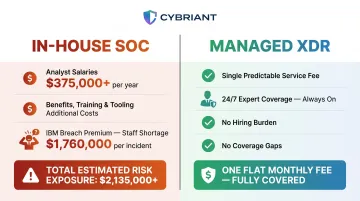
- ~$375,000 in annual salaries alone (three analysts)
- Additional spend on benefits, training, tooling, and infrastructure
- Higher breach exposure: IBM found staffing shortages added $1.76 million per incident
MXDR delivers equivalent or superior coverage without the hiring burden or the compounding risk of coverage gaps.
Tool Sprawl and Licensing Waste
Beyond staffing, most organizations carry separate licenses for SIEM, EDR, NDR, and threat intelligence feeds - often with significant capability overlap. MXDR consolidates these into a single managed service, cutting redundant licensing costs and the operational burden of managing multiple vendor relationships.
Key Metrics to Measure Managed XDR ROI
Mean Time to Detect (MTTD)
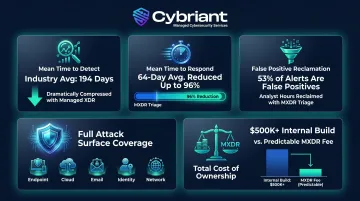
MTTD measures the average time from threat occurrence to discovery. IBM's 2024 research found the average time to identify a breach was 194 days, while Mandiant's M-Trends 2024 report showed a median dwell time of 10 days for incidents in their response engagements.
MXDR's correlated telemetry across endpoints, cloud, network, email, and identity systems measurably compresses this detection window compared to siloed point tools.
Mean Time to Respond (MTTR)
MTTR measures the time from detection to containment or remediation. IBM found the average containment time was 64 days; organizations using security AI and automation shortened their total breach lifecycle by 98 days compared to those without it.
Forrester's Total Economic Impact study of Expel's MDR service found a 96% reduction in MTTR - from 530 minutes to just 23 minutes. That kind of compression comes from pre-built playbooks and 24/7 analyst coverage, which lets MXDR providers act immediately rather than waiting for an internal team to come online after hours.
False Positive Rate and Analyst Hours Reclaimed
The 2024 Devo SOC Performance Report found that up to 53% of security alerts are false positives, and a Morning Consult/IBM survey found analysts spend roughly one-third of their workday investigating non-genuine threats.
MXDR filters and prioritizes alerts intelligently, reclaiming analyst hours that can be redirected to strategic security projects. Calculate the dollar value by multiplying hours saved by your team's loaded hourly rate (approximately $60–65/hour based on median analyst salaries).
Security Coverage and Attack Surface Visibility
Traditional endpoint-only detection misses significant attack vectors. The CrowdStrike 2024 Global Threat Report documented a 75% increase in cloud environment intrusions year-over-year, while the Verizon 2025 DBIR found compromised credentials were the initial access vector in 22% of breaches.
MXDR extends coverage from partial endpoint visibility to full cross-domain monitoring - endpoint, email, cloud, identity, and network - reducing the blind spots that lead to costly undetected breaches.
Total Cost of Ownership (TCO) vs. In-House Equivalent
Compare MXDR's predictable service fee against the fully-loaded cost of building equivalent capabilities in-house. That internal cost includes:
- Hiring and onboarding security analysts
- Ongoing training and certification
- Tool licenses and infrastructure
- Benefits, overhead, and turnover costs
For SMBs and mid-market organizations that cannot absorb a $500,000+ annual SOC investment, this comparison is often the most compelling ROI argument of all.
How to Calculate Your Managed XDR ROI: A Step-by-Step Framework
Any security or IT leader can work through this five-step process using internal data and industry benchmarks. Even rough estimates produce a defensible business case.
Step 1 – Establish Your Cost Baseline
Document all current security spending to create your "before" benchmark:
- Tool licensing (SIEM, EDR, NDR, threat intelligence feeds)
- SOC staffing (internal salaries + benefits, or current outsourced SOC costs)
- Incident response retainers
- Compliance audit costs
- Security training and certification costs
This baseline represents your current investment before MXDR implementation.
Step 2 – Estimate Your Breach Risk Exposure
Use a risk-adjusted breach cost model:
Annual Risk Value = (Probability of Breach) × (Average Breach Cost for Your Sector)
Industry research shows 43% of cyberattacks target small businesses, and the Verizon 2025 DBIR found ransomware present in 75% of System Intrusion pattern breaches affecting SMBs. Use these probabilities as conservative estimates for your sector.
For breach costs, reference IBM's sector-specific data or use the $4.4 million global average as a baseline, adjusting for your organization's size.
Step 3 – Quantify Operational Efficiency Gains
Calculate current analyst time spent on:
- Alert triage and investigation
- False positive verification
- Manual correlation across tools
- Security reporting and documentation
Assign dollar values using your team's loaded hourly rate (salary + benefits + overhead, typically 1.3-1.5x base salary). Industry benchmarks suggest MXDR's automation and expert triage eliminate 30-40% of this manual effort.
Example: If two analysts spend 50% of their time on alert triage (approximately 2,080 hours annually at $65/hour), that's $135,200 in current costs. A 35% reduction saves $47,320 annually.
Step 4 – Add Consolidation and Tool Savings
Identify tools that MXDR replaces or makes redundant:
- Standalone SIEM licensing and infrastructure
- Separate EDR/endpoint protection subscriptions
- Network detection tools
- Threat intelligence feed subscriptions
- Log management and storage costs
Total the annual licensing and management costs for these tools to calculate direct consolidation savings.
Step 5 – Apply the ROI Formula and Interpret Results
With your data from Steps 1-4 in hand, plug the numbers into this formula:
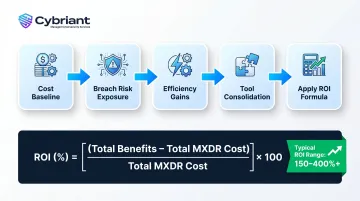
ROI (%) = [(Total Benefits – Total MXDR Cost) / Total MXDR Cost] × 100
Total Benefits include:
- Risk-adjusted breach cost reduction (from Step 2)
- Operational efficiency savings (from Step 3)
- Tool consolidation savings (from Step 4)
Calculations that only count operational efficiency and tool consolidation typically land at 150-300% ROI. Factor in risk-adjusted breach cost reduction and that figure often climbs past 400% - which is why most organizations find MXDR one of the higher-returning security investments they can make.
A Sample Managed XDR ROI Walkthrough
Let's illustrate the five-step framework with a representative mid-market scenario: a 500-employee professional services firm with a small IT team, limited security tooling, and no dedicated SOC.
Disclaimer: All figures below are illustrative estimates for demonstration purposes, not guaranteed outcomes.
Step 1: Baseline Security Spend
Current annual costs:
- SIEM tool licensing: $35,000
- Endpoint protection: $28,000
- One security analyst (salary + benefits): $140,000
- Incident response retainer: $15,000
- Compliance audit support: $12,000
- Total baseline: $230,000
Step 2: Breach Risk Exposure
Using conservative industry probabilities:
- Annual breach probability for this sector/size: 25%
- Average breach cost for mid-market services firm: $2.8 million
- Risk-adjusted annual exposure: $700,000
With MXDR's faster detection and response (reducing breach likelihood by 60% and breach costs by 40% when incidents occur):
- Risk-adjusted exposure with MXDR: $280,000
- Annual risk reduction value: $420,000
Step 3: Operational Efficiency
Current state:
- One analyst spends 60% of time on alert triage (1,248 hours annually)
- Loaded hourly rate: $67
- Current triage cost: $83,616
With MXDR handling Level 1 triage:
- Analyst time reclaimed: 40% (499 hours)
- Annual efficiency savings: $33,433
Step 4: Tool Consolidation
MXDR replaces:
- SIEM licensing: $35,000
- Standalone threat intelligence feed: $18,000
- Log management infrastructure: $8,000
- Total consolidation savings: $61,000
Step 5: Apply ROI Formula
Assumed annual MXDR cost: $120,000
Total annual benefits:
- Risk reduction: $420,000
- Operational efficiency: $33,433
- Tool consolidation: $61,000
- Total benefits: $514,433
ROI = [($514,433 – $120,000) / $120,000] × 100 = 329%
These numbers only hold up if your inputs are accurate. Two calculation errors consistently undercut otherwise solid ROI cases:
Common Mistakes to Avoid
- Undervaluing breach risk: Too-low probability estimates and missing indirect costs - downtime, reputation damage, customer churn, post-breach remediation - systematically deflate your ROI figure.
- Ignoring hidden analyst costs: Salary alone undersells the true expense. Factor in benefits, training, turnover recruitment, and the opportunity cost of senior staff handling manual triage instead of strategic security work.
How Cybriant Can Help You Measure and Maximize Managed XDR ROI
Cybriant has been delivering managed security services to businesses of all sizes since 2015. The company holds SOC 2 Type 2 certification, earned a spot on MSSP Alert's Top 250 MSSPs list for five consecutive years through 2022, and operates a 24/7 security operations center staffed by experienced analysts. For SMBs and mid-market companies, that combination makes strong, measurable ROI realistic - not just theoretical.
Service Capabilities That Drive ROI
CybriantXDR's core capabilities are built around the metrics that move ROI - faster detection, faster response, and a smaller attack surface:
- 24/7 human-led SOC monitoring: Analysts actively investigate and remediate alerts around the clock, not just flag them for review the next morning.
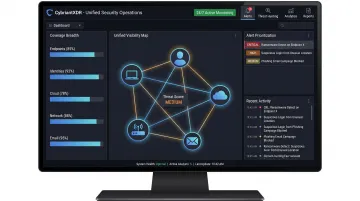
- Unified visibility across the full attack surface: Coverage spans endpoints, identities, networks, cloud environments, and email - closing the gaps that endpoint-only tools leave open and directly reducing both MTTD and MTTR.
- Integrated vulnerability and patch management: Continuous scanning plus risk-based patch management for operating systems and up to 800 third-party applications, eliminating the cost of a separate vulnerability management tool.
- Custom response playbooks: Tailored playbooks for each threat scenario combine automated containment with expert-led response, so threats are contained quickly and damage is limited.
Get Your Tailored ROI Assessment
The framework covered in this article gives you a solid starting point. For a projection tied to your specific environment, risk profile, and existing tool stack, Cybriant can build a tailored ROI assessment. Call 844-411-0404 to start that conversation.
Conclusion
Measuring Managed XDR ROI is not only possible but essential for making informed security investment decisions. The value extends well beyond breach prevention to include operational efficiency, staff optimization, tool consolidation, and compliance risk reduction.
The five-step framework outlined here gives you a practical path to building your business case:
- Establish your cost baseline
- Estimate breach risk exposure
- Quantify operational efficiency gains
- Calculate tool consolidation savings
- Apply the ROI formula to your specific environment
ROI isn't a one-time calculation. Run this analysis annually - or after any significant change to your environment, such as a merger, a new compliance requirement, or a major vendor contract renewal. Each cycle sharpens your numbers and strengthens your case for continued investment as your security program grows.
Frequently Asked Questions
How do you calculate ROI for a managed XDR solution?
Use the formula: (Total Benefits – Total Costs) / Total Costs × 100, where benefits include breach risk reduction, operational efficiency savings, and tool consolidation. Each benefit category should be quantified using data specific to your organization's environment and current security costs.
What metrics should I track to measure Managed XDR effectiveness?
Track MTTD (Mean Time to Detect), MTTR (Mean Time to Respond), false positive rate, analyst hours reclaimed, and security coverage breadth across your attack surface. Improvements in each metric translate directly to quantifiable business value through reduced breach costs and operational savings.
How long does it take to see ROI from a Managed XDR deployment?
Operational ROI from efficiency gains and reduced alert triage time is often visible within the first 90 days. Breach risk reduction value is realized over time as the service matures and continuous threat management prevents incidents that would otherwise occur.
Is Managed XDR worth the investment for small and mid-sized businesses?
Yes - SMBs and mid-market companies often see the strongest ROI because they gain enterprise-grade detection and response capabilities without the cost of building an internal team, which typically exceeds $400,000 annually for even minimal 24/7 coverage.
How does Managed XDR reduce costs compared to building an in-house SOC?
An in-house SOC requires salaries for multiple analysts ($125,000+ median per analyst), benefits, training, tool licensing, infrastructure, and ongoing recruitment to address turnover. The fully-loaded cost typically exceeds $500,000 annually for minimal 24/7 coverage.
What is the difference between Managed XDR and MDR, and does it affect ROI?
MXDR extends MDR's endpoint focus to the full attack surface - cloud, network, email, and identity systems. This broader coverage improves ROI by closing blind spots that lead to costly undetected breaches, especially as attackers shift toward cloud environments and compromised credentials.