Introduction
In 2023, the healthcare sector experienced 732 data breaches affecting 500 or more individuals - exposing the protected health information of more than 113 million people. Hacking and IT incidents accounted for 81% of these breaches and 96% of all breached records. But the consequences go far beyond regulatory fines: patients already admitted to a hospital when a ransomware attack begins face a 34–38% increase in mortality risk.
These numbers reflect a structural problem. Healthcare organizations hold some of society's most sensitive data yet routinely run on lean IT teams, legacy systems that resist standard patching, and expanding attack surfaces filled with connected medical devices. This combination makes them disproportionately targeted - and uniquely vulnerable.
This article explains what Managed Detection and Response (MDR) is in the healthcare context, why it delivers protection that legacy tools like EDR or SIEM alone cannot, and what to look for when choosing a provider that understands both cybersecurity and patient care.
Overview
- Healthcare is the most targeted sector for cyberattacks: patient data fetches premium prices on the dark web, legacy systems create exploitable gaps, and downtime pressure pushes organizations to pay ransoms fast
- MDR combines 24/7 monitoring, proactive threat hunting, and active incident response rather than passive alerting alone
- Healthcare MDR must address HIPAA compliance, IoMT device visibility, and clinical workflow awareness
- Choose providers with verifiable healthcare experience, clear SLAs, broad telemetry coverage, and Business Associate Agreement (BAA) support
Why Healthcare Is a Prime Cybersecurity Target
Healthcare faces three structural vulnerabilities that make it uniquely attractive to attackers.
High-Value Data, High Adversary ROI
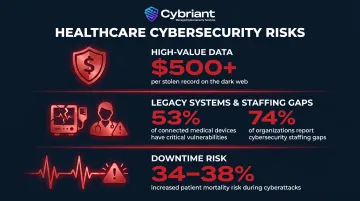
Electronic protected health information (ePHI) is immutable and comprehensive - containing Social Security numbers, dates of birth, insurance details, and complete medical histories. On the dark web, medical records fetch $500+ per record, while basic personally identifiable information sells for just $5–$15.
For attackers, healthcare data offers better returns than almost any other target. That financial incentive isn't going away.
Legacy Systems and Staffing Gaps Create Blind Spots
A 2022 FBI notification revealed that 53% of connected medical devices and IoT devices in hospitals have known critical vulnerabilities. More than 40% of medical devices at end-of-life receive little to no security patches.
That patch debt doesn't sit in isolation. When combined with severe staffing shortages - 74% of healthcare organizations report cybersecurity staff gaps - the exposure surface grows faster than most teams can address it.
Downtime Isn't Just Expensive - It's Dangerous
Unlike retail or financial services, healthcare downtime threatens patient safety directly. During a 2021 month-long ransomware attack on four hospitals, neighboring emergency departments saw measurable increases in patient census, ambulance arrivals, and stroke code activations.
Hospitals know that delayed care equals clinical harm. That reality makes them statistically more likely to pay ransoms than organizations in other sectors.
That urgency extends beyond the operational level. HIPAA's Security Rule mandates specific technical safeguards for ePHI, and recent guidance from CISA and HHS has tightened expectations further. A breach now triggers both a clinical crisis and a compliance emergency - with strict 60-day notification timelines starting from the date of discovery.
What Is Managed Detection and Response (MDR) in Healthcare?
MDR is a fully managed cybersecurity service that combines advanced detection technology with human analyst expertise to continuously monitor, detect, investigate, and respond to threats - 24 hours a day, 7 days a week. MDR is a service, not just a software tool.
What Makes Healthcare MDR Different
Analysts must understand clinical workflows, recognize normal EHR access patterns versus suspicious behavior, and make containment decisions that balance security with patient care continuity. Isolating a compromised endpoint in a corporate environment is straightforward; doing so in a hospital could inadvertently take a critical care system offline during an active procedure.
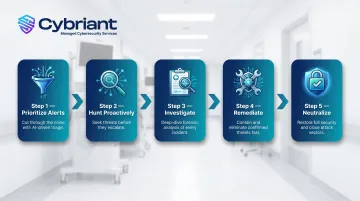
The Five Core MDR Steps in Healthcare:
- Prioritize alerts using automation and human triage to filter false positives
- Hunt proactively for stealthy threats that bypass automated rules
- Investigate to determine scope, severity, and clinical impact
- Remediate by isolating infected systems and removing malware
- Neutralize through root cause analysis to prevent recurrence
What Healthcare MDR Monitors
Those five steps only work when analysts can see everything. Healthcare MDR ingests telemetry from endpoints (workstations, servers, kiosks), network traffic, identity and access logs, email gateways, EHR audit trails, cloud platforms, and IoMT/OT device telemetry. This depth of visibility is what separates MDR from point solutions like antivirus or firewall monitoring.
The SOC You Can't Afford to Build Alone
MDR gives small and mid-size healthcare organizations the functional equivalent of a Security Operations Center staffed by security specialists, without requiring the budget, headcount, or expertise to build one internally. According to the SANS 2025 SOC Survey, fully staffed 24/7 SOCs typically employ 10 full-time equivalents, with base salary costs alone exceeding $1M annually before benefits, tooling, or training.
How MDR Protects Healthcare Organizations
Continuous 24/7 Monitoring and Threat Detection
MDR's always-on monitoring closes the coverage gap that leaves healthcare organizations most vulnerable during off-hours. Nights, weekends, and holidays are precisely when attackers prefer to move. Behavioral analytics and machine learning establish baselines of "normal" activity so deviations (such as an admin account accessing patient records at 3am) trigger immediate analyst review rather than waiting for a rule match.
Cybriant's 24/7 Managed SIEM with live monitoring continuously aggregates and analyzes security events across the environment so threats are identified and escalated in real time, not discovered after damage is done.
Proactive Threat Hunting
MDR analysts don't wait for alerts to fire. They actively search for indicators of compromise using behavioral trends, threat intelligence feeds, and hypothesis-driven investigations.
For example, an analyst might identify a dormant user account making low-volume queries against patient databases - ultimately revealing a weeks-old credential compromise from a phishing attack, caught before any data exfiltration occurs. This proactive posture reduces dwell time and stops breaches before encryption or exfiltration.
Rapid Incident Response and Containment
Upon confirming a threat, MDR analysts take direct containment action within pre-defined SLA windows. They don't hand off an alert and wait - they act. Typical containment steps include:
- Isolating compromised endpoints from the network
- Blocking malicious traffic at the firewall or DNS layer
- Revoking or resetting compromised credentials immediately
In healthcare, speed of containment is a clinical priority. Delayed response can mean EHR systems go offline, diagnostic equipment becomes inaccessible, or patient care is diverted. Healthcare organizations using AI and automation extensively shortened breach lifecycles by 80 days and lowered average breach costs by $1.9 million, according to IBM's 2025 Cost of a Data Breach report.
HIPAA Compliance and Audit Support
Healthcare MDR directly supports HIPAA Security Rule compliance across several key areas:
- Continuous audit logging of access events and system activity
- Access anomaly detection that flags unusual patterns before they escalate
- Incident documentation with chain-of-custody for regulatory review
- Breach assessment support to determine scope and notification obligations
HIPAA's 60-day breach notification window starts from the date of discovery. MDR's rapid detection gives organizations maximum time to respond, notify, and remediate - rather than discovering a breach weeks after the fact. MDR providers also deliver audit-ready documentation that simplifies regulatory responses.
Key Benefits of MDR for Healthcare Organizations
Reduced Downtime and Protected Patient Care Continuity
MDR's speed of detection and active containment stops ransomware before it cascades across the network - keeping EHR systems, diagnostic tools, and billing platforms operational. Healthcare organizations hit by ransomware lost an average of more than 17 days to downtime, with the longest stretch averaging 27 days in 2022.
Cost-Effectiveness Compared to Building an In-House SOC
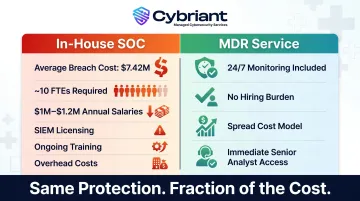
The average healthcare data breach cost $7.42 million in 2025 - the highest across all industries for the 14th consecutive year. Building an equivalent in-house defense is expensive and slow to staff.
MDR delivers SOC-level coverage at a fraction of what an internal team costs:
- Breach cost avoided: $7.42M average per healthcare incident
- Internal SOC staffing: ~10 FTEs, $1M–$1.2M in base salaries annually
- Additional in-house costs: SIEM licensing, ongoing training, and facility overhead
- MDR advantage: Equivalent 24/7 monitoring delivered as a managed service, without the hiring burden
Access to Specialized Healthcare Cybersecurity Expertise
MDR providers bring analysts who understand both cybersecurity and clinical context - a combination that takes years to build internally and rarely exists at the staffing levels healthcare organizations actually need. This frees healthcare IT teams to focus on systems management and clinical support while the MDR partner handles threat operations.
MDR vs. Other Healthcare Security Solutions
MDR vs. EDR
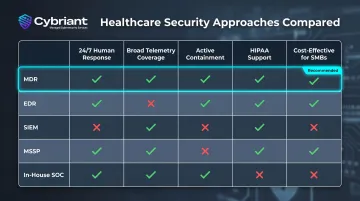
Endpoint Detection and Response (EDR) monitors and responds to threats on individual managed devices - laptops, workstations, servers - but has no visibility into network traffic, cloud platforms, unmanaged medical devices, or cross-environment lateral movement. MDR uses EDR as one component within a broader, orchestrated defense. EDR is an input to MDR, not a substitute.
MDR vs. SIEM
A Security Information and Event Management (SIEM) system collects and correlates logs across the environment to generate alerts - but SIEM stops at the alert. It requires a dedicated analyst team to triage, investigate, and act on findings. Without that capacity (which most healthcare organizations lack), SIEM creates alert fatigue rather than security. According to ESG research, 96% of security professionals have made tradeoffs between efficacy and efficiency just to keep up with alerts. MDR integrates with SIEM and provides the human expertise layer that turns raw alerts into investigated, prioritized, and resolved incidents.
One terminology point buyers often trip over: a managed SIEM service (like Cybriant's 24/7 Managed SIEM) already layers human monitoring and response on top of the SIEM platform, so in practice it delivers much of what organizations expect from MDR. The real question isn't "MDR or SIEM" but whether trained analysts are actively watching and acting on the alerts, whatever the service is labeled.
MDR vs. MSSP
A Managed Security Service Provider (MSSP) typically monitors security tools and forwards alerts to the internal team for action - response responsibility stays with the customer. MDR goes further: MDR providers actively investigate and contain threats on the customer's behalf. For a hospital IT team of 3–5 people receiving an alert at 2am, this distinction is the difference between containment and catastrophe.
MDR vs. In-House SOC
Building an internal Security Operations Center offers maximum control but requires significant ongoing investment in staffing, tooling, training, and 24/7 shift coverage. For most healthcare organizations outside of large health systems, this is cost-prohibitive. MDR delivers equivalent SOC-level capability as a managed service - spreading cost across the provider's customer base and giving your team immediate access to senior analysts and threat hunters that would take years to hire and train internally.
How to Choose the Right MDR Provider for Healthcare
Key Evaluation Criteria
Healthcare-Specific Experience
- Demonstrated understanding of HIPAA requirements, EHR systems, and clinical workflows
- Ability to handle IoMT device telemetry and OT environments
- Experience with medical device vulnerabilities and advisories (such as DICOM workstations, infusion pumps, and imaging systems)
Clear, Contractually Defined SLAs
- Detection time (Mean Time to Detect)
- Response time (Mean Time to Respond)
- Containment authority and escalation procedures
- Documented runbooks for healthcare-specific scenarios (ransomware, insider threat, vendor compromise)
Comprehensive Telemetry Coverage
- Endpoints, identity systems, network traffic, cloud platforms
- IoMT/OT device visibility (especially for unagentable devices)
- EHR audit trail integration
- Email gateway monitoring
Compliance Support and Documentation
- Audit-ready logging and reporting
- ePHI handling policies
- Signable Business Associate Agreement (BAA)
- Support for HIPAA breach notification timelines
Questions to Ask During Evaluation
- Do you sign Business Associate Agreements with healthcare clients?
- What IoMT devices and medical systems can your platform monitor?
- Can you demonstrate healthcare-specific incident response playbooks?
- What are your contractual SLAs for detection and containment?
- How do you integrate with our existing EHR and SIEM systems?
Red Flags to Avoid
- Providers relying purely on automated alerting without human-in-the-loop review
- Lack of transparency into detection logic or analyst decision criteria
- No documented runbooks for healthcare-specific scenarios
- Pricing models that escalate unpredictably as device counts grow
Why Cybriant Fits Healthcare MDR Requirements
Cybriant holds SOC 2 Type 2 certification and has appeared on MSSP Alert's Top 250 MSSPs list for five consecutive years - backed by over 10 years of managed cybersecurity experience. Its 24/7 Managed SIEM includes live monitoring and active remediation, making it a practical option for healthcare organizations that need continuous threat detection without standing up their own security infrastructure.
Frequently Asked Questions
What is managed detection and response (MDR) in healthcare?
Healthcare MDR is a fully managed cybersecurity service combining 24/7 expert monitoring, threat hunting, and active incident response, tailored to the specific risks of clinical environments, ePHI protection, and HIPAA compliance. It delivers SOC-level capability without requiring internal staffing.
How does managed detection and response work in healthcare?
MDR continuously monitors endpoints, networks, identity systems, and EHR platforms. Analysts perform real-time triage and proactive threat hunting, then take direct containment and remediation actions on the organization's behalf, without waiting for internal IT to respond first.
What is the difference between MDR and EDR in healthcare?
EDR monitors and responds to threats on individual endpoint devices. MDR is a broader managed service that incorporates EDR alongside network, cloud, and identity monitoring, with human analysts providing investigation and response across the entire environment, including unmanaged medical devices.
Is MDR the same as a security operations center (SOC) in healthcare?
MDR delivers SOC-level capability as an outsourced service: 24/7 monitoring, threat hunting, and incident response. Healthcare organizations avoid the cost of building an in-house SOC, which typically requires 10+ FTEs and over $1M annually.
What is the difference between MDR and MSSP in healthcare?
MSSPs typically monitor and alert, leaving response to the customer. MDR providers take active containment and remediation steps on the organization's behalf - a critical distinction in healthcare, where delayed response directly affects patient safety.
Does MDR replace SIEM in healthcare?
MDR does not replace SIEM but enhances it. SIEM provides log aggregation and alerting, while MDR adds the human analyst layer needed to investigate those alerts, prioritize real threats, and take direct action, reducing alert fatigue and converting raw detections into actual outcomes.