Introduction
Defense contractors face a new reality: CMMC is no longer optional - it's contractual. With Phase 1 launched in November 2025 following the DFARS effective date, continuous security monitoring has become a mandatory requirement embedded directly into DoD contracts. The stakes are significant: the DoD estimates 118,289 organizations will need a CMMC Level 2 C3PAO certification, representing 35% of the entire Defense Industrial Base.
A properly configured SIEM (Security Information and Event Management) system directly satisfies key NIST SP 800-171 control families - including Audit & Accountability (3.3), Incident Response (3.6), and System Integrity (3.14). It generates verifiable audit logs, detects unauthorized access in real time, and produces the forensic evidence assessors require.
Without that capability, defense contractors risk NOT MET findings during their C3PAO assessment - failures that can disqualify organizations from contract eligibility and cut them out of the defense supply chain entirely.
That's a risk most contractors can't afford to take. This guide evaluates the top CMMC-ready SIEM solutions to help defense contractors and SMBs choose the right continuous monitoring capability before their certification window closes.
Overview
- A SIEM collects and correlates security event logs across your environment, mapping directly to NIST SP 800-171 requirements for CMMC Level 2
- CMMC-ready SIEMs must cover Access Control (3.1), Audit & Accountability (3.3), Incident Response (3.6), and System Integrity (3.14)
- Key differentiators include log retention policies, real-time alerting, CUI environment scoping, and 24/7 managed monitoring
- Managed SIEM services are typically the most cost-effective route for small and mid-sized contractors lacking in-house security talent
- Each solution reviewed is assessed for compliance coverage, deployment flexibility, and fit for defense industrial base organizations
What Makes a SIEM "CMMC-Ready"?
A "CMMC-ready" SIEM generates, retains, and protects audit logs in a format verifiable by a C3PAO assessor. The evidence it produces - event logs, alert histories, anomaly reports - becomes part of the documentation package reviewed during your assessment. Without that evidence trail, continuous compliance cannot be demonstrated.
NIST SP 800-171 Control Families a SIEM Addresses
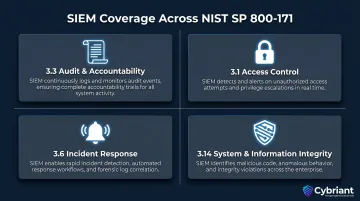
A CMMC-ready SIEM directly satisfies or supports multiple core control families:
- 3.3 (Audit & Accountability): Centralized log aggregation, retention, and correlation. NIST SP 800-171 Rev. 2 requires audit records sufficient for monitoring and reporting unauthorized activity (3.3.1), user-traceable actions (3.3.2), alerts on logging failures (3.3.4), and correlated audit review (3.3.5).
- 3.1 (Access Control): Detecting unauthorized access attempts. Control 3.1.12 mandates monitoring and controlling remote access sessions, with audit logs providing user-level traceability.
- 3.6 (Incident Response): Real-time alerting and forensic analysis. Controls 3.6.1 and 3.6.2 require an incident-handling capability with tracking, documentation, and reporting.
- 3.14 (System & Information Integrity): Malware detection reporting. Control 3.14.6 requires monitoring inbound and outbound communications traffic to detect attacks.
Three Most Common SIEM-Related Gaps Found During CMMC Assessments
The CMMC Assessment Guide Level 2 highlights frequent failures:
- Insufficient log retention: While NIST SP 800-171 Rev. 2 does not mandate a specific numeric minimum, NIST SP 800-92 emphasizes retaining logs long enough for forensic analysis and compliance verification. Many organizations fall short.
- No real-time alerting for anomalous behavior: Failing to configure alerts for audit failures (3.3.4) or remote access sessions (3.1.12) consistently results in NOT MET findings.
- No documented alert review process: Collecting logs is only half the requirement. Assessors verify that alerts are reviewed, triaged, and acted upon through documented procedures.
Self-Managed vs. Managed SIEM
Closing these gaps depends in part on who's running the platform. A self-managed SIEM requires internal security staff to configure, monitor, and respond to alerts. A managed SIEM - delivered by an MSSP - includes 24/7 live analyst coverage, alert triage, and incident escalation. Most SMBs in the DIB lack dedicated SOC teams, making managed SIEM the more practical path to CMMC compliance.
The section below lists the top five CMMC-ready SIEM solutions currently serving DIB contractors, evaluated on compliance coverage, deployment model, and organizational fit.
Top CMMC-Ready SIEM Solutions for Continuous Security Monitoring
The tools below fall into two categories: enterprise platforms that require in-house security staff to configure, monitor, and maintain, and Cybriant's fully managed SIEM, which delivers the same compliance coverage without requiring you to staff or run the platform yourself. For most small and mid-sized defense contractors, the choice isn't which platform to buy. It's whether to buy and run one, or let an expert team handle it.
Cybriant Managed SIEM
Cybriant is an Alpharetta, GA-based MSSP with over 10 years of experience in cybersecurity. SOC 2 Type 2 certified and named to MSSP Alert's Top 250 MSSPs List, Cybriant's Managed SIEM is built for organizations that need 24/7 security monitoring without standing up an internal SOC.
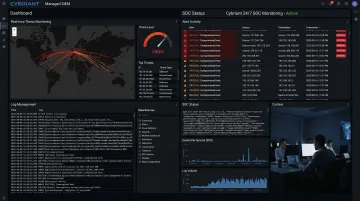
The service pairs live analyst monitoring with real-time threat detection, log correlation, and incident escalation. Defense contractors get a team actively reviewing alerts and generating the audit evidence required for CMMC assessment - making it a practical fit for small and mid-sized contractors that can't staff an in-house security operation.
| Attribute | Details |
|---|---|
| Key CMMC-Relevant Features | 24/7 live monitoring and analysis, real-time alerting, log management, incident response support, audit trail generation mapped to NIST 800-171 control families |
| Deployment Model | Fully managed MSSP delivery; no need for internal SOC or dedicated SIEM engineers |
| Best For | Small and mid-sized defense contractors needing CMMC Level 2 compliance without building in-house security operations capability |
IBM QRadar SIEM
IBM QRadar is a widely recognized enterprise SIEM platform used across regulated industries, including defense. IBM's presence in government and defense sector environments is well-established, with IBM Cloud for Government holding FedRAMP High authorization.
QRadar's advanced correlation engine, pre-built compliance reporting modules, and broad integration library directly support the log aggregation and anomaly detection required under NIST 800-171. IBM's QRadar Content Extension for NIST provides pre-configured rules and dashboards aligned to NIST requirements, reducing setup time for compliance teams.
| Attribute | Details |
|---|---|
| Key CMMC-Relevant Features | Real-time threat detection, compliance reporting dashboards, log management, behavioral analytics, integration with threat intelligence feeds, NIST content extension |
| Deployment Model | On-premises or QRadar on Cloud; IBM Cloud for Government is FedRAMP High authorized |
| Best For | Mid-to-large defense contractors or prime contractors with internal SOC teams seeking a customizable, full-featured SIEM platform |
Splunk Enterprise Security
Splunk Enterprise Security is one of the most widely deployed SIEM platforms globally, recognized in the Gartner Magic Quadrant. Splunk Cloud Platform holds FedRAMP High authorization (Class D) and supports DoD Impact Level 5 (IL5) deployments, making it suitable for defense contractors processing CUI.
For CMMC compliance, Splunk's search and correlation capabilities let security teams build custom detection rules, create NIST 800-171-aligned dashboards, and produce the forensic log evidence needed during a C3PAO assessment. Splunk's Compliance Essentials app references CMMC v1.0 and NIST SP 800-171 Rev 2, offering pre-built searches and reports to accelerate that work.
| Attribute | Details |
|---|---|
| Key CMMC-Relevant Features | Custom detection rules, NIST 800-171 compliance dashboards, log retention and search, threat intelligence integration, incident investigation workflows, CMMC and NIST content packs |
| Deployment Model | On-premises, Splunk Cloud (FedRAMP High, IL5), or hybrid |
| Best For | Larger DIB organizations or those with dedicated security analysts who need deep customization and powerful log search capabilities |
Microsoft Sentinel
Microsoft Sentinel is a cloud-native SIEM and SOAR (Security Orchestration, Automation, and Response) platform built on Azure. Azure Government holds FedRAMP High authorization, and Sentinel is available within GCC High and DoD clouds supporting DoD Impact Levels up to IL5. That authorization makes Sentinel directly relevant for DoD contractors using Microsoft 365 GCC High or Azure Government to meet CMMC CUI processing requirements.
Sentinel's native integration with Microsoft 365, Azure Active Directory, and Defender for Endpoint creates a unified visibility layer across the exact tools many DIB contractors already use. Microsoft offers CMMC 2.0 Level 2 Advanced Posture analytics rules via GitHub, enabling pre-built detection aligned to CMMC requirements.
| Attribute | Details |
|---|---|
| Key CMMC-Relevant Features | Native Microsoft 365/Azure integration, automated threat detection, UEBA (User and Entity Behavior Analytics), compliance workbooks for NIST 800-171, SOAR-driven incident response, CMMC 2.0 analytics rules |
| Deployment Model | Cloud-native (Azure); available in GCC High and Azure Government for CUI environments (IL5 authorized) |
| Best For | Defense contractors already operating in Microsoft 365 GCC High or Azure Government who want integrated SIEM capabilities without a separate tool stack |
LogRhythm SIEM
LogRhythm is a compliance-focused SIEM platform with a track record in regulated industries including defense. LogRhythm's Axon FedCloud holds FedRAMP High authorization, making it suitable for government and defense contractor environments. LogRhythm's built-in compliance automation modules and structured incident response workflows are designed to reduce the manual effort required to generate assessor-ready evidence.
Its out-of-the-box log source support and compliance-first design minimize setup overhead. LogRhythm's NIST Compliance Automation Suite covers 64 of the 110 NIST SP 800-171 controls, and a dedicated CMMC module provides pre-configured content aligned to CMMC requirements.
| Attribute | Details |
|---|---|
| Key CMMC-Relevant Features | Compliance reporting automation, log source management, behavioral analytics, structured incident response playbooks, audit trail generation, NIST and CMMC compliance modules |
| Deployment Model | On-premises or cloud (LogRhythm Axon); Axon FedCloud is FedRAMP High authorized |
| Best For | Mid-sized defense contractors seeking a compliance-first SIEM with structured workflows and lower configuration overhead than enterprise platforms |
How to Evaluate a SIEM Before Your Assessment Window Closes
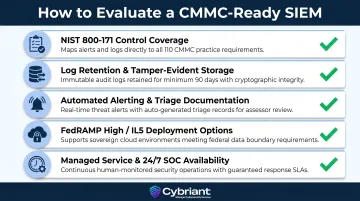
A common mistake: organizations choose a SIEM based on brand recognition rather than its ability to produce assessor-verifiable compliance evidence. These are the five criteria that matter for CMMC compliance specifically:
- Coverage across NIST 800-171 control families - particularly AU (Audit & Accountability), AC (Access Control), IR (Incident Response), and SI (System & Information Integrity). The CMMC Assessment Guide requires evidence that security controls are monitored on an ongoing basis.
- Log retention periods sufficient for forensic analysis and compliance verification, with tamper-evident storage.
- Automated alerting on audit failures, unauthorized access attempts, and security events - with documented triage procedures for incident escalation.
- Deployment options suited to CUI-scoped environments: FedRAMP High or IL5 authorization for cloud, on-premises for air-gapped networks.
- Managed service availability for organizations without an internal SOC, providing 24/7 analyst coverage and incident response support.
Beyond the criteria above, cost structure matters - especially for SMBs in the defense industrial base. Licensing, implementation, and ongoing management fees can add up fast with self-managed platforms. A managed SIEM from an MSSP typically delivers stronger CMMC compliance outcomes at a lower operational burden than running an enterprise platform in-house.
Conclusion
A CMMC-ready SIEM directly shapes your contract eligibility, assessment outcomes, and standing in the defense supply chain. The wrong tool - or one lacking managed support - can produce NOT MET findings during a C3PAO review, putting DoD contracts at risk.
Evaluate SIEM options based on your specific CMMC scope (which systems process CUI), your internal security staffing capacity, and whether you need a managed service or a self-managed platform. CMMC implementation timelines routinely stretch several months, so deploying and configuring your SIEM well ahead of your assessment window gives you time to close gaps before they become findings.
Cybriant's 24/7 Managed SIEM is built for organizations that need continuous, expert-backed monitoring without standing up an internal SOC. If you're working toward CMMC certification, reach out to Cybriant to talk through your monitoring requirements and map a path to compliance before your contract deadline.
Frequently Asked Questions
Is CMMC compliance difficult?
CMMC compliance is complex but achievable with structured preparation. The core challenges are scoping CUI environments, implementing all 110 NIST 800-171 controls, and generating verifiable evidence for each. Starting early - and using managed services or GRC tools - significantly reduces the burden.
Does CMMC require a SIEM?
CMMC does not explicitly mandate a SIEM by name, but several NIST SP 800-171 requirements - particularly in the Audit & Accountability (3.3) and Incident Response (3.6) control families - effectively require the log aggregation, monitoring, and alerting capabilities that a SIEM provides.
What NIST 800-171 controls does a SIEM address for CMMC Level 2?
A SIEM supports 3.3 (Audit & Accountability) for log collection and retention, 3.1 (Access Control) for detecting unauthorized access, 3.6 (Incident Response) for real-time alerting, and 3.14 (System & Information Integrity) for malware detection reporting.
What is the difference between a managed SIEM and a self-managed SIEM for CMMC?
A self-managed SIEM requires internal security staff to configure, monitor, and respond to alerts. A managed SIEM (delivered by an MSSP) bundles 24/7 analyst coverage and incident escalation, which is the more practical option for most small and mid-sized defense contractors.
How long does continuous monitoring need to be maintained for CMMC?
Continuous monitoring must be sustained between assessments - every 3 years for Level 2 C3PAO certifications - and supported by annual SPRS affirmations. SIEM logs and alert records serve as ongoing evidence of an active security monitoring program.
Can small defense contractors afford a CMMC-ready SIEM?
Standalone enterprise SIEM platforms can be cost-prohibitive for small DIB organizations, but managed SIEM services from MSSPs offer a more accessible model - bundling the tool, monitoring, and analyst support into a predictable monthly fee. This approach makes continuous compliance monitoring practical for small and mid-sized defense contractors without requiring an in-house security team.