Introduction
Small and medium-sized businesses face the same volume and complexity of cyberattacks as large enterprises, but typically with 10% of the security budget. According to the 2025 Verizon Data Breach Investigations Report, 88% of SMB breaches involve ransomware, compared to just 39% for large organizations - a staggering disparity driven by weaker defenses and unpatched vulnerabilities.
Most SMBs treat vulnerability management as a checkbox exercise: run a quarterly scan, file the report, and move on. The real value shows up in operational outcomes - reduced downtime, faster compliance readiness, and avoided breach costs that average $3.31 million for organizations under 500 employees.
Those outcomes don't happen by accident. This guide breaks down how structured, continuous vulnerability management changes real risk exposure for SMBs - covering what the service actually does, why it works, and what to look for in a provider - in a threat landscape where attackers weaponize new flaws in under five days.
Overview
- Vulnerability management services continuously identify, prioritize, and remediate security weaknesses before attackers exploit them
- Attackers target SMBs precisely because they assume weaker defenses - unmanaged vulnerabilities are the most common entry point
- Proactive detection catches weaknesses before exploitation - without requiring a full-time security team on staff
- Managed vulnerability programs cost a fraction of post-breach recovery, and the protection compounds over time when applied consistently
What Is Vulnerability Management for SMBs?
Vulnerability management is the ongoing process of scanning systems, identifying security weaknesses, prioritizing fixes by risk level, and applying remediation - repeated continuously as new threats emerge. Unlike a one-time security audit or annual penetration test, vulnerability management operates as a cycle that adapts to your evolving environment.
For SMBs, this applies across every layer of the environment:
- Networks and on-premises infrastructure
- Endpoints (desktops, laptops, mobile devices)
- Cloud services and SaaS applications
- Web applications and APIs
- Third-party software (browsers, Java, Adobe products)
- Any system storing or transmitting business or customer data
Think of vulnerability management as an operational discipline, not a one-and-done technical project. The goal isn't a perfect security score. It's keeping the business running securely, staying out of regulatory trouble, and staying ahead of the new vulnerabilities that get disclosed every single day.
Key Advantages of Vulnerability Management Services
These advantages apply to managed or systematically run vulnerability management programs and connect directly to outcomes SMBs track: risk exposure, cost control, compliance, and business continuity.
Proactive Risk Detection Before Attackers Strike
This advantage is the ability to find and fix weaknesses before cybercriminals exploit them, shifting your posture from reactive breach response to proactive defense.
Automated scanning continuously checks systems against known vulnerability databases, flags newly disclosed CVEs as they appear, and surfaces misconfigurations or unpatched software before they become active threats. New exposures - whether from software updates, configuration changes, or newly published exploits - are identified within hours, not weeks.
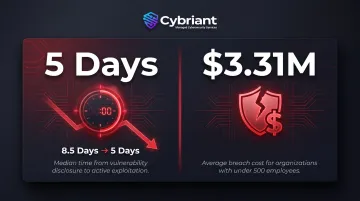
The window between disclosure and active exploitation has collapsed. Rapid7's 2026 Global Threat Landscape Report found the median time from a vulnerability's publication to its inclusion in CISA's Known Exploited Vulnerabilities catalog dropped to just 5.0 days - down from 8.5 days the prior year.
28.96% of vulnerabilities in 2025 were exploited on or before the day their CVE was published. Attackers use automation and AI to weaponize flaws faster than most SMBs can respond.
The cost of inaction is concrete. IBM's Cost of a Data Breach Report 2023 found organizations with fewer than 500 employees face an average breach cost of $3.31 million - a 13.4% increase from the prior year.
KPIs impacted:
- Number of critical/high vulnerabilities open at any time
- Mean time to remediate (MTTR)
- Breach frequency
- Total cost of security incidents per year
This risk is highest for SMBs with internet-facing systems, customer payment data, or cloud-hosted applications - environments where automated attack tools operate at scale. Research shows the entire IPv4 address space can be scanned in under 45 minutes, meaning exposed systems get probed almost immediately after vulnerabilities are disclosed.
Compliance Readiness Without a Dedicated Security Team
Managed vulnerability management services help SMBs meet regulatory requirements - PCI DSS, HIPAA, SOC 2, CMMC - without needing an in-house compliance or security function to run the program.
The service handles scheduled scan cycles, generates audit-ready reports, tracks remediation timelines, and produces the documentation regulators and auditors require - reducing the burden on internal IT staff who often lack specialized compliance expertise.
Compliance failures expose SMBs to fines, customer data liability, and lost enterprise contracts. Vulnerability scanning isn't optional - it's mandated across every major regulatory framework.
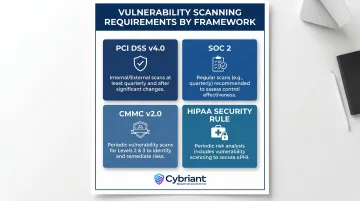
Key requirements include:
- PCI DSS v4.0: Requires internal vulnerability scans at least once every three months and external scans by an Approved Scanning Vendor
- SOC 2: Trust Services Criteria CC7.1 mandates conducting vulnerability scans periodically and after any significant change
- CMMC v2.0: Requires scanning for vulnerabilities in organizational systems periodically and remediating them based on risk assessments
- HIPAA Security Rule: Mandates conducting accurate assessments of potential risks and vulnerabilities and implementing security measures to reduce them
Compliance is also a revenue-enabling factor. Many SMBs pursuing enterprise contracts must demonstrate active vulnerability management. Cyber insurers like Beazley require applicants to confirm they implement critical patches within 28 days of availability, and offer up to 20% premium discounts for regular internet-facing vulnerability scanning.
Key metrics to track: compliance audit pass rate, open compliance findings, audit preparation time, cyber insurance premium levels, and time to achieve certifications.
This matters most for SMBs in regulated industries - healthcare, finance, retail - or those serving enterprise clients that require SOC 2, HIPAA, or PCI DSS evidence, and for any business renewing or applying for cyber liability insurance.
Lower Total Cost Compared to Post-Breach Recovery
At $3.31 million average breach cost for SMBs, the financial case is straightforward: prevention costs a fraction of recovery.
Managed vulnerability management services replace an unpredictable incident - forensic investigation, system restoration, regulatory notification, legal fees, reputational recovery - with a predictable monthly cost. Managed services typically run $45–$73 per endpoint per month when bundled with broader security services; standalone vulnerability assessments range from $1,000–$5,000 per project.
A breach doesn't just cost money. It creates downtime that disrupts service delivery, erodes customer trust, and in severe cases causes business closure. VikingCloud research found that 40% of SMBs admit an attack costing $100,000 or less could put them out of business - a threshold well below the average breach cost.
The financial impact shows up across incident response and recovery costs, unplanned downtime hours, cyber insurance premiums, and IT remediation labor.
This cost advantage is most visible for SMBs that have previously experienced a security incident, operate on tight margins where unplanned IT costs are destabilizing, or are scaling and adding new systems that regularly expand their attack surface.
What Happens When Vulnerability Management Is Ignored
Without a structured vulnerability management program, SMBs operate with unknown weaknesses in their systems. The assumption that small businesses can "fly under the radar" no longer holds. Attackers use automated scanning tools that can map the entire IPv4 address space in under 45 minutes, meaning exposed systems are discovered and probed almost instantly.
Common operational consequences of an unmanaged vulnerability posture include:
- Unpatched software becomes an active attack vector exploited by ransomware
- Misconfigured cloud services expose sensitive data publicly
- Outdated systems accumulate unfixable vulnerabilities over time
- Critical business systems become compromised without detection
Each of these risks compounds quickly. The Verizon 2024 DBIR found that organizations take approximately 55 days to remediate 50% of critical vulnerabilities once patches are available - yet the median time to active exploitation is just 5 days. That gap hands attackers a 50-day window of free access to known weaknesses, with most businesses unaware anything is wrong until the damage is done.
How to Get the Most Value from Vulnerability Management Services
Vulnerability management delivers compounding returns when applied as a continuous practice, not as a periodic project. Scanning frequency, remediation follow-through, and verification of fixes all need to be consistent to generate real risk reduction.
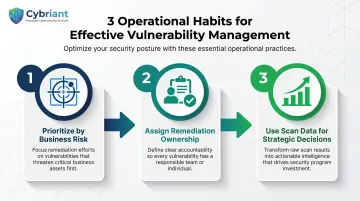
Three operational habits that separate effective vulnerability management programs:
1. Prioritize by actual business risk, not just CVSS scores
Not all high-severity vulnerabilities pose equal risk to your organization. Evaluate each finding against:
- Asset criticality (how important is this system to business operations?)
- Threat context (is this vulnerability being actively exploited?)
- Exposure pathways (can attackers reach this system from the internet?)
- Business impact (what happens if this system is compromised?)
2. Assign clear internal ownership of remediation timelines
Scanning without remediation is security theater. Establish clear accountability for patching and remediation, with defined SLAs based on risk level. Critical vulnerabilities in internet-facing systems should be addressed within days, not weeks.
3. Review scan results to guide decisions, not just store reports
Vulnerability management data should inform strategic security decisions: which systems need replacement, where to invest in security controls, and how to allocate limited IT resources for maximum risk reduction.
For SMBs Without In-House Security Expertise
These habits are achievable without a dedicated security team - if you have the right partner. A managed security service provider with real-time scanning and patch management handles the operational load, so your organization runs a mature vulnerability program without hiring specialist staff.
Cybriant's managed vulnerability management service covers continuous scanning across networks, endpoints, cloud services, and third-party applications - combined with automated patch management and 24/7 monitoring from a SOC 2 Type 2 certified Security Operations Center.
The result: predictable monthly pricing, expert guidance on risk prioritization, and a program scaled to SMB budgets without sacrificing coverage.
Conclusion
Vulnerability management's value for SMBs lies in three interconnected outcomes: proactive risk reduction before exploitation, compliance readiness that protects revenue and reputation, and prevention economics that make ongoing vulnerability management far cheaper than breach recovery.
Each scan-remediate-monitor cycle builds on the last, steadily reducing the attack surface. New vulnerabilities are disclosed daily, and attack timelines have collapsed to days - sometimes hours. Resilient SMBs don't succeed because they have fewer weaknesses. They succeed because they have a systematic process to find and fix those weaknesses before attackers reach them.
Treating vulnerability management as an ongoing operational practice - not a one-time project - is what turns reactive firefighting into a defensible security posture. For SMBs without a dedicated security team, partnering with a managed service provider like Cybriant gives you that process without the overhead of building it from scratch.
Frequently Asked Questions
How much does a vulnerability assessment cost?
Cost depends on scope: number of systems, assessment depth, and whether you use managed services or DIY tools. Managed services typically run $45-$73 per endpoint monthly, while standalone assessments range from $1,000-$5,000 per project - well below the average cost of a single breach incident.
Is SMB still vulnerable?
Yes. SMBs are actively targeted by cybercriminals and face a higher rate of attacks than large enterprises on a per-business basis. Attackers use automated tools to exploit known, unpatched vulnerabilities at scale, and 88% of SMB breaches involve ransomware compared to just 39% for large organizations.
What is an SMB in cybersecurity?
SMB stands for small and medium-sized business. These organizations typically lack dedicated security teams or enterprise-grade defenses, which is why they are a frequent target for attackers and a core focus for managed security service providers.
How is vulnerability management different from a one-time security audit?
A security audit captures a point-in-time snapshot of your security posture. Vulnerability management is a continuous cycle of scanning, prioritizing, remediating, and rescanning. New vulnerabilities emerge constantly - often exploited within days of disclosure - so ongoing programs are necessary to maintain protection.
What should SMBs prioritize when starting a vulnerability management program?
Start with internet-facing systems first, then systems handling sensitive customer or payment data, then internal infrastructure. Address the highest-exposure, highest-severity vulnerabilities before expanding scope. This approach delivers the greatest risk reduction with limited resources.
Can SMBs manage vulnerabilities without an in-house IT security team?
Yes. Managed vulnerability management services give SMBs access to continuous scanning, expert prioritization, and remediation guidance without building an internal security function. Monthly pricing keeps costs predictable and within SMB budgets.