Introduction
The enforcement window for CMMC 2.0 has officially closed. As of November 10, 2025, the DFARS final rule made CMMC an active contract requirement - not a future consideration. Defense contractors who cannot demonstrate compliance now risk losing existing contracts and being locked out of DoD bidding entirely.
The challenge is sharpest for small businesses, which make up 73% of all companies doing business with the Department of Defense. These organizations rarely have the internal staff or specialized expertise to implement the 110 security controls in NIST SP 800-171 on their own.
Most small DIB contractors run with one or two IT staff already stretched across helpdesk, infrastructure, and daily operations. That leaves no capacity for building CMMC-compliant environments, maintaining System Security Plans, or managing audit evidence collection.
What follows is a practical breakdown of what CMMC MSP services include, how to evaluate a qualified provider, and where responsibility is divided between your organization and your MSP.
Overview:
- CMMC 2.0 Level 2 requires implementing 110 NIST SP 800-171 controls - far beyond most small contractors' internal capabilities
- Only 103 active C3PAOs serve 75,000+ DIB organizations, creating substantial assessment backlogs
- Qualified CMMC MSPs deliver gap assessments, 24/7 SIEM monitoring, vulnerability management, and SSP development
- MSPs touching CUI or Security Protection Data fall within CMMC scope and require documented responsibility matrices
- Early MSP partnership accelerates certification timelines and provides competitive advantage in contract bidding
What Are CMMC MSP Services?
CMMC MSP services are managed IT and cybersecurity services specifically structured to help Defense Industrial Base (DIB) contractors implement, document, and maintain the controls required for CMMC 2.0 certification. Unlike generic IT outsourcing, every service is scoped to NIST SP 800-171 requirements and the CMMC assessment process.
These services address the complete compliance lifecycle - from initial gap analysis through third-party assessment and ongoing maintenance. For contractors handling Controlled Unclassified Information (CUI), the stakes are high: without proper implementation and documentation of all 110 requirements, certification fails and contract eligibility disappears.
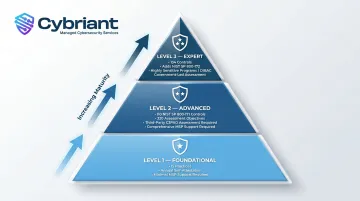
CMMC 2.0 levels relevant to MSP services include:
- Level 1: Covers 15 requirements with self-attestation - minimal MSP support typically needed
- Level 2: Requires third-party assessment by a C3PAO for most CUI contracts, implementing all 110 NIST SP 800-171 controls - this is where comprehensive MSP support becomes essential
- Level 3: Adds 24 requirements from NIST SP 800-172 for highly sensitive programs
Level 2 is the most common requirement for DIB primes and subcontractors handling CUI. It's also the level that demands the most comprehensive MSP support, as organizations must meet all 320 assessment objectives defined in NIST SP 800-171A.
What Is the Difference Between an MSP and an MSSP?
A Managed Service Provider (MSP) focuses on day-to-day IT operations: network administration, helpdesk support, device management, software updates, and infrastructure maintenance. The goal is keeping your technology running.
A Managed Security Service Provider (MSSP) focuses on cybersecurity - threat monitoring, firewall management, intrusion detection, SIEM, vulnerability management, and incident response. Where an MSP keeps the lights on, an MSSP keeps adversaries out.
Why CMMC Level 2 typically requires both capabilities:
The 110 NIST SP 800-171 controls span both IT administration and active security operations. Neither discipline covers the full scope alone:
- MSP functions: Configuration management, user access control, system maintenance
- MSSP functions: Continuous monitoring, audit logging, threat detection, incident response
A provider delivering only one side will leave compliance gaps.
When evaluating CMMC service providers, verify they can deliver both operational IT management and advanced security operations - or that they have formal partnerships to cover both domains.
Why Defense Contractors Cannot Afford to Go It Alone on CMMC
The Complexity Barrier
CMMC Level 2 is built on 110 requirements from NIST SP 800-171, which expand into 320 assessment objectives in NIST SP 800-171A. These controls cover:
- Access control (least privilege, separation of duties)
- Configuration management (baseline configurations, security settings)
- Media protection (data sanitization, device handling)
- Incident response (detection, reporting, remediation)
- Audit and accountability (log generation, review, retention)
- System and communications protection (boundary defense, encryption)
Very few small or mid-sized defense contractors maintain internal teams with the expertise to implement and document all of these correctly. Each control requires specific technical implementation, documentation in your System Security Plan, and evidence collection for assessment.
The Resource Reality
Consider the typical scenario: a small DIB manufacturer or subcontractor with one or two IT staff who already manage helpdesk tickets, infrastructure maintenance, software updates, and daily operational issues. These professionals have no remaining capacity to:
- Architect a CMMC-compliant network boundary
- Configure and maintain a SIEM platform
- Conduct continuous vulnerability scanning and remediation
- Develop and maintain a comprehensive System Security Plan
- Implement multi-factor authentication across all systems
- Document evidence for 320 assessment objectives
- Coordinate with a C3PAO during assessment
Most DIB organizations face a straightforward math problem: the staff hours required to meet CMMC don't exist inside their current teams, and hiring the expertise in-house costs more than most contracts are worth.
Compliance as a Competitive Deadline
CMMC is appearing in DoD contracts right now, and the pool of certified assessors is severely limited. As of March 2026, there are only 103 active C3PAOs to serve approximately 75,000 to 80,000 DIB organizations requiring Level 2 certification. Industry reports indicate C3PAO wait times stretching from 3 to 12 months, with some organizations already reporting backlogs extending into the following year.
That bottleneck has caught federal attention. The Government Accountability Office reported in March 2026 that the DoD "did not assess and document how it intends to mitigate the risk of private sector capacity being insufficient to meet its needs for assessments."
Contractors that partner with a qualified CMMC MSP early will:
- Move through assessment preparation faster
- Secure C3PAO assessment slots sooner
- Achieve certification ahead of competitors
- Maintain eligibility for contract bidding without interruption
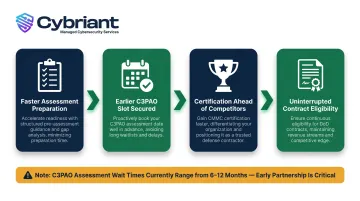
With C3PAO slots booking out 6 to 12 months, contractors who wait until a contract requires CMMC certification are likely to miss bid windows entirely.
Core CMMC Managed Services Your Provider Should Deliver
Gap Assessment and System Security Plan (SSP) Development
A qualified CMMC MSP should begin with a thorough evaluation of your current environment against all 320 assessment objectives in NIST SP 800-171A. This gap assessment identifies exactly which controls are missing, partially implemented, or improperly documented.
The MSP should then help build or update your System Security Plan - the foundational document that maps every control to how it's implemented in your specific environment. The SSP must clearly define:
- System boundaries and data flows
- CUI storage and processing locations
- Responsibility assignments (internal staff vs. MSP)
- Technical implementation details for each control
- Evidence collection and retention procedures
Without a comprehensive SSP, assessment fails before it begins.
24/7 Security Monitoring and SIEM Management
Continuous monitoring is a CMMC requirement, not optional. NIST SP 800-171 control families AU (Audit and Accountability) and SI (System and Information Integrity) mandate real-time analysis of security events across your environment.
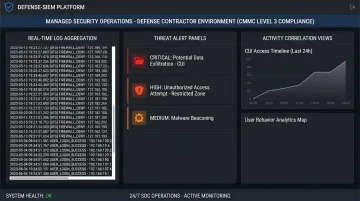
Your MSP should provide around-the-clock Security Information and Event Management (SIEM) with live analysis of security events. Cybriant's 24/7 Managed SIEM, for example, delivers continuous monitoring and threat analysis for defense contractors managing CUI across complex environments. This includes:
- Aggregation of logs from all in-scope systems
- Real-time correlation and threat detection
- Automated alerting for suspicious activity
- Incident escalation and response coordination
- Comprehensive reporting for audit evidence
Assessors will verify continuous monitoring during your C3PAO evaluation - gaps in SIEM coverage translate directly into findings.
Vulnerability Scanning and Patch Management
NIST SP 800-171 control families RA (Risk Assessment) and SI (System and Information Integrity) require ongoing identification and remediation of vulnerabilities. Real-time vulnerability scanning paired with structured patch management keeps your environment continuously hardened and reduces the risk of findings during assessment.
Your MSP should provide:
- Continuous automated vulnerability scanning
- Risk-based prioritization of remediation efforts
- Automated patch deployment with testing protocols
- Tracking and documentation of all remediation activities
- Regular vulnerability reports for compliance evidence
Patch management must cover operating systems, applications, and firmware across all devices within your CMMC boundary.
CUI Protection and Access Control Management
The entire CMMC program centers on protecting Controlled Unclassified Information. Your MSP should help:
- Identify exactly which systems store, process, or transmit CUI to define your boundary
- Restrict user access to the minimum permissions needed for each role
- Deploy MFA across all user accounts and privileged access points
- Ensure CUI resides only in FedRAMP Moderate or equivalent environments
- Track how information moves within and outside your boundary
Access control implementation must be documented in your SSP and validated through technical evidence during assessment.
Incident Response Planning and Assessment Support
A CMMC MSP should help develop and test your incident response plan (required under NIST SP 800-171 domain IR - Incident Response). This includes:
- Defining incident detection and reporting procedures
- Establishing escalation paths and communication protocols
- Documenting containment, eradication, and recovery steps
- Conducting tabletop exercises to validate readiness
Your MSP should also be prepared to support you during the actual CMMC assessment. This means providing documentation of their processes and being available for interviews by the C3PAO assessor about their role in your compliance program. Your assessor will verify that shared responsibilities are properly implemented - your MSP's cooperation is essential.
How to Choose the Right CMMC MSP for Your Business
Verify Genuine DIB and CMMC Experience
Ask prospective providers for case studies and references from other defense contractors they've guided through CMMC assessments. Check whether they:
- Hold CMMC-AB credentials such as Registered Practitioner Organization (RPO) status
- Employ staff with CISSP, CMMC-CP, CCP, or CCA certifications
- Have documented experience with C3PAO assessments
- Understand DIB-specific requirements (DFARS, ITAR, EAR)
If CMMC is a new service area for the provider, treat that as a disqualifying signal. Providers without prior C3PAO audit experience won't know where assessors look hardest - and your certification timeline can't absorb that gap.
Demand a Customer Responsibility Matrix (CRM) Mapped to NIST SP 800-171A
CMMC 2.0 Level 2 requires that responsibilities between an Organization Seeking Certification (OSC) and its external service providers be clearly defined. 32 CFR Part 170 explicitly mandates a Customer Responsibility Matrix documenting this division.
The CRM should specify, for each of the 320 assessment objectives:
- Whether the MSP is responsible
- Whether the client is responsible
- Whether responsibility is shared
- How implementation will be verified
Without this level of granularity, accountability gaps will surface during your audit. The CRM is not optional - it's a regulatory requirement and a critical assessment artifact.
Require Evidence, Not Just Assertions
Ask the MSP for artifacts that prove they're implementing the controls they claim. A CMMC assessor reviewing a CRM where the MSP owns 50-70% of controls will verify those implementations independently - assertions alone won't hold up.
Request sample evidence such as:
- SIEM configuration documentation
- Vulnerability scan reports and remediation tracking
- Incident response procedures and testing records
- Access control policies and technical implementations
- Audit log retention and review processes
If an MSP hesitates to share sample artifacts pre-engagement, that reluctance will become a serious problem when your C3PAO assessor arrives.
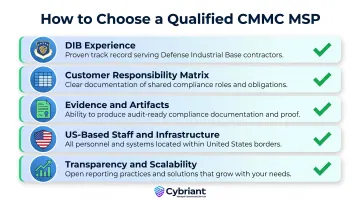
Confirm US-Based Staff and Compliant Infrastructure
For contractors subject to DFARS, ITAR, or EAR requirements, it's critical that the MSP's support staff are US persons and that their data centers and tools are US-hosted.
Ask specifically:
- Are support personnel US citizens or permanent residents?
- Where are data centers physically located?
- Does the MSP use FedRAMP Moderate or FedRAMP High environments for storing vulnerability data, SIEM logs, system documentation, and backup data?
These systems may contain information that itself requires CUI-level protections. If your MSP stores or processes this data in non-compliant environments, your entire CMMC program is at risk.
Evaluate Transparency, Scalability, and Long-Term Partnership Mindset
CMMC compliance is ongoing, not a one-time project. Your certification must be maintained through continuous monitoring, regular assessments, and adaptation to evolving threats.
Assess whether the provider:
- Offers clear, predictable pricing without hidden fees
- Has a documented plan for supporting your environment post-certification
- Proactively flags control gaps rather than waiting for you to ask
- Provides transparent reporting and regular communication
- Can scale services as your organization grows
Because your assessor will review your MSP's processes during a C3PAO audit, you and your MSP are genuinely assessed together. That shared accountability means your MSP's documentation practices, staffing decisions, and response times all show up in your audit results - not just their own.
Does Your MSP Need to Be CMMC Compliant?
External Service Provider (ESP) Definition Under CMMC
32 CFR Part 170 defines an External Service Provider as any third-party vendor that stores, processes, or transmits CUI or Security Protection Data (SPD) on behalf of a defense contractor. Security Protection Data includes SIEM logs, vulnerability scan results, firewall records, configuration data, and passwords that grant access to in-scope environments.
If your MSP handles any of this data, they qualify as an ESP and fall within CMMC assessment scope.
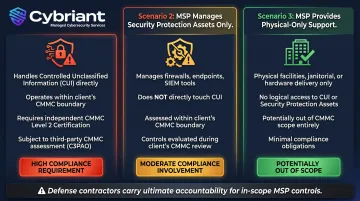
Three Compliance Scenarios for MSPs
Scenario 1: MSP stores, processes, or transmits CUI
If an MSP operates backup services, remote monitoring and management (RMM) tools, or any platform that collects CUI from your environment onto their own infrastructure, they must pursue their own CMMC Level 2 certification independently. They will need their own C3PAO assessment and certification before they can support your compliance program.
Scenario 2: MSP manages Security Protection Assets without CUI
If an MSP manages SIEM, firewalls, endpoint detection, or vulnerability scanning tools - and these systems generate Security Protection Data but don't hold CUI - the MSP is assessed as part of your CMMC assessment rather than certified separately. The C3PAO will review the MSP's implementations during your audit.
Scenario 3: MSP provides only hands-on physical support
If an MSP provides only on-site physical support with no data flowing through their own infrastructure (purely on-site services with no remote access or data collection), they may be entirely out of CMMC scope. However, this scenario is rare in practice with modern managed services.
What This Means for Defense Contractors
When scoping your compliance program:
- Map all data flows between your environment and your MSP's systems
- Identify whether CUI or SPD reaches MSP infrastructure
- Design your CMMC program to minimize unnecessary MSP access to sensitive data
- Document all ESP relationships clearly in your System Security Plan
You - the Organization Seeking Certification - carry ultimate accountability for ensuring that any in-scope MSP controls are properly implemented and documented. The C3PAO will hold you responsible for your MSP's performance.
Why MSPs Should Proactively Pursue CMMC Compliance
An MSP that has achieved its own CMMC Level 2 certification simplifies every client's assessment, reduces risk for every client engagement, and gives defense contractors a clear reason to choose them over uncertified alternatives.
Credentials like SOC 2 Type 2 certification reinforce that posture. Cybriant, for example, has earned consecutive placement on MSSP Alert's Top 250 MSSPs List - a recognition that reflects the kind of sustained security investment defense contractors need to see before trusting an MSP with their compliance program.
Frequently Asked Questions
What are CMMC services?
CMMC services are managed IT and cybersecurity offerings delivered by an MSP or MSSP to help defense contractors implement and maintain compliance. These typically include gap assessments, SIEM monitoring, vulnerability management, CUI protection, and SSP development.
Do MSPs need to be CMMC compliant?
It depends on what data the MSP handles. MSPs that store, process, or transmit CUI on their own systems need independent Level 2 certification. Those that only manage Security Protection Assets are assessed as part of their client's CMMC assessment boundary.
What is the difference between an MSP and an MSSP?
An MSP focuses on IT operations and infrastructure management - network administration, helpdesk, device management. An MSSP focuses on cybersecurity services like SIEM, threat monitoring, and vulnerability management. CMMC Level 2 compliance typically requires both types of capabilities.
Why is CMMC Level 2 important?
CMMC Level 2 is the most common certification required for DoD contractors handling Controlled Unclassified Information (CUI). Without it, companies cannot bid on or retain DoD contracts. For most DIB organizations, it's a direct business continuity requirement.
What is a CMMC SSP (System Security Plan)?
A System Security Plan is a required document that maps each of the 110 NIST SP 800-171 controls to your environment. It details who owns each control and how third-party providers like MSPs contribute to its implementation.
How can an MSP achieve CMMC Level 2?
An MSP pursues CMMC Level 2 certification through three steps:
- Undergo a third-party assessment by a C3PAO against the 320 objectives in NIST SP 800-171A
- Ensure their internal environment and tools meet all required security controls
- Maintain ongoing compliance documentation